Teddy Duchamp
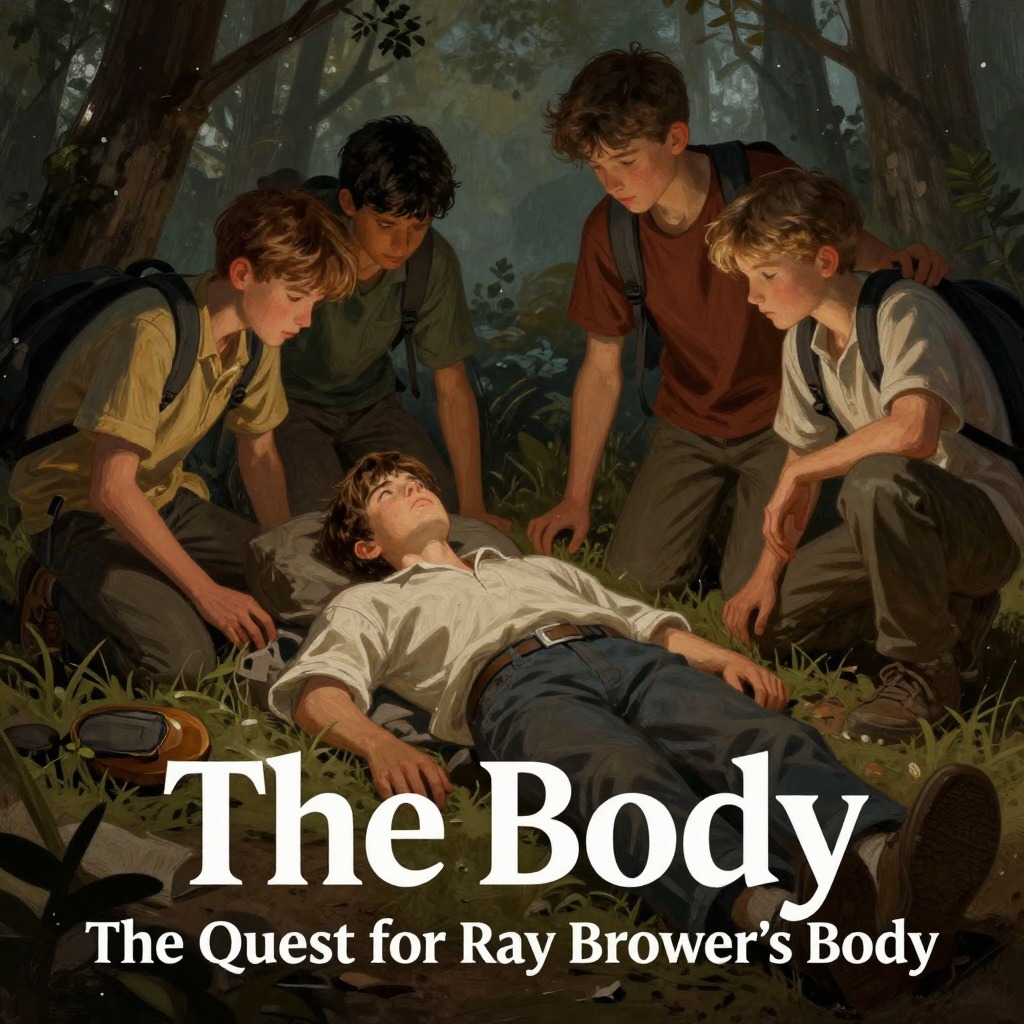
The BodyTeddy Duchamp is one of the four boys at the heart of the story, a twelve-year-old whose life has been shaped by a single, catastrophic act of violence. His father, Norman Duchamp, a veteran who stormed the beach at Normandy, held Teddy's head down on a cast-iron stove burner when the boy was eight, permanently disfiguring his ears and leaving him with a hearing aid and thick glasses. Despite this, Teddy remains fiercely proud of his father, visiting him weekly at the Togus VA hospital and insisting that his father was a hero, not a lunatic. This contradiction—between the brutal reality of his home life and the idealized image he clings to—makes Teddy one of the most tragic figures in the novel, a boy whose bravado is a fragile shield against a truth he cannot bear.
Identity and Background
Teddy is introduced as the most visibly damaged member of the group. He wears thick glasses because of naturally poor eyesight and a flesh-colored hearing aid, the result of his father's abuse. His ears are described as looking like "two lumps of warm wax," and he keeps his hair long to cover them, giving him an anachronistic Beatle haircut years before the Beatles were known in America. He is close to thirteen but looks older, and his laugh is a distinctive, high-pitched cackle—"Eeee-eee-eee, like a rusty nail being slowly hauled out of a rotten board." He is the dumbest of the regular gang, but also the craziest, known for "truck-dodging" on Route 196, where he runs in front of speeding pulp-trucks, laughing as the windblast ripples his clothes. His poor vision makes this game especially dangerous, and his friends live in fear that he will misjudge one. He will do anything on a dare, and his recklessness is a constant source of both excitement and terror.
Life and Plot Trajectory
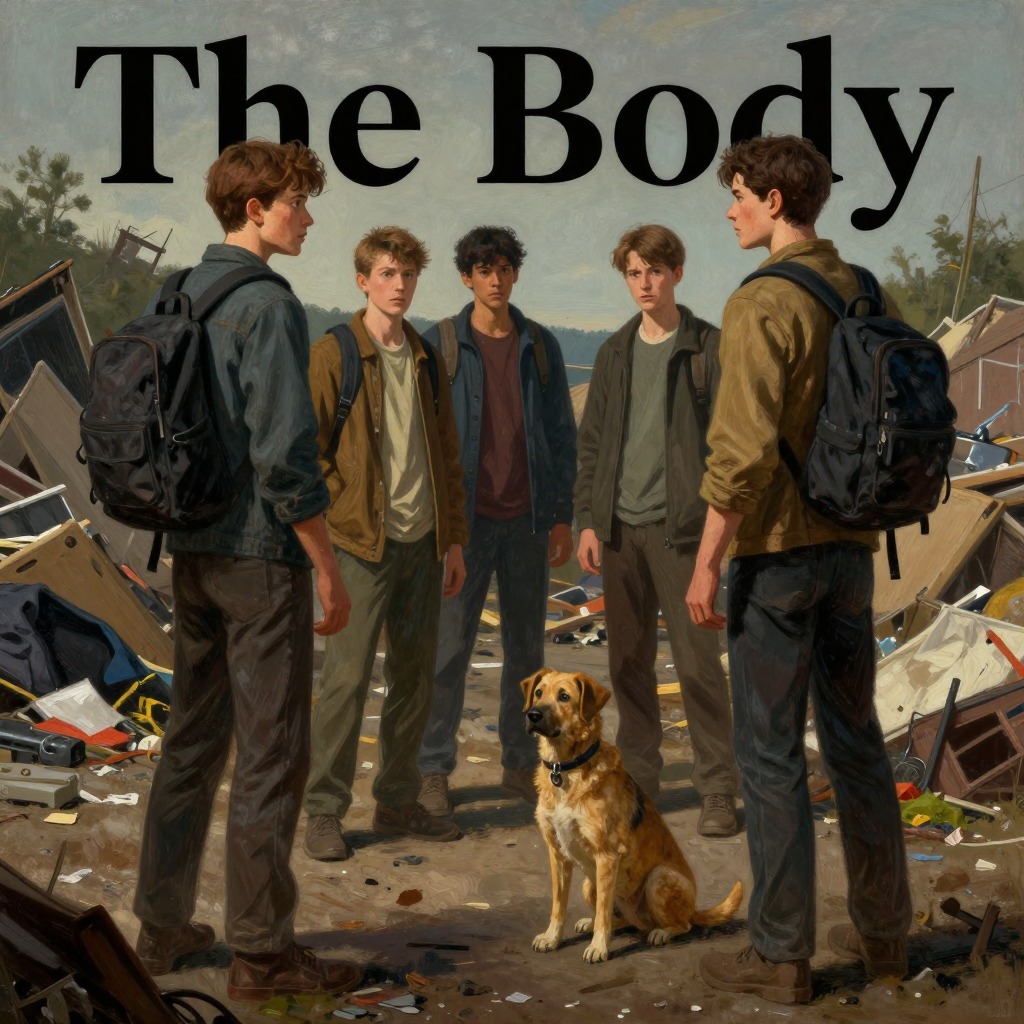
Teddy's journey through the story is a series of escalating confrontations with his own trauma. When the boys decide to hike the railroad tracks to find the body of Ray Brower, Teddy is the most eager, seeing it as another dare. He attempts to dodge a freight train on the trestle, and Gordon Lachance has to physically drag him off the tracks to prevent him from being killed. Later, at the Castle Rock Dump, Teddy provokes the dump-keeper Milo Pressman by taunting his dog Chopper, and when Milo calls Teddy's father a "loony," Teddy explodes in a rage, screaming that his father stormed the beach at Normandy and threatening to kill Milo. This confrontation triggers a sudden, violent breakdown: Teddy bursts into tears, sobbing uncontrollably on the railroad ties, his carefully constructed defenses shattered. Chris Chambers comforts him, reminding him that Milo's words change nothing, but the damage is done. Teddy's vulnerability is exposed, and he is forced to confront the fact that the world sees his father not as a hero, but as a madman.
Key Actions and Objectives
Teddy's primary objective is to prove his own courage and to defend his father's honor. He is obsessed with the idea of military service, wanting to join the Army like his father, and he is the most enthusiastic consumer of Gordon's "Le Dio" stories, which are about American soldiers fighting in France. He sees the hike to find Ray Brower as a rite of passage, a chance to be a hero. His actions are driven by a need to assert control over a world that has already hurt him so badly. He is the first to suggest crossing the trestle, the first to taunt Milo, and the first to volunteer to fight Ace Merrill's gang. But his bravery is always tinged with a desperate, almost suicidal quality, as if he is daring the world to hurt him again.
Relationships and Conflict
Teddy's relationships are defined by his need for validation and his inability to fully trust. He is closest to Chris Chambers, who is the only one who can calm him down after his breakdown, and to Gordon, who tells him the Le Dio stories. But he also fights with them, as when Gordon stops him from dodging the train. His relationship with his father is the central conflict of his life: he loves and admires the man who nearly killed him, and he cannot reconcile that love with the abuse. This conflict is externalized in his confrontation with Milo, and it is the source of his deepest pain. He is also in constant conflict with the world's perception of him as a "loony's kid," a label that he fights against with every ounce of his being.
Change and Ending
Teddy's arc is one of gradual, tragic decline. After the hike, he and Vern Tessio drift away from Gordon and Chris, finding a new group of younger kids to boss around. He is turned down by the Air Force and classified 4-F by the draft, a rejection that devastates him. He graduates high school only after being held back, and gets a job with the Castle Rock Public Works Department, filling potholes. In 1971 or early 1972, he dies in a car crash in Harlow. His Chevrolet Bel Air, full of friends, hits a utility pole and rolls six times. One girl survives for six months on a respirator before dying. The narrator, Gordon, reflects that Teddy was posthumously awarded the "Dogpiss of the Year Award," a bitter epitaph for a boy who wanted nothing more than to be a hero. His death is squalid, meaningless, and utterly avoidable, a final, cruel irony for a life that was defined by a single, catastrophic act of violence.
Narrative Role and Evaluation
Teddy functions as a symbol of the damage that adults can inflict on children, and of the tragic consequences of a life lived in the shadow of trauma. He is a foil to Gordon, who is able to escape Castle Rock and find success, while Teddy is trapped by his own history and his own limitations. His story is a warning about the cost of blind loyalty and the danger of trying to live up to a myth. He is also a source of both comic relief and genuine pathos, his crazy laugh and reckless stunts masking a deep well of pain. His death, like Vern's, underscores the novel's central theme: that childhood friendships are fragile, and that the world is not kind to those who are already broken.