33 Himmel Street
The Book Thief33 Himmel Street, also known as the Hubermann house, is the domestic center of the story’s moral and emotional life. Liesel Meminger enters it as an undernourished foster child with a small suitcase and The Grave Digger’s Handbook hidden beneath her clothes; later, the same house receives Max Vandenburg, a Jewish man whose presence transforms the family’s home into a concealed refuge. Its rooms hold books, fear, hunger, arguments, kindness, and the exhausting fiction that life has remained ordinary while the world outside has become lethal.
Appearance and Arrival
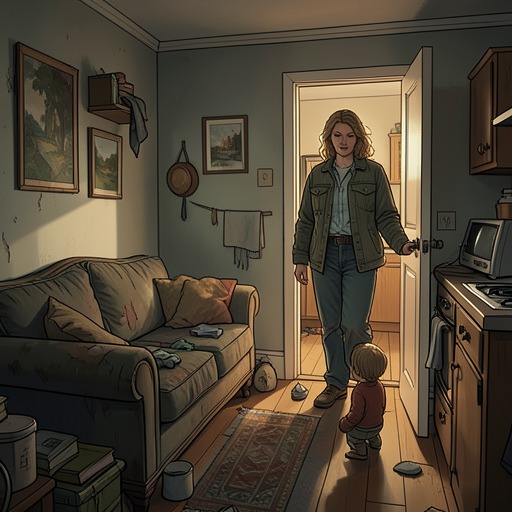
The house is presented without grandeur. It is pale, almost sick-looking, enclosed by an iron gate and marked by a brown, spit-stained door. The dull key that opens it feels less like a welcoming emblem than a hard, physical burden: its teeth pierce Hans Hubermann’s hand as he grips it. The building therefore begins as a threshold whose material plainness carries emotional weight. Behind that door, Liesel crosses into a new family while still carrying the evidence of the death and dislocation that preceded her arrival.
Hans brings Liesel inside by one hand while her suitcase takes the other. Buried beneath folded clothes is the small black copy of The Grave Digger’s Handbook, the book she has taken from the snow near her dead brother’s burial. The house consequently becomes the first place in which her book thievery is preserved rather than exposed. Her dangerous brown eyes, her incomplete memory of her father, and the label communist attached to him are also part of what she brings into the household. Even before the family understands the full history she carries, 33 Himmel Street receives a child shaped by political violence, bereavement, and poverty.
The Hidden Basement
The house’s decisive transformation occurs when Max Vandenburg arrives in November 1940. He is twenty-four, exhausted, shaking, and burdened by clothes that seem to weigh him down. His arrival turns the Hubermann home into a clandestine shelter. A book placed inside his suitcase contains an identity card, a map, directions, and a key taped to its inside cover; alongside it, Max receives a small supply of bread, fat, three carrots, and water. At 33 Himmel Street, ordinary household objects become instruments of concealment, movement, and survival.
Max initially sleeps in Liesel’s room, but the intimacy and danger of that arrangement horrify him. He decides that the basement is the only place where he belongs, reasoning that a Jew must exist in a basement or another hidden venue of survival. Hans and Rosa do not argue when he asks to remain there. They carry down blankets, replenish the kerosene lamp, and accept his request for scraps rather than food wanted by anyone else. The basement is thus both refuge and degradation: it keeps Max alive while forcing him to measure his existence against cold, scarcity, silence, and the possibility of discovery.
The basement also becomes the house’s private counterworld. Above it, the Hubermanns must preserve the appearance of an ordinary German household; below it, Max’s concealed life makes the political reality impossible to deny. The space contains not only a person hidden from the authorities but the family’s knowledge of what the authorities would do if they found him. In this arrangement, architecture gives fear a location. The basement is not merely a room beneath the house; it is the physical form of the secret that governs every room above it.
Domestic Performance and Danger
The arrival of Max forces the family to divide its existence between private truth and public performance. Hans explains that he must continue playing the accordion several times a week because the family needs the money and because stopping would arouse suspicion. He has already claimed that Max is sick, but now everyone must behave as though nothing has happened. The house becomes a stage on which routine is carefully repeated, while the basement remains the hidden backstage where the real emergency persists.
The family’s restraint is itself an action. When a Jewish man appears at their residence in the early hours, fear could produce hysteria, yet the Hubermanns resist that impulse. Rosa sends Liesel away in a voice that is calm but firm, an unusual control that reveals how deliberately the household manages information. The ordinary harshness of family speech becomes protective camouflage. At 33 Himmel Street, a command, a pause, or a refusal to explain may matter as much as an open act of courage.
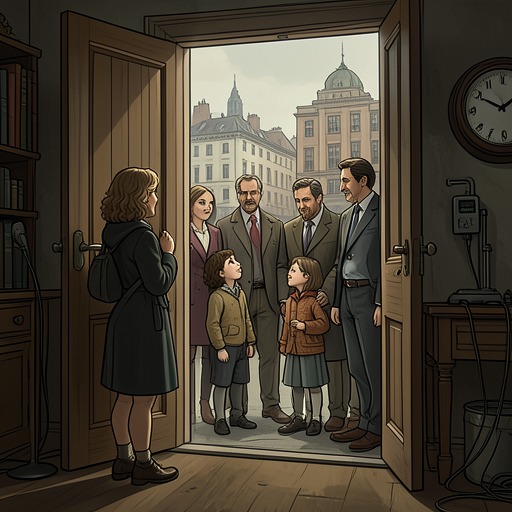
That fragile system is repeatedly threatened by the house’s boundaries. A seven-punch knock is hammered into the door, followed by the demand to open up, at the very moment when there is no time to move anyone. The door that first admitted Liesel and later admitted Max now becomes the point at which the hidden household may be exposed. Its sounds carry the outside world directly into the family’s center, converting a familiar entrance into an instrument of suspense.
Books, Family, and Moral Choice
Books give 33 Himmel Street a second identity. Liesel’s first stolen book arrives there in her suitcase, and the house becomes the setting in which words grow from private objects into sources of connection and understanding. Her developing ability to read is inseparable from the household’s emotional history: the books she carries and encounters exist alongside the communist label attached to her father, the bonfire, the dead letters, her mother’s suffering, and her brother’s death. The house gathers these fragments until political authority and personal grief become legible as parts of the same story.
The Hubermann family’s relationship to Max also distinguishes the house from the categories imposed by Nazi Germany. Alex Steiner is a member of the Nazi Party but does not hate Jews or anyone else; within the Hubermann household, however, resistance is expressed through shelter, food, silence, and continued care. Max’s earlier friendship with Walter Kugler, formed through repeated fights and later strengthened into genuine friendship, shows how personal bonds cross the identities that the regime tries to make absolute. The house protects that human complexity even while the surrounding society reduces people to labels, stars, party affiliations, or alleged political inheritances.
The address is also linked to Liesel’s changing relation to authority. At first, the only thing she knows about her father is the unexplained word communist. Later, the evidence gathered in and around the household allows her to connect that word with Hitler, the bonfire, her mother’s suffering, and her brother’s death. 33 Himmel Street therefore functions as a place of interpretation as well as shelter. It is where a child’s scattered memories begin to acquire political meaning, and where reading becomes a way of confronting the forces that have shaped her life.
The House Under War
War repeatedly presses against the house from outside. During an air raid, the people of Himmel Street run from their homes carrying what they value most: babies, photo albums, wooden boxes, and books. Liesel carries her books between her arm and her ribs. Hans, who has forgotten even his accordion in the rush, turns back to rescue Frau Holtzapfel’s suitcase and jokes about the weight of its contents. The scene places 33 Himmel Street within a neighborhood whose residents flee together, yet it also shows how the house’s inhabitants define survival through the objects and relationships they refuse to abandon.
The address is finally inseparable from the street beyond it. Jews are driven down Munich Street in a starving procession, watched by Hans and Liesel among the crowd. They see bodies dirtied and weakened by forced movement, soldiers’ hands pushing the prisoners forward, and faces belonging to people many of whom will die. The house cannot seal itself off from that history. Even when its doors and basement provide temporary protection, the wider violence remains visible at the threshold and in the streets.
Its significance lies in this contradiction. 33 Himmel Street is a small, vulnerable house, yet it becomes the place where a foster child’s literacy develops, where a Jewish refugee is hidden, and where moral decisions are made through daily gestures rather than public declarations. It offers no safety that can be trusted permanently; the knock at the door and the sirens outside prove that concealment is always provisional. Still, within its pale walls and beneath its floor, the household creates a brief human space in which care resists the classifications, silences, and violence imposed by Nazi Germany.