Adolf Hitler
The Book ThiefAdolf Hitler is the distant ruler whose language and image organize the world of Liesel Meminger. He appears as a political leader, an object of childhood fascination, and the hidden source of grief, persecution, and war. The narrative makes his power most disturbing not through constant physical presence but through its diffusion: his words are repeated at rallies, his likeness is displayed on flags, his birthday becomes a public ritual, and his ideology enters the lives of people who may not fully understand or accept it.
Image, Dream, and Early Imprint
Adolf Hitler first appears through Liesel’s dream before she has acquired the knowledge needed to interpret him. In January 1939, shortly before her tenth birthday, she dreams that she is attending a rally where he speaks. She studies the skull-colored part in his hair and the precise square of his mustache while listening contentedly to the torrent of words from his mouth; in the dream, his sentences seem to glow. When he crouches and smiles at her, she smiles back and greets him in hesitant German. The scene establishes a crucial contradiction: Hitler’s charisma can reach a child through sound, spectacle, and friendliness before she understands the political meaning of what he represents.
Liesel’s own identity has already been damaged by the labels circulating within Hitler’s Germany. She has dark brown eyes, which the narrative presents as dangerous in a country that idealizes German blondness, and she cannot remember her father except through a word she does not understand: communist. Her uncertainty is therefore not separate from Hitler’s political world. It is produced by a system that converts family history into suspicion and turns racial or political categories into inherited threats.
Words, Rituals, and Ideological Power
Hitler’s authority is repeatedly performed through public language. At a rally in Molching, a speaker in a polished brown uniform asks the crowd for silence and begins with “Heil Hitler!” followed by the salute to the Führer. He declares the day beautiful because it is Hitler’s birthday and because Germany has once again stopped its enemies from reaching into the nation’s minds. His speech then becomes a passionate denunciation of the alleged disease spreading through Germany: communists and Jews are named as enemies to be watched, pursued, and destroyed.
The effect on Liesel is selective but decisive. She does not absorb the entire speech as a coherent political argument. Instead, the word communist seizes her attention, connecting the public performance to the private fragments of her life. She recalls dark rooms, men in suits, her mother’s suffering, her brother’s death, and the books burned in Hitler’s name. The resulting calculation identifies Hitler as the “they” whom Hans Hubermann and Rosa Hubermann had feared. Hitler’s power is thus shown as a power of association: a single political word can unlock a child’s understanding of several earlier wounds.
The same authority is embedded in ordinary civic display. On Hitler’s birthday, every window in Molching carries a Nazi flag. At Frau Diller’s, the glass is washed until the swastika resembles a jewel on a red-and-white blanket; elsewhere, the flag hangs from the ledge like laundry. The Hubermanns become frightened when they cannot find their own flag, and Rosa warns that authorities may come to take them away. Its eventual discovery behind Hans Hubermann’s accordion turns a household object into a small protection against the state. The flag is not merely decoration: its absence appears dangerous, while its presence signals compliance.
Racial Politics and the Manufactured Community
Hitler’s Germany defines belonging through exclusion. During the 1936 Olympics, his games are presented as a national showcase, yet Jesse Owens’s four gold medals undermine the racial claims attached to the event. Owens’s victory in the 4 × 100-meter relay, together with international reports that Hitler refused to shake his hand, exposes the contradiction between the regime’s racial hierarchy and athletic achievement. Rudy Steiner, rather than Hitler’s intended audience, becomes the person most impressed by Owens. He covers himself in charcoal and imitates the Black athlete, transforming a state-managed spectacle into an act of admiration that crosses the boundaries the regime tries to enforce.
The political order also reaches beyond Jews. Alex Steiner is a member of the Nazi Party but does not hate Jews or anyone else, demonstrating that formal membership and private belief need not coincide. Yet the system still pressures individuals to perform loyalty. Marches, anthems, and the required “Heil Hitler” salute create a public community in which participation is visible and refusal is risky. These repeated gestures make ideology feel ordinary by placing it inside birthdays, sports, school life, uniforms, flags, and songs.
The treatment of Max Vandenburg and Walter Kugler reveals the legal transformation of prejudice into social structure. The two men had fought repeatedly as teenagers and eventually became genuine friends, but Max was dismissed from the Jedermann Engineering Factory with other Jews after the Nuremberg Laws forbade Jews from holding German citizenship and prohibited marriage between Germans and Jews. When Walter strikes the star on Max’s sleeve, he recognizes that the old friendship now exists under a new political order. Max answers that fighting a Jew is not forbidden even though marrying one is, a bitter distinction showing how thoroughly the law has reorganized ordinary relationships.
Consequences and Historical Scale
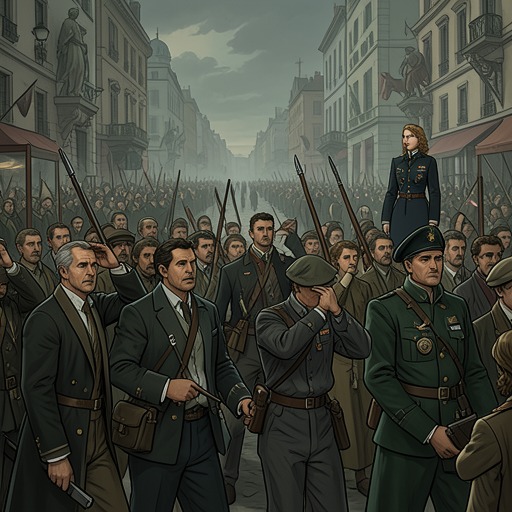
Hitler’s ideology becomes visible most starkly in the procession of Jewish prisoners on Munich Street. The prisoners move under soldiers’ hands, with enormous eyes in starving skulls, dirt molded to their bodies, and legs that stagger between forced running and malnourished walking. Hans Hubermann and Liesel watch from within the crowd. The scene places the ruler’s abstractions beside the bodies those abstractions have condemned. The prisoners are not presented as a political category but as individuals approaching death, while the spectators’ presence shows how public order can surround suffering without stopping it.
The narrative later measures Hitler’s rule against its accumulated destruction. By the time Germans are beginning to pay in earnest, the Führer’s confidence is described as physically faltering: his knees are beginning to shake, even though he is credited with an iron will. The contrast is not a redemption of his determination. It is an indictment of the will that has driven the country toward catastrophe and left tens of thousands dead within a short period. Hitler’s apparent strength and the weakness of the people caught beneath it form the story’s central political imbalance.
Narrative Significance
Adolf Hitler functions less as a rounded private character than as a historical force, an ideological shadow, and a test of language’s power. He is the figure behind the word that Liesel struggles to understand, the leader whose birthday turns streets into synchronized displays, and the authority whose categories make a father disappear, persecute Max Vandenburg, and send starving prisoners through public roads. His appearances therefore mark the movement from enchantment to recognition: the child who smiles at him in a dream gradually understands that the glowing torrent of words has consequences in homes, laws, friendships, and bodies.
The book’s treatment of Hitler also exposes the instability of political spectacle. His speeches promise purity and protection, while the world they produce is marked by fear, exclusion, forced conformity, and death. Against that official language, Liesel’s developing literacy offers another relation to words. Hitler uses language to reduce people to enemies; Liesel learns to connect words with memory, suffering, and human particularity. His greatest presence is consequently felt in the struggle over what words are allowed to mean and what actions they make possible.