Antisemitism
The Book ThiefAntisemitism is the ideological and institutional persecution of Jewish people that shapes the social world of Nazi Germany in The Book Thief. It appears in yellow stars, anti-Jewish slurs, political speeches, forced public humiliation, exclusion from citizenship and employment, and the destruction of Jewish homes and businesses. The novel presents it as a system that makes hatred look official and ordinary, while also exposing the moral choices required of people who live inside it.
Definition and Public Enforcement
Antisemitism is made visible through the streets of Molching. Shops bear yellow stars and anti-Jewish slurs, including the words “JEWISH FILTH,” so that discrimination is written directly onto commercial property and public space. The marks do more than insult: they identify Jewish people as a separate and supposedly contaminating category, converting ideology into an everyday visual environment.
The system is also enforced through law. After the Nuremberg Laws, Jews are forbidden German citizenship and marriage between Germans and Jews. Max Vandenburg loses his employment at the Jedermann Engineering Factory along with other Jewish workers, demonstrating how antisemitism reaches beyond personal hostility into citizenship, labor, family life, and economic survival. The law narrows the possibilities of ordinary life before the later violence becomes fully visible.
Antisemitism as Political Language and Ritual
At Hitler’s birthday celebration in Molching, antisemitism is folded into a nationalist ceremony of flags, uniforms, marching, singing, and collective salutes. The town’s windows display the swastika, and the public gathering begins with “Heil Hitler!” before a speaker describes enemies as a disease spread through Germany. His denunciation names both Communists and “Die Juden—the Jews,” presenting political opponents and Jewish people as infections to be identified and destroyed.
This speech changes Liesel Meminger’s understanding of her own history. The word “communist” recalls the label attached to her father, whom she cannot remember, while the bonfire, the dead letters from her mother, her mother’s suffering, and her brother’s death combine into an association with the Führer. Antisemitic and anti-communist language therefore operates not only as public propaganda but also as a mechanism for reorganizing a child’s private grief. The state’s categories invade memory, making personal loss appear connected to the political enemy named by the regime.
The rituals surrounding antisemitism create the appearance of unanimous belief. Nazi flags dominate the view, the crowd breathes and sings together, and the ceremony turns obedience into a bodily habit. The public performance matters even when private convictions differ. National identity is produced through repeated gestures and formulas, while Jewish people are excluded from the community that those gestures claim to represent.
Complicity, Fear, and the Limits of Resistance
Hans Hubermann’s conduct shows how antisemitism constrains people who do not hate Jews. In the spring of 1937, after Jews are increasingly terrorized, Hans submits an application to join the Nazi Party, almost to his shame. Immediately afterward, he encounters the destruction of Kleinmann’s clothing store: men have thrown bricks through it, a yellow star is smeared on the door, and “JEWISH FILTH” has been painted across the entrance. Hans offers help to Joel Kleinmann, but Kleinmann tells him to go away, recognizing that even an offer of assistance may place them both in danger.
Hans is not admitted to the Party at once. Instead, his application remains under suspicion, and he is placed on a waiting list. When the Gestapo searches his house after Kristallnacht and finds nothing suspicious, his pending application helps explain why he is allowed to stay. His protection is therefore conditional rather than moral: the regime tolerates him because he appears potentially useful and sufficiently aligned, not because it accepts independent compassion. Antisemitism produces a political world in which even a person’s survival can depend on the bureaucratic appearance of loyalty.
The destruction of Jewish establishments during Kristallnacht marks a sharper stage of persecution. For Max Vandenburg, however, the night of broken glass also becomes the moment of escape. While his family is crowded into an apartment, Walter Kugler arrives at the door and initiates the plan that will eventually bring Max to Himmel Street. The same antisemitic violence that devastates Jewish communities creates the immediate conditions for Max’s flight, though escape does not mean safety; it leads to concealment, dependence, and the constant danger of discovery.
Jewish Identity Under Persecution
Max’s history with Walter Kugler reveals the distance between earlier personal relationships and the racial categories imposed by the state. As teenagers, Max and Walter fight repeatedly, then develop genuine friendship. After the Nuremberg Laws and the dismissal of Jewish workers, their old relationship becomes almost impossible to recover in public. Walter touches the star on Max’s sleeve and observes that they could no longer fight as they once had, while Max answers that no law forbids fighting a Jew. The exchange exposes the absurdity of a system that regulates intimacy while pretending its classifications are natural.
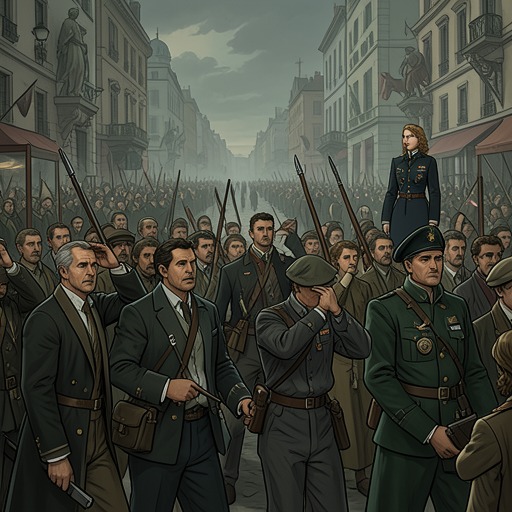
The star becomes a compulsory public identity. During the Dachau prisoner parade, Jewish men and women pass through Munich Street wearing Stars of David, their clothing marked and their misery treated as if it were an assigned property. Soldiers force them to hurry and stop moaning; the prisoners’ hunger, dirt, staggering steps, and exhausted faces make persecution physically legible. They are not presented as an abstract category but as individuals reduced by organized violence and compelled to move through the gaze of spectators.
When Liesel later searches the procession for Max, recognition comes not simply from facial features but from his behavior. He is the only face looking directly at the German spectators, studying them with fixed concentration. That act of looking reverses, however briefly, the structure of the parade: the persecuted person becomes an observer of those who have gathered to watch his humiliation. Liesel recognizes him through this refusal to disappear into the category imposed upon him.
Antisemitism and the Politics of Belonging
The novel contrasts antisemitic exclusion with relationships that cross the boundaries imposed by Nazi identity politics. Alex Steiner belongs to the Nazi Party but does not hate Jews or anyone else, a contradiction that reveals the gap between institutional membership and personal belief. Hans’s eventual Party approval likewise carries no evidence that he embraces antisemitic hatred; instead, it becomes the consequence and burden of his earlier application, especially after his compassion toward a Jewish prisoner exposes him to danger.
Rudy Steiner’s response to racial ideology offers another contradiction. In 1936, during the Olympics held under Adolf Hitler, Jesse Owens wins his fourth gold medal in the 4 × 100-meter relay despite racist claims that he is subhuman because he is Black and despite Adolf Hitler’s refusal to shake his hand. Rudy is deeply impressed by Owens. He covers himself in charcoal to imitate the Black athlete, turning the regime’s racial hierarchy into a child’s act of admiration and thereby revealing how unstable the official categories can be when confronted with achievement and identification.
Yet the regime repeatedly tries to discipline such contradictions through institutions and ceremony. Children are taught Germany’s racial superiority in the BDM, while Jewish people are treated as the principal violators of the German ideal. The anthem, the march, and the salute at youth gatherings make belonging appear measurable through obedience. Antisemitism thus works alongside nationalism: it defines who belongs by manufacturing an excluded population and trains citizens to experience exclusion as loyalty.
Narrative and Thematic Significance
Antisemitism governs the novel’s recurring contrast between labels and persons. Liesel’s father is reduced to the unexplained word “Kommunist”; Max is reduced to the star on his sleeve; Jewish prisoners are reduced, in the eyes of the crowd and soldiers, to a procession of racial enemies. Against these imposed names, the narrative restores particularity through faces, memories, friendships, letters, and acts of recognition.
The regime also controls records and messages. Nazi authorities solicit newspapers, posters, books, flags, and enemy propaganda for destruction, while official documents determine Party membership and social permission. In contrast, Hans’s letter to Walter includes a map, a route from Pasing to his front door, and the warning “Be careful.” Such private communication does not erase the system, but it creates a counter-network of responsibility within it.
The final parade scenes show the consequences of antisemitism without allowing the persecution to remain safely distant. The prisoners’ stars, starving bodies, and dying eyes embody a policy that has converted human beings into marked, disposable outsiders. Liesel’s search for Max and her recognition of the face that studies the crowd oppose that process of erasure. The novel’s central judgment is therefore not that antisemitism is simply hateful, but that it is a social technology: it classifies, isolates, disciplines, and mobilizes people until cruelty can pass as public order. Its power depends on ceremonies and paperwork as much as on violence, and its defeat begins wherever one person sees the marked individual rather than the label imposed upon him.