Battle of Stalingrad
The Book ThiefThe Battle of Stalingrad is presented not as a distant military episode but as a vast machine of death whose effects travel back to Himmel Street. It takes younger Hans Hubermann away in the name of the Führer, destroys Robert Holtzapfel, mutilates a returning soldier, and leaves Max Vandenburg’s hidden life shadowed by cold, waiting, and visions of war. In the novel’s moral geography, Stalingrad is both a place and a recurring wound: a battlefield that continues to exist in the bodies and memories of those who survive it.
Historical and Narrative Setting
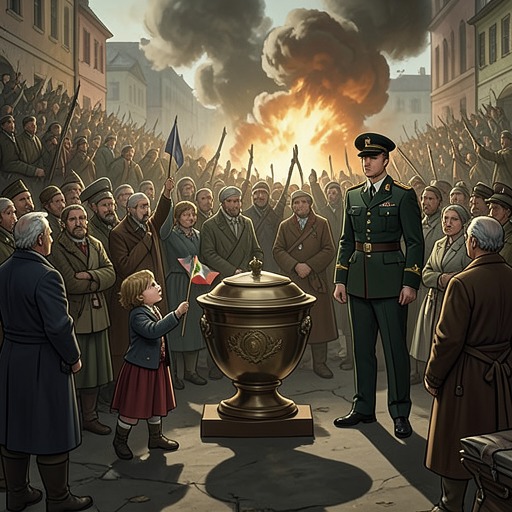
The battle belongs to 1942 and early 1943, when Stalingrad is imagined as a city governed by a merciless daily cycle. Each morning, its sky is bleached white like a bedsheet. During the day, blood splashes across that whiteness until it seems full and swollen against the earth; in the evening, the sky is wrung out and bleached again for the next dawn. The repetition makes slaughter feel industrial and procedural. Even this terrible rhythm understates the violence, because the fighting continues beyond the daylight hours.
The narration places the battle inside a larger landscape of souls being carried away. Stalingrad is therefore not described through strategy, commanders, or territorial gains, but through bodies, weather, and the work of death. The white sky, the blood, and the repeated washing create an image of war that is both physical and symbolic: history appears to cleanse itself each night only to prepare another day of killing.
The Battle’s Reach into Himmel Street
Younger Hans Hubermann disappears from Himmel Street when he leaves in the name of the Führer. His departure opens another story whose steps lead tragically to Russia and specifically to Stalingrad. The battlefield is first experienced by the people at home as absence: a boy is gone, and those left behind cannot yet know the exact shape of what is happening to him. The distance between Molching and Russia does not lessen the event’s force; it makes uncertainty part of the suffering.
The battle also reaches the neighborhood through the German military system. Alex Steiner is sent to Austria, to an army hospital outside Vienna, where his tailoring expertise is redirected toward repairing uniforms, socks, and shirts for soldiers suffering in Russia. Hans Hubermann is sent first to Stuttgart and later to Essen for the LSE, one of the least desirable home-front positions. Thus Stalingrad reorganizes lives even when the characters are not physically there: labor is assigned according to the needs of the front, and the wounded return as evidence of what the state has demanded.
Bodies, Injury, and Death
Frau Holtzapfel’s son Robert embodies the battle’s most devastating local consequence. In Russia on January 5, 1943, during an icy day filled with dead Russians and Germans, three forms of sound are said to interweave: Russian, bullets, and German. Robert’s legs are blown off at the shins. He dies in a cold, stench-filled hospital while his brother watches, turning a military explosion into a family trauma that cannot be contained by the battlefield.
The scene is rendered through the material details of injury rather than through abstract heroism. Robert’s hands are caked in blood as he heaps snow onto the place where his lower legs have been severed. The snow is supposed to cool or cover the wound, yet it belongs to the same frozen environment that has produced the suffering. Hot hands, a red scream, steam, and rotting snow make the body’s vulnerability impossible to separate from the landscape. Stalingrad is not merely where Robert dies; it is the environment in which ordinary distinctions between earth, weather, flesh, and violence collapse.
A different survivor gives Liesel a compressed account of the battle’s afterlife. When she asks what happened to his hand, he answers that Stalingrad happened to it. He has been shot in the ribs and has lost three fingers. His contempt for the German cold makes the local winter seem trivial beside the cold of Russia, and his damaged hand becomes a permanent, visible remainder of the battle. The response refuses sentimental distance: Stalingrad is not an explanation that resolves pain, but a name that identifies its source.
Consequences for the Living
The battle’s consequences extend beyond death and amputation. Max Vandenburg’s hidden existence is shaped by confinement, cool cement, and the cruelty of passing time. His minutes are cruel and his hours punishing, while his declining health develops through constant coldness, swimming hands, and an inability to warm himself even beside the fire. His visions of boxing with the Führer connect his private physical collapse to the political power responsible for the war. Although Max is not described as a Stalingrad combatant, the battle belongs to the same system of violence that has forced him into concealment and made the basement a substitute for a world at war.
The Jews who are driven down Munich Street also carry the battle’s atmosphere into Molching. They move with enormous eyes in starving skulls, dirt molded to their bodies, and legs that stagger under soldiers’ hands. Their suffering is not identical to Robert’s, but the narrative places both scenes within a single structure of state violence, bodily depletion, and death. Stalingrad helps enlarge the novel’s understanding of war: the front line is not the only place where bodies are consumed, because the same ideology produces hunger, forced movement, persecution, and disappearance elsewhere.
Narrative Significance
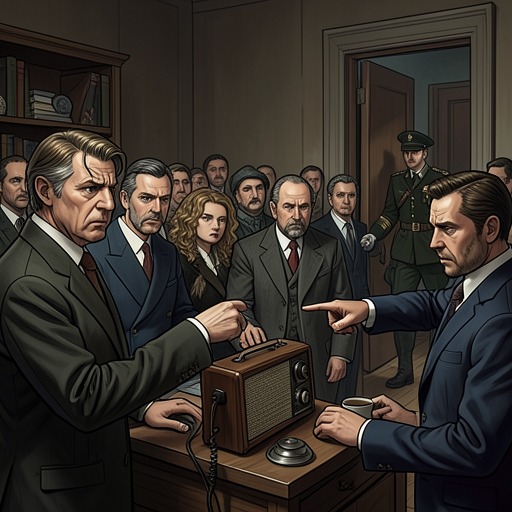
Stalingrad functions as a recurring temporal and emotional reference point. The real next raid is announced after a radio report and the earlier uncertainty of war, while the people of Himmel Street again become a trail moving toward shelter. Inside the basement, Liesel opens The Whistler and reads aloud. Rudy notices, draws others’ attention to the book, and Hans Hubermann comes closer until the crowded room grows quiet around her voice. Reading does not cancel the danger, but it gives the community a temporary form of order against the noise of war.
The battle also demonstrates how the novel’s history is assembled from partial knowledge. At home, people receive rumors, radio information, departures, damaged soldiers, and family losses; only the narrator’s wider perspective can connect those fragments to the Russian winter and to Robert Holtzapfel’s death. This movement between local scenes and distant catastrophe makes Stalingrad a structural hinge. The battle is elsewhere, yet it explains what happens here.
Its final significance lies in the contrast between war’s scale and its intimate aftermath. A city can become a daily cycle of bleached sky and blood, but the consequences finally appear as one absent son, one dead brother, one hand missing three fingers, one family forced to watch, and one neighborhood learning to read through fear. Stalingrad gives the novel a history that cannot remain historical: it enters the household, the body, the basement, and memory, where its violence continues long after the battle itself has become a name.