Color Symbolism
The Book ThiefColor Symbolism is the book’s central visual grammar for translating human history into sensation. Death first notices colors, then humans, and repeatedly uses the spectrum to approach experiences that resist ordinary explanation. Through changing skies, ruined landscapes, and remembered scenes of Liesel Meminger, color becomes both a method of narration and a record of the emotional pressure exerted by war, death, and survival.
Definition and Narrative Function
Color enters the narrative through Death’s perception. Death does not see a day as a single visual unit but as a continuous succession of shades: a single hour may contain thousands of colors, from waxy yellows and cloud-spat blues to murky darknesses. This attention is practical as well as aesthetic. Noticing color distracts Death from the strain of the work and helps Death cope with the length of time spent performing it. The motif therefore joins beauty to burden: the act of looking closely at the world is a way to remain sane while carrying human bodies and memories.
Death’s preferred image is a chocolate-colored sky, imagined as dark chocolate that can be slowly savored. The comparison gives the sky a taste and texture, turning perception into a form of temporary relief. Yet the comfort is never detached from mortality. Death asks what color everything will be when a person is lying in the remains of the body and Death arrives, so every visual description carries the approaching presence of death beneath its surface.
The Three Dominant Colors
The book ultimately concentrates its color system into red, white, and black. Death recalls Liesel through a long list of colors, but the three colors seen at the moments of encountering her in the flesh remain the most resonant. They overlap rather than forming a tidy sequence: black falls onto global white, and white onto thick, soupy red. The arrangement is layered, not stable, suggesting that innocence, violence, and death coexist within the same historical image.
Black is identified as a signature color and as the darkest moment before dawn. It accompanies Death’s encounter with a young man of about twenty-four whose plane is still coughing smoke before crashing into the earth. The aircraft’s wings become sawn-off arms, an image that turns machinery into a wounded body. Black therefore signifies eclipse, destruction, and the loss of movement, but it also occupies the threshold before dawn, retaining a narrow association with transition rather than absolute finality.
Red belongs to the last time Death sees Liesel. The sky resembles boiling soup, burned in places and streaked with black crumbs and pepper. The street had earlier held children playing hopscotch, with tapping feet, laughter, and smiles still echoing after the children are gone; then bombs arrive. Red consequently binds ordinary childhood to sudden devastation. Its warmth is not reassuring. It is the color of a world made violent, where a familiar street becomes an oil-stained surface and play is followed by destruction.
White carries the force of blinding global brightness in the final layering of the colors. Set against black and red, it is not simple purity. It becomes an overpowering field onto which the other colors are written, a surface capable of receiving both the dark mark of death and the red of catastrophe. The three colors gain their meanings through contrast and collision: black is intensified by white, red is made more violent by its surrounding brightness, and white is made less innocent by the marks laid over it.
Color, Memory, and Witnessing
Color is also the structure of Death’s recollection. After the destruction surrounding Liesel, her book is stepped on during the cleanup and thrown onto a garbage truck. Death climbs aboard, takes it in hand, and keeps it, later viewing it thousands of times. The book becomes an object through which Death studies the places where Death and Liesel intersect, trying to understand what Liesel saw and how she survived. Color thus belongs not only to the original scenes but also to their repeated afterlife in memory.
The recurrence is explicitly distressing. So many humans and so many colors continue triggering inside Death, harassing memory through heaps of bodies, plastic-like air, glue-like horizons, human-made skies punctured and leaking, and coal-colored clouds beating like black hearts. The imagery makes history appear manufactured and bodily at once. Colors are not passive labels applied to events after the fact; they are active reminders that return with the force of trauma.
The color motif also gives Death a way to hold together experiences that otherwise fragment. Death’s memories of Liesel do not form a neutral chronology at first. They gather as visual flashes, especially around red, white, and black, until those colors formulate into a pattern. The pattern does not erase the catastrophe. Instead, it makes witnessing possible by giving scattered suffering a recurring shape.
Color in Human Relationships
The motif is not confined to Death’s elevated perspective. Hans Hubermann shares the same attentiveness when he and Liesel finish a night of reading and look through the frosted window at the pink bars of light on the snowy rooftops of Himmel Street. Hans tells Liesel to look at the colors. His remark reveals a form of human recognition: he notices the world with enough care to name its changing light, and the shared act of looking follows a difficult night in which both have conquered the work and exhaustion before them.
That dawn scene places color beside literacy and affection. Liesel is still gripping the black book with silver lettering when the snow turns orange, and she notices a boy on a rooftop, remembering Werner. The changing colors connect the immediate landscape to a dead child and to the memories awakened by reading. A black book, pink light, orange snow, and the remembered figure of Werner form a chain in which objects and colors carry personal history from one consciousness to another.
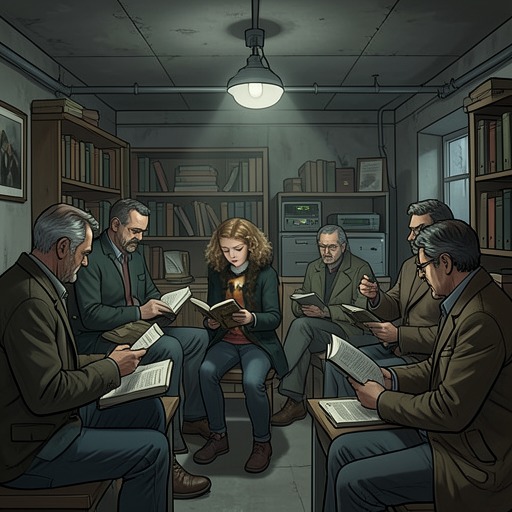
Color also appears within communal crisis. During an air raid, twenty-two people crowd into the Fiedlers’ deep basement, including the Steiner family, Frau Holtzapfel, Pfiffikus, a young man, and the Jenson family. The shelter is dank and cold, with jagged walls, a single hanging globe, and sirens muffled through the structure. In that compressed darkness, Liesel opens The Whistler and reads aloud. Rudy Steiner first pays attention, then signals others to listen; Hans Hubermann comes closer, and by the third page the crowded basement has become quiet except for Liesel’s reading. The scene does not remove the danger, but language creates a different atmosphere inside it, showing how perception can be redirected from panic toward shared attention.
Symbolic Consequences
Color Symbolism finally makes the book’s history legible as an accumulation of opposites rather than a moral diagram. The narrative contains so many humans and so many colors because human conduct cannot be reduced to one visual or ethical tone. The same world that produces bombing, racial persecution, and heaps of bodies also contains reading, neighborhood cooperation, Hans Hubermann’s sensitivity to dawn, and Rosa Hubermann’s hidden capacity for care. Color keeps these realities in contact without pretending that one cancels the other.
The motif’s deepest significance lies in its refusal of clean separation. Red, white, and black fall on top of one another; dawn is preceded by the darkest moment; a beautiful sky is perceived during a job defined by death; a book rescued from rubble becomes the means of preserving a life. Through these tensions, color converts catastrophe into a form of witness. Death’s attention to the spectrum is not an escape from human suffering but a way of carrying its contradictions, returning again and again to the visual traces that prove human existence is both terrible and worth remembering.