Death’s Eclipse
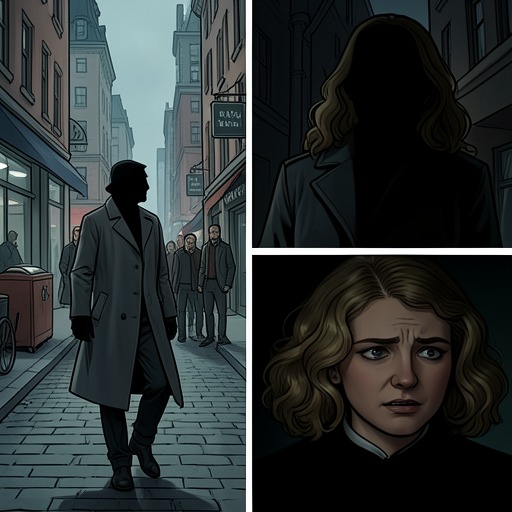
The Book ThiefDeath’s Eclipse is the recurring image through which Death perceives and interprets human dying. It is not a literal astronomical event but a momentary eclipse in the visual field: darkness briefly overlays the colors of the world as a human soul leaves the body. The motif gives death a recognizable shape while insisting that every death remains a singular encounter, witnessed by a narrator who has seen millions of them.
Definition and Visual Form
Death describes the image as a final shadow or darkening that appears when a human dies. In the scene of the dying pilot, the horizon has begun to charcoal, the remaining blackness above has become a fading scribble, and the man's bone-colored body lies beneath a ruffled uniform. As Death moves away, the graying light seems to wrestle with the sky, producing a last moment of eclipse and the recognition that another soul is gone.
The image is composed through the collision of three dominant colors. Red, white, and black fall over one another: thick, soupy red, blinding global white, and the scribbled signature black. This layering makes the eclipse more than an isolated shade. It becomes the dark mark that crosses a world already saturated with violence, brightness, and blood, a signature imposed briefly upon the visible scene.
Occurrences and Narrative Pattern
The motif first appears as a dark threshold before the dawn. Death calls the black image the darkest moment before light returns, establishing the eclipse as a passage between states rather than a permanent condition. The plane crash supplies the concrete setting for that transition: the aircraft coughs smoke, leaks it from both sides, cuts three deep gashes into the earth, and becomes a broken metallic bird with sawn-off wings. Death enters the wreckage, loosens the pilot's soul, and carries it away, leaving the body, the smell of smoke, and a smiling teddy bear behind.
The crowd's arrival changes the scene without undoing its central fact. As people gather, the sky lightens and the blackness disappears, yet Death still perceives the departing soul through the final eclipse. The crowd behaves as crowds do, while the narrator registers the private transformation hidden inside the public spectacle: a body remains visible, but the person who animated it has gone.
The same pattern is explicitly repeated beyond the crash. Death says that, despite all the colors touching and grappling with the world, an eclipse often appears for just a moment when a human dies. The recurrence is vast rather than exceptional; Death has seen millions of such eclipses and more than can be remembered. Repetition therefore supplies the image's structure, while the individual circumstances of each death prevent the pattern from becoming emotionally empty.
The Pilot and the Final Signature
The pilot's death gives the motif a particularly charged form. Before Death reaches him, the dying man speaks in English and says, "Thank you." The words briefly establish a human exchange amid wreckage and silence, but Death reaches into the cockpit before Rudy Steiner can discover what the pilot has said. The soul is extracted from the ruffled uniform, and Death moves away through the crowd carrying it.
Above the departing narrator, the sky eclipses once more. This time the black signature seems to take the shape of a swastika, an untidy emblem lingering overhead. The image links the pilot's death to the political violence surrounding the narrative, but it does not turn the pilot into a symbol only. A teddy bear rests on the shoulder of the corpse, and a lemon candle burns beneath the trees; these small objects preserve a human scale within the emblematic darkness.
Death's greeting, "Heil Hitler," is deliberately presented as an act performed after the narrator has already entered the trees. The gesture is shadowed by irony: Death claims that no one served the Führer more loyally during Adolf Hitler's reign, because Death was always in the right place at the right time, collecting the human consequences of that rule. The eclipse thus falls between political power and mortal reality. The regime may occupy the sky as a black signature, but Death carries away the person rather than the ideology.
Death, Recognition, and Human Contradiction
The eclipse is the form taken by recognition. Death does not merely remove a soul; for a brief instant, Death recognizes that a distinct human existence has ended. The motif gives a visual interval to an otherwise invisible act, allowing departure to be seen as a change in the world's light. Its brevity matters: the darkness passes, the sky resumes its colors, and yet the loss cannot be reversed.
The motif also holds together the narrator's distance and attention. Death has witnessed millions of eclipses and admits having seen more than can be remembered, which places individual deaths within an overwhelming history. At the same time, the narrator keeps the story of the book thief among a small legion of extraordinary human stories, each one treated as an attempt to prove that human existence is worth the effort of attention. The repeated image therefore does not flatten the dead into statistics; it creates a pattern in which particular lives can still be recovered and retold.
Finally, Death's Eclipse embodies the contradiction Death observes in humanity. Death sees people at their ugliest and their most beautiful and wonders how the same species can contain both. The human heart is described as a line, while Death's own is a circle, a contrast between human finitude and the narrator's seemingly continuous movement among endings. Yet Death envies one human capacity: humans have the good sense to die. The eclipse is where that mortality becomes visible—not as simple annihilation, but as a moment of darkness, recognition, and uneasy compassion.