First air-raid shelter reading
The Book ThiefThe First air-raid shelter reading is a defining wartime episode in which Liesel Meminger reads The Whistler aloud during a bombing at the Fiedlers’ basement shelter. Its decisive significance lies in the contrast between physical helplessness and verbal agency: Liesel cannot stop the bombs, but she can give the people around her a rhythm, an image, and a reason to remain together. The reading also turns a private skill learned with Hans Hubermann into a public form of care.
Causes and Setting
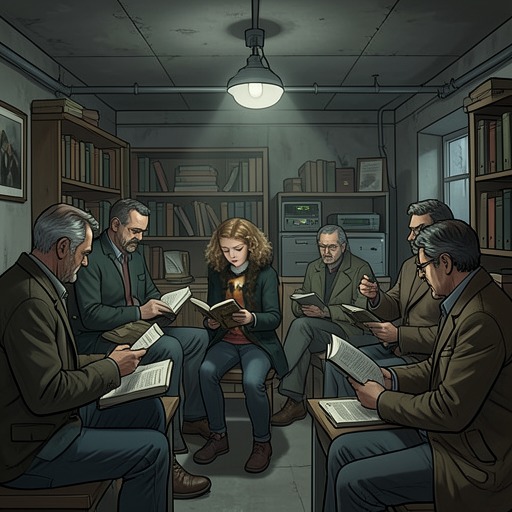
The event occurs during a genuine raid after a radio warning identifies Molching as a possible target. Himmel Street again becomes a trail of people moving toward the Fiedlers’ house, six houses away, whose deep basement receives twenty-two people. The shelter contains the Steiner family, Frau Holtzapfel, Pfiffikus, a young man, and the Jenson family among others. Its conditions are hardly reassuring: one bare globe hangs from the ceiling, the room is dank and cold, jagged walls press into people’s backs, and distorted sirens penetrate the cellar. Even the arrangement of the occupants reflects the strain of communal survival, since Rosa Hubermann and Frau Holtzapfel are kept apart to prevent their quarrels from worsening the crisis.
The warning produces a sharper fear than the earlier false alarm. Rosa Hubermann has reminded Hans Hubermann to take his accordion, but Hans refuses because he did not take it last time and everyone survived. The moment exposes how war unsettles ordinary logic, replacing calculation with superstition. As the residents descend, Mr. Fiedler says that the raid feels real, while the children begin to wail. Above them, bombs strike with such force that air pressure seems to push down like a ceiling and take bites from Molching’s empty streets.
The Reading During the Bombing
Rosa grips Liesel’s hand fiercely, but the noise becomes unbearable. When Rosa releases her, Liesel opens the book at the top of the pile, The Whistler, and begins reading aloud. At first her voice is almost lost in the shelter. Rosa’s demand for clarification and the surrounding din do not make Liesel stop; she remains fixed on the first page and continues speaking.
Rudy Steiner is the first to give her sustained attention. When he notices what she is reading, he signals his siblings to listen, and Hans comes closer. Their attention spreads through the room until a quietness begins to emerge. By page three, everyone is silent except Liesel. The shelter has not become safe—the bombs are still outside—but the people inside have acquired a common focus. Fear remains present in their eyes, while the act of listening gives it a shape that can be endured.
For at least twenty minutes, Liesel distributes the story through her voice. The youngest children are soothed, and the adults and older children imagine the whistler fleeing a crime scene. Liesel herself does not enter that imagined scene in the same way. She concentrates on the physical mechanics of words, seeing them as bodies stranded on paper, yet the spaces between sentences summon Max Vandenburg. She remembers reading to him when he was ill and wonders whether he is in the basement or once again stealing a glimpse of the sky. The reading therefore carries two simultaneous realities: an immediate public emergency and the private absence of the hidden friend whose nightmares have made fear intimate to her.
The children’s response confirms the reading’s practical effect. One boy considers crying again, but Liesel winks at him, imitating Hans or Rudy, and resumes. Her gesture is small and deliberate: she does not claim that danger has passed, but interrupts panic and restores the story’s continuity. Even after the sirens signal safety, Mr. Jenson announces that they are safe and Frau Holtzapfel tells him to be quiet because Liesel is nearly at the end of the chapter. Liesel says that only two paragraphs remain and finishes without rushing or theatrical flourish, giving the words precedence over the announcement.
Consequences and Aftermath
Liesel completes the first chapter of The Whistler while the adults maintain silence out of respect. Once the group leaves the shelter, children hurry past her, while many older residents—including Frau Holtzapfel and Pfiffikus—thank her for the distraction. Their gratitude recognizes more than entertainment. Liesel has supplied a temporary shelter within the shelter, a verbal structure that allows frightened people to wait together until the physical danger ends.
The aftermath also sharpens the event’s irony. The raid has threatened Molching, but Himmel Street is untouched. The community’s terror has not been disproportional in the emotional sense: the basement’s people heard the bombs, felt the pressure, and waited for the ground to shake. The absence of visible destruction does not erase the reality of what they endured. Instead, the contrast shows why the reading matters. Words have not defeated violence or guaranteed survival; they have made the interval of uncertainty inhabitable.
Narrative and Thematic Significance
The episode marks the expansion of Liesel’s literacy from family practice to communal responsibility. Hans Hubermann taught her to read in private, and she later read to Max Vandenburg in the intimacy of illness. In the shelter, those experiences converge before an audience of neighbors. A book once associated with individual development becomes an instrument of collective steadiness, while Liesel becomes not merely a reader but a witness who gives form to what others cannot articulate.
The scene also belongs to the book’s larger pattern of trauma returning through sound, memory, and repetition. Liesel has seen death directly, including her younger brother Werner’s body on the train, and she shares with Max a life shaped by nightmares: she wakes screaming, while Max wakes gasping for air beside a smoking fire. The shelter reading does not remove such memories. Instead, the words hold them at a distance long enough for people to remain present. Liesel’s inward concentration on the bodies of words and her memory of Max show that reading is both an outward act of care and a private method of bearing inherited and experienced fear.
The narration further complicates the apparent simplicity of the scene. The event is presented through carefully controlled interruptions, chapter markers, observations about words, and retrospective knowledge of later loss. The shelter’s temporary silence therefore carries a double meaning: it records what happened in the basement and preserves it as an act of memory. Liesel’s voice cannot alter the war’s machinery, the later deaths, or the separation of those she loves. It can, however, make frightened people listen to one another. That limited power is precisely what gives the First air-raid shelter reading its lasting force.