Frau Heinrich
The Book ThiefFrau Heinrich is the foster-care official who brings Liesel Meminger to her new home at 33 Himmel Street. Though she appears only briefly, her movements frame Liesel’s entry into the Hubermann household and later expose the permanent uncertainty surrounding the girl’s mother.
Arrival at the Hubermann Home
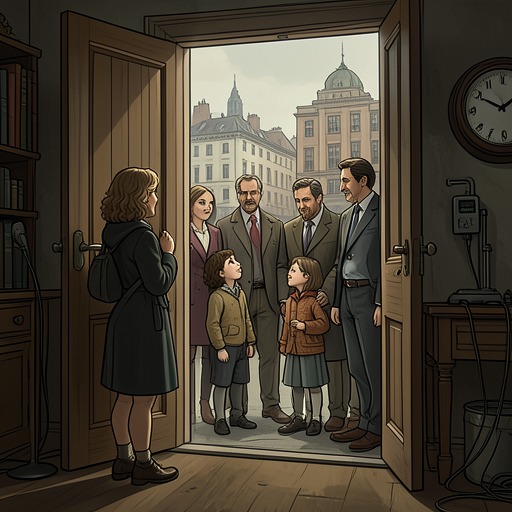
Frau Heinrich accompanies Liesel in a car through a gray, rain-obscured landscape and turns to tell her that they are nearly there, identifying the destination as her new home. The reassurance is practical rather than intimate: Liesel is being transferred into foster care, and the promise of a “new home” carries the weight of a life already severed from its previous one.
When they arrive, Frau Heinrich goes inside while Liesel remains in the car with an unnamed man. Liesel assumes that the man is there to prevent her from running away or to force her into the house if she resists. Frau Heinrich’s temporary disappearance therefore leaves the child facing the threshold of the Hubermann household through uncertainty and apprehension rather than welcome. She soon returns with Hans Hubermann and Rosa Hubermann, completing the handover that places Liesel in their care.
Connection to Liesel’s Lost Family
Frau Heinrich remains associated with Liesel’s unanswered questions about her mother. When Liesel later wants to write a letter, Hans Hubermann reminds her of the woman from the foster-care office who had brought her to the Hubermanns and visited a few times. He suggests that Frau Heinrich might forward the letter to Liesel’s mother, Paula Meminger, although even he sounds unconvinced.
That uncertainty becomes explicit after Hans requests another visit. Frau Heinrich explains to the Hubermanns that the foster-care office has completely lost contact with Paula Meminger. Liesel continues checking the mailbox every afternoon through March and into April despite this explanation, but no letter arrives. Frau Heinrich thus becomes the bearer of a devastating institutional fact: Liesel’s hope of reconnecting with her mother has no reliable channel through which to survive.
Limited Role and Narrative Function
The evidence presents Frau Heinrich less as a developed personal presence than as an agent of the foster-care system. Her function is administrative, but the consequences of her actions are deeply personal. She carries Liesel from one household to another, identifies the Hubermanns as the child’s next home, and later communicates that the previous family connection has disappeared from official reach.
Her brief appearances also emphasize the difference between institutional procedure and lived attachment. Frau Heinrich can arrange a placement and report the loss of contact, but she cannot restore Liesel’s family or answer the larger questions surrounding her father’s communist label, her brother’s death, and the political forces that have shaped her displacement. Those unanswered questions remain with Liesel after Frau Heinrich has left.
Significance in Liesel’s Development
Frau Heinrich marks the boundary between Liesel’s forced separation and the relationships she gradually forms on Himmel Street. The foster-care official brings her to the Hubermanns, but Hans Hubermann and Rosa Hubermann become the people who inhabit the words “new home” with daily actions, conflict, discipline, and care. Frau Heinrich’s role ends at the point where that new life begins.
Her later report about Paula Meminger prevents the transition from becoming a simple reunion story. Liesel’s persistence at the mailbox shows that the official loss of contact does not immediately extinguish personal hope. In this way, Frau Heinrich’s limited testimony helps establish one of the central conditions of Liesel’s life: she must build belonging in the present while carrying a past that institutions can neither explain nor return.