Frau Holtzapfel
The Book ThiefFrau Holtzapfel is the wiry woman who lives near the Hubermanns on Himmel Street, first defined by her long-running feud with Rosa Hubermann and later transformed by the deaths of both sons. Her arc gives neighborhood hostility a tragic depth: the woman who spits on the Hubermanns’ door becomes someone who needs Liesel Meminger’s voice, and whose grief finally overwhelms her ability to move through the street as she once did.
Identity and Introduction
Frau Holtzapfel is an unmarried mother with two sons, both a few years older than the Hubermann children and both serving in the army. The narrative presents her as wiry, spiteful, and remarkably persistent. Her most recognizable action is also one of the book’s most concrete neighborhood rituals: whenever she walks past the Hubermanns’ house, she spits on their front door and insults them. Because the door stands only meters from the gate, she has both the opportunity and the accuracy to make the gesture unavoidable.
Her hostility toward Rosa Hubermann has lasted roughly a decade, although no one knows how it began. The feud has become so old that the women may have forgotten its original cause, leaving only repetition behind: Frau Holtzapfel spits, Rosa reacts, and the quarrel renews itself. Her insult, “Schweine!”, turns the doorway at the Hubermanns’ home into a small threshold of domestic conflict. The behavior is comic in its regularity, but it also establishes Frau Holtzapfel as a woman who expresses herself through forceful, public acts rather than through reconciliation or explanation.
The Neighboring Conflict
The conflict between Frau Holtzapfel and Rosa is not presented as a single decisive dispute but as accumulated antagonism. Its persistence gives it the quality of a social habit, one that survives even after its cause has disappeared. Frau Holtzapfel’s repeated assault on the door is therefore more than a personal insult: it is a performance of resentment carried out in the shared space of Himmel Street, where private hostility becomes part of the neighborhood’s daily sound and movement.
Her position also contrasts with the political divisions surrounding the families. Alex Steiner can belong to the Nazi Party without hating Jews or anyone else, while Liesel’s dark eyes and her father’s unexplained label of “Kommunist” expose the danger of public categorization. Against that larger system of labels, Frau Holtzapfel is initially known through a domestic label of her own: the woman who spits on number thirty-three. Yet the same community that reduces people to habits and affiliations eventually has to confront the individual suffering concealed behind them.
From Antagonist to Reader’s Patron
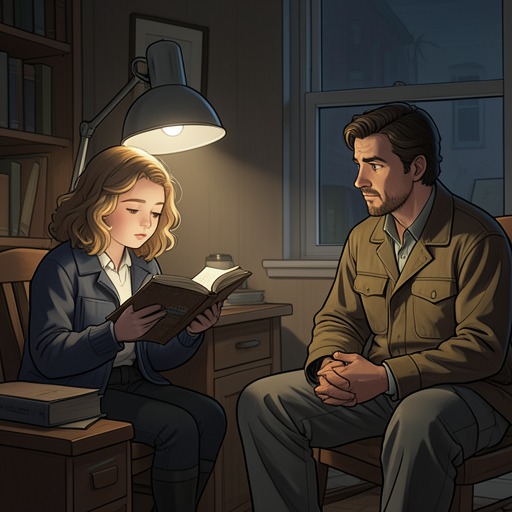
Frau Holtzapfel’s relationship with Liesel changes when she hears Liesel read aloud in the shelter. She admits that she liked the book Liesel read there and had hoped to hear the rest of it, but the immediate danger has passed because the shelter is safe for now. She therefore asks Liesel to come to her home and continue reading to her. This request reverses their earlier relationship. Instead of confronting the Hubermanns through Rosa, Frau Holtzapfel approaches the household through Liesel and seeks not an argument but a story.
The request is also an act of permission and dependence. Liesel initially worries that Frau Holtzapfel wants the book itself, but Frau Holtzapfel wants Liesel’s presence and voice. Reading becomes a form of service that crosses the boundary between neighboring households. The woman who had made the Hubermanns’ doorway a site of contempt now makes her own home a place where Liesel’s words are awaited. Her change does not erase her spiteful character; it reveals that beneath the practiced aggression is a capacity to listen and a need for consolation.
Sons, War, and Bereavement
Frau Holtzapfel’s two sons are introduced as soldiers, but their military status soon becomes inseparable from the war’s destruction. During the forced movement of Jewish prisoners through Munich Street, the crowd watches starving people pushed along by soldiers. The scene places military power, public spectatorship, and Jewish suffering in the same urban space, while Frau Holtzapfel’s family remains connected to the army through her sons. Her household is not outside the war’s machinery, even though its consequences will eventually arrive as personal loss.
The first visible sign of that loss comes when Liesel finds Frau Holtzapfel sitting with wet streams on her face: one of her sons is dead. The grief is not abstract or ceremonious. It appears on her face as tears while the household around her has to absorb the knowledge that the woman known for spitting and insults has become a bereaved mother. The narrative immediately indicates that this is only half of what she will endure.
Later, Hans Hubermann is sent to give her the news of Michael’s death. She recognizes the truth from his face before the message is fully spoken: two sons have died within six months. The accumulated loss changes her physical relationship to Himmel Street. She runs sobbing toward the gathering, repeating Michael’s name at least two dozen times, then embraces his body for nearly an hour. Afterward she returns to the street and sits in the blinding sunlight because she can no longer walk. The woman whose presence had once been marked by purposeful passage, accurate spitting, and verbal attack is reduced to stillness by bereavement.
Narrative Significance
Frau Holtzapfel embodies the novel’s movement from caricature to human complexity. At first, her defining action makes her easy to recognize: she is the spiteful neighbor who says “Schweine!” at the Hubermanns’ door. Later, the same character is shown asking for a continuation of Liesel’s shelter reading, sitting with tears on her face, and losing both sons in six months. These developments do not cancel one another. They establish how a person can be simultaneously abrasive, attentive, politically entangled through family, and devastated by love.
Her story also gives Liesel’s reading a social consequence beyond the Hubermann home. Words that began amid Liesel’s hunger, illiteracy, and confusion gradually become something others need. Frau Holtzapfel’s request demonstrates that reading can cross hostility without pretending the hostility never existed. In the end, her grief confirms the cost of the world surrounding Himmel Street: war does not merely pass through distant battlefields or through the Jewish prisoners seen on Munich Street. It enters neighboring kitchens, removes sons, and leaves a mother unable to walk.