Hans Hubermann
The Book ThiefHans Hubermann, known to Liesel Meminger as Papa, is the quiet center of her new household on Himmel Street. A tall, understated painter who plays the accordion, he first appears almost invisible, yet Liesel recognizes in his soft silver eyes a deep kindness. His decisive significance lies in the contrast between that unremarkable public presence and the dangerous promises he keeps: Hans turns ordinary domestic care, artistic skill, and remembered loyalty into resistance against the identities and cruelties imposed by Nazi Germany.
Identity and Introduction
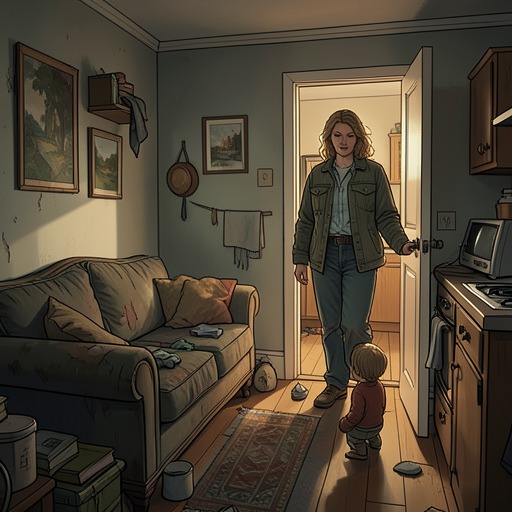
Hans arrives in Liesel’s life as one side of the foster-family tableau that greets her: the tall man beside Frau Heinrich and Rosa Hubermann, walking straight while a hand-rolled cigarette smolders between his fingers. The physical impression is plain rather than heroic. He is not presented as a commanding public figure, and the narrative repeatedly emphasizes that most people barely notice him. His painting is excellent, his musical ability better than average, but he seems to belong to the background even when standing at the front of a line.
That modesty is part of his identity, not evidence of emptiness. Hans works as a painter and plays the piano accordion, an ability that helps him earn extra money in the pubs of Molching, including the Knoller, during winter. The accordion also gives him a history that reaches beyond the household. It connects him to Erik Vandenburg, to World War I, and eventually to Erik’s son, Max Vandenburg. Thus the instrument is both livelihood and moral inheritance: it carries music into the family while also carrying an old obligation toward a man threatened by the present regime.
Liesel’s first intimate recognition of Hans comes in the washroom, when he turns on the light and she studies his eyes. Their softness allows her to understand that her foster father is worth a great deal. This recognition becomes especially important because Liesel arrives burdened by hunger, grief, and an unexplained label attached to her absent father: communist. Her dark brown eyes also mark her as potentially suspect in a Germany that has made racial and political categories dangerous. Hans’s value is therefore established not by ideological declaration but by the way he sees a frightened child before reducing her to a category.
Moral History and the Promise of Help
Hans’s relationship with Max is rooted in a promise made through the history of Erik Vandenburg. When Walter Kugler approaches Hans and asks whether he still plays the accordion, the practical question conceals a larger one: whether Hans is still willing to help. Hans stops painting, listens, and arranges a later meeting. The exchange activates the moral history attached to his accordion and converts memory into present risk.
In November 1940, Max arrives at 33 Himmel Street at twenty-four years old, exhausted, shaking, and weighed down by his clothes and fatigue. The question about the accordion is not merely a question about music; it tests whether Hans will honor an obligation that may endanger everyone in the house. Hans accepts the burden rather than treating the danger as a reason to erase the past. His courage is consequently relational and specific. He does not oppose persecution through a public speech; he responds to one person whose survival has become his responsibility.
Hans’s conduct also exposes the contradiction between official membership and private morality in Nazi Germany. Alex Steiner is identified as a Nazi Party member who does not hate Jews, but Hans’s position is defined more sharply by action. Whatever public conformity is required around him, his private decision to help Max refuses the regime’s demand that Jewishness determine the limits of human obligation. The law strips Jews of German citizenship and forbids intermarriage, while Hans preserves an older and more personal idea of Germany: one in which a promise, a friendship, and a debt to the dead still matter.
The Household Under Pressure
Hiding Max transforms the Hubermanns’ home into a divided social space. The household must contain the truth of a Jewish man upstairs while displaying the appearance of uninterrupted normality outside. Hans explains that he cannot simply abandon his accordion work: the family needs the money, and stopping would make people suspicious. He has already claimed that Max was sick; now everyone must continue behaving as though nothing has changed.
This pressure makes Hans’s ordinary manner a survival technique. The family’s fear is intense, but it does not produce hysteria. Rosa orders Liesel away in a calm, firm voice when necessary, and Hans maintains the routines that conceal the hidden room and the hidden life. Public behavior becomes a form of impression management: playing in the pubs, moving through the street, and answering the door all belong to the visible world, while the basement and the man upstairs belong to the concealed one. The moral cost is that a family must smile after catastrophe and perform normality continuously, not because life remains normal, but because the performance protects Max.
The danger eventually arrives at the door of 33 Himmel Street in the form of a seven-punch knock. There is no time to move anyone elsewhere. The household’s carefully managed boundary is suddenly exposed to an unknown visitor, and Hans’s earlier promise becomes a present test. The scene reveals how little separates domestic safety from state violence: a door, a voice, and the expectation that it must be opened.
Public Witness and Private Responsibility
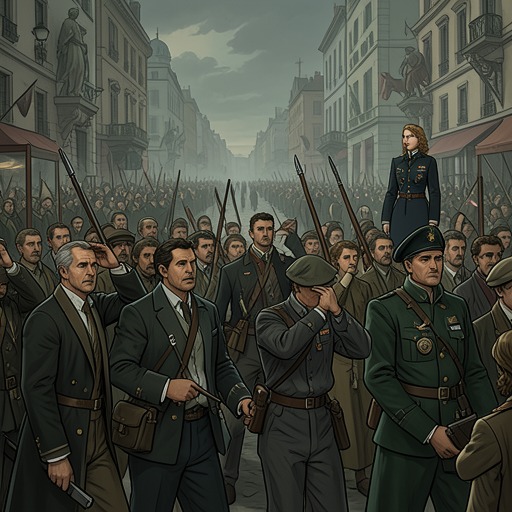
Hans’s compassion extends beyond the basement. During the procession on Munich Street, Jews are forced down the road by soldiers, their starving bodies marked by dirt, their steps staggering between compelled running and malnourished walking. Hans watches above the crowd, his eyes described as silver and strained, while Liesel looks through gaps and over shoulders. His response is not detached observation. The same eyes that recognize Liesel’s worth now confront a procession of people being reduced to a persecuted category.
The contrast between Hans’s quietness and the violence surrounding him gives his character its force. He is not powerful enough to stop the procession, and the evidence does not turn him into a conventional public hero. Instead, his moral presence is measured by attention, memory, and the refusal to let official spectacle become ordinary. His household shelters one man, but his gaze registers the many whose bodies pass through the street and toward death.
Character Arc and Narrative Significance
Hans is a round character because his apparent simplicity repeatedly opens into unexpected responsibility. He is a working painter who needs income, a musician who depends on public routines, and a foster father whose gentleness gives Liesel emotional security. Yet those ordinary roles coexist with choices that expose him and his family to lethal danger. The surprise is not that he possesses heroic qualities in the abstract; it is that he keeps making costly decisions through small, recognizable acts.
His importance to Liesel’s development is inseparable from language and memory. Liesel’s understanding of the Führer grows from the accumulation of her father’s label, a bonfire, dead letters, her mother’s suffering, and her brother’s death. Hans does not erase those associations. By telling her the story of World War I, Erik Vandenburg, and the visit to the fallen soldier’s wife, he gives her the missing history behind the man upstairs. His explanation turns a concealed presence into a human relationship and teaches Liesel that words, labels, and political identities have consequences only when people choose to wield or resist them.
Hans Hubermann therefore embodies the book’s tension between invisibility and significance. He appears to be merely part of the background, but the background is where his decisive actions occur: in a washroom beside a frightened child, in a quiet meeting about an accordion, in a house that must pretend nothing has changed, and on a street where persecuted Jews pass beneath the gaze of witnesses. His kindness is not passive softness. It is a discipline of seeing, remembering, and keeping faith when the surrounding world insists that some people should no longer count.