Hans Hubermann’s LSE truck accident
The Book ThiefHans Hubermann’s LSE truck accident is the decisive incident that transforms his wartime fate. Serving in the LSE in Essen, Hans is ordered into a truck whose crash kills Reinhold Zucker and injures several men, while Hans suffers a broken leg. The accident is at once bodily catastrophe, moral reversal, and bureaucratic escape: Hans survives because Zucker forces a seat exchange, and the resulting injury allows him to leave the hazardous LSE for work closer to home.
Causes and Circumstances
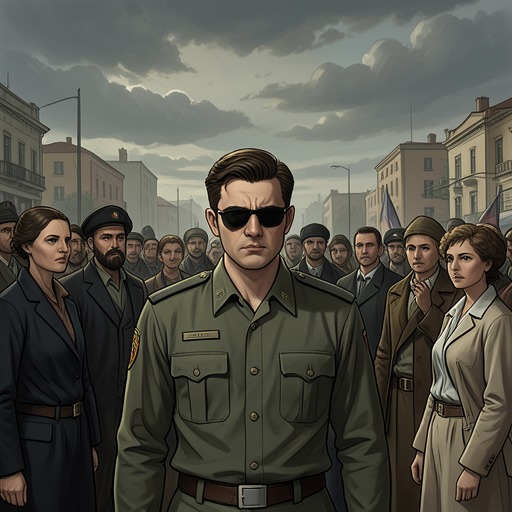
Hans had first been sent to Stuttgart and then to Essen, where he occupied one of the least desirable positions on the German home front: the LSE. He was not sent to fight at the front, but his assignment still placed him inside the machinery of war, exposed to dangerous transport and the expendability of ordinary men. The accident therefore grows out of a broader wartime system in which labor, uniforms, vehicles, and bodies are moved according to military necessity rather than individual safety.
The immediate cause begins with a seat dispute. Hans has just sat down in his appointed place when Reinhold Zucker, standing above him beneath the truck’s low ceiling, orders him to move. Zucker announces that he is swapping seats, dismissing Hans’s question about why with impatient contempt. The back seat is probably the most uncomfortable: drafty and cold. Hans nevertheless gives in, later explaining that the draft in his original position would have gone straight through his ears. The exchange appears minor, even absurdly ordinary, but it determines who will occupy each place when the vehicle overturns.
The Crash and Its Physical Cost
The olive-green truck is traveling toward the camp, perhaps ten miles away, when the left front wheel is punctured and the driver loses control. The vehicle rolls repeatedly, throwing men, air, light, trash, and tobacco together as the blue sky changes from ceiling to floor. When the motion stops, the men are crowded against the truck’s right-hand wall, their faces pressed into the filthy uniforms beside them. The scene converts a routine journey into an indiscriminate struggle for orientation and survival.
The injuries reveal the accident’s material severity without softening it into abstraction. Six men are burned by cigarettes; two hands are broken; several fingers are broken; Hans Hubermann’s leg is broken; and Reinhold Zucker suffers a broken neck, snapped almost in line. The truck carries its own aftermath inside it, and the men must confront the fact that one of their companions is dead before they can even return to camp.
The medical response is itself part of the disaster. Helmut Brohmann regains consciousness and tries to restart the engine from the driver’s compartment, but the truck will not move. Another truck and an ambulance are requested, yet the ambulance does not arrive. The men understand what that absence means. Their injuries are handled within the priorities of military transport, where delay, insufficient care, and the need to continue the journey take precedence over individual recovery.
Death, Return, and Reversal
During the trip back to camp, the men try not to look at Zucker’s open-mouthed sneer. At times they forget and rest their feet on the body, an appalling gesture produced by the cramped vehicle and the demands of movement rather than presented as simple cruelty. Once they arrive, everyone tries to avoid pulling him out. Hans participates in the task, then manages only a few abbreviated steps before the pain in his leg fractures his movement and brings him down.
An hour later, a doctor confirms that Hans’s leg is definitely broken. The sergeant’s response gives the injury its unexpected institutional consequence. With a half grin, he tells Hans that he will rest while the authorities decide what to do with him, and says he will report that Hans did a great job. More importantly, he proposes that Hans is no longer fit for the LSE and should be sent back to Munich to work in an office or perform whatever cleanup is required there. The broken leg thus changes value within the military structure: physically, it is damage; administratively, it becomes the means of removing Hans from a dangerous assignment.
The reversal is sharpened by the seat exchange. Zucker’s insult and coercion force Hans out of the position Hans was originally given, but Zucker occupies the altered position and dies in the crash, while Hans survives with a serious but nonfatal injury. The accident does not make survival feel secure or deserved. It instead exposes how narrowly Hans’s life depends on another man’s arbitrary decision, a punctured wheel, and the impersonal movement of a damaged truck.
Consequences for Hans and His Family
Hans’s broken leg ends his service in the LSE and redirects him toward Munich. The injury therefore brings suffering while also providing a route away from the work that had placed him in repeated danger. His return is associated with the family’s anxious relief. Rosa Hubermann prays beside the accordion, and Liesel believes those prayers may have helped Hans survive the accident, even while recognizing that, whether or not they had power, they could not have harmed him. The accordion, normally a sign of Hans’s presence and care, becomes linked to the household’s waiting and fear.
The accident also carries the shadow of other wartime bodies. Max Vandenburg endures cold cement, punishing time, and a severe decline in health; Jewish prisoners are marched through the streets with starving skulls and dirt molded to their bodies; Frau Holtzapfel’s son Robert loses both legs and dies. Against these wider injuries, Hans’s broken leg is neither trivial nor equivalent. It is a concrete wound that reveals how war distributes vulnerability unevenly, while his survival gives the family a reprieve unavailable to many others.
Narrative and Thematic Significance
The LSE truck accident functions as a compact example of the book’s recurring collision between chance and consequence. Hans does not escape because the war becomes merciful. He escapes because a hostile superior changes seats, a wheel is punctured, and the crash produces an injury that the authorities can reinterpret as useful. The event’s moral logic is therefore unstable: the same act that saves Hans kills Reinhold Zucker, and the same wound that damages Hans becomes the reason he can leave the LSE.
Its significance also lies in the contrast between official purpose and human cost. The LSE is part of the home front, yet its work still subjects men to bodily harm, inadequate medical response, and the grim handling of the dead. Hans’s reassignment is not a triumph over the system so much as a temporary escape permitted by it. The accident leaves him alive, injured, and closer to Munich, but it makes clear that survival in wartime may depend less on justice than on a sequence of arbitrary pressures whose consequences no one can control.