Hiding Max Vandenburg
The Book ThiefHiding Max Vandenburg is the decisive act of private resistance at the center of the Hubermanns’ household. When Max Vandenburg reaches 33 Himmel Street in November 1940, he is twenty-four, exhausted, shaking, and carrying the danger imposed on him by Nazi persecution of Jews. Hans Hubermann receives him because an old promise has become an obligation, and the family turns its basement into a place of survival. The rescue does not remove fear; it makes fear part of daily life, requiring the Hubermanns to hide a man in their home while behaving as though nothing has changed.
Promise and Historical Pressure
Hans Hubermann’s decision begins before Max appears. On June 16, 1939, a stranger named Walter Kugler approaches Hans while he is working and asks whether he is a man who likes to keep a promise. Hans agrees to meet him later that night. The question is deliberately indirect, but its meaning becomes clear when Max arrives: Kugler is asking Hans to honor a debt connected with Max Vandenburg and to help him survive.
The promise carries the weight of an earlier friendship. Max and Walter Kugler had fought thirteen times over several years, with Walter winning ten contests and Max three. Their rivalry eventually became genuine friendship, but Nazi persecution destroyed the ordinary conditions in which that friendship had existed. Max lost his job with the Jewish workers at the Jedermann Engineering Factory in 1935, after the Nuremberg Laws stripped Jews of German citizenship and prohibited marriage between Jews and Germans. Walter, meanwhile, was eventually sent to Poland to enforce Germany’s authority over Poles and Jews. The history behind the promise therefore joins personal loyalty to a political system that has made loyalty dangerous.
Hans himself survives in public through compromise and concealment. His accordion playing gives him a distinctive place in Molching, where his style is valued for warmth rather than perfection. He performs the required Nazi gestures when asked and flies the flag on the prescribed days, while privately refusing the hatred directed at Jews. His public behavior keeps suspicion away, but it also creates the conditions under which the hidden act can continue.
Max’s Arrival and the Basement
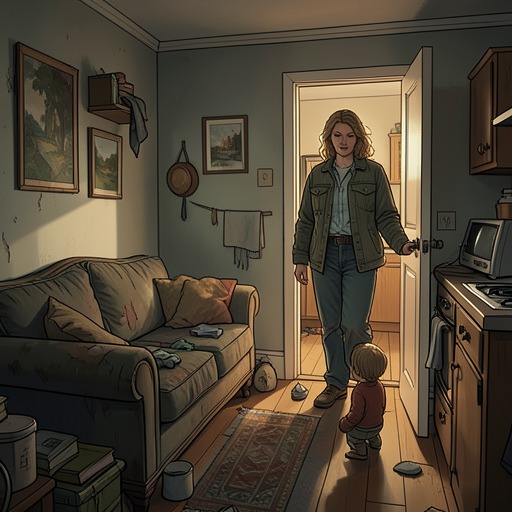
Max reaches Munich and Molching before appearing in a stranger’s kitchen, asking for help while suffering from the condemnation he believes he deserves. Hans shakes his hand and makes him coffee in the dark. In November 1940, Max stands in the kitchen of 33 Himmel Street with clothes that seem to weigh him down and an exhaustion so intense that even an itch could overwhelm him. His arrival is not an ordinary visit but the sudden materialization of the danger Hans has agreed to receive.
The question about the accordion carries a second question beneath it: whether Hans will still help. Hans’s answer is enacted rather than explained. After Liesel Meminger glimpses the outline of a book on the kitchen table, Hans whispers that she is a good girl. Liesel remains awake for an hour, listening to the quiet fumbling of sentences between the adults. The household’s secret is introduced through fragments, withheld explanations, and the child’s recognition that the adults are speaking around something perilous.
The Hubermanns move Liesel to the basement, where Hans tells her what is happening. The basement contains drop sheets, the smell of paint, and words painted on the walls from earlier lessons. It becomes both a hiding place and a threshold between ordinary domestic life and the concealed reality of Nazi persecution. Max is meant to remain there, away from windows, streets, and questioning neighbors; the family’s home is divided into a visible household and a hidden life beneath it.
Max initially believes that the basement is the only place where he belongs. He promises never again to sleep in Liesel’s room, appalled that bewilderment allowed him to do so on his first night. He reasons that, as a Jew in a Germany organized around persecution, he is destined to exist in a basement or another concealed place of survival. His self-understanding has been forced into the architecture of hiding: the basement is not merely where he is placed, but where persecution tells him he ought to exist.
Performing Ordinary Life
The family’s most difficult task is not simply keeping Max out of sight; it is continuing to act normally. Hans must keep playing the accordion several times a week because the family needs the money and because stopping would invite questions. He has already claimed that Max is sick, but the household must now reproduce its old routines with greater care. Life has altered radically, yet every public gesture must suggest continuity.
This produces a form of constant impression management. The basement is a hidden backstage area, while the street, work, and social obligations form the public stage on which the Hubermanns perform normal German life. Fear appears as anxiety, disbelief, and paranoia, but the striking fact is that the family resists hysteria. Rosa Hubermann orders Liesel away in a calm, firm voice, even though the presence of a Jewish fugitive in their home threatens every member of the household. Calmness becomes a practical discipline rather than evidence that the danger is small.
Hans’s public conformity is therefore double-edged. His required greeting and flag display protect the household from immediate suspicion, while his private action places it in direct opposition to the racial order those rituals support. The secrecy depends on repetition: ordinary work, ordinary speech, ordinary movement, and ordinary explanations must continue around the extraordinary fact of Max’s presence. A single mistake could collapse the boundary between the visible family and the hidden guest.
The pressure is made concrete by the seven-punch knock at the door of 33 Himmel Street. When it comes, there is no time to move anyone elsewhere. The family has reached the point at which concealment can no longer be treated as a controlled arrangement; the door itself becomes an instrument of exposure. The threat is not only the person outside but the sudden loss of time, the condition that makes every escape plan inadequate.
Family, Fear, and Shared Survival
Liesel’s involvement changes the hiding place from a secret known only to adults into a shared moral world. She encounters Max as a foreigner in the kitchen, notices the book near him, and is drawn into the quiet, incomplete explanations. Hans’s assurance that she is a good girl places trust in her before she fully understands the scale of the danger. Her youth does not make her irrelevant: the household depends on her ability to keep knowledge within the family.
Max and Liesel also form a connection through nightmares. Max is ashamed that he slept in her room and later promises to remain in the basement, but the two eventually share a deeper recognition: both carry traumatic memories into sleep. Their relationship is described through the swapping of nightmares, turning private suffering into a bond. The basement consequently becomes more than a prison or shelter. It is a confined space where two children of grief recognize one another, even though Max is an adult and Liesel is a girl still learning to understand the labels imposed upon her.
The political world has already reached Liesel through fragments she cannot initially interpret. She remembers that her father was labeled a communist, though she does not understand the word; she has seen a large bonfire, carries the suffering of her mother, and has lost her brother. These elements gather into an understanding that the Führer is connected to the destruction around her. Max’s arrival gives that abstract power a human consequence: the persecuted person is no longer a distant category but a man breathing inside her home.
Hans and Max’s relationship is shaped by obligation, gratitude, and danger. Hans does not rescue Max through a public declaration; he offers coffee in darkness, a handshake, a basement, and the continuation of a promise. Max arrives convinced that he deserves condemnation, while Hans acts against the political identity assigned to him. Their connection demonstrates how an inherited debt can become an ethical choice when the surrounding society has converted friendship into a liability.
Consequences and Narrative Significance
Hiding Max requires the Hubermanns to live in contradiction. Hans belongs publicly to a society that demands Nazi loyalty, yet his defining private action is the protection of a Jewish man. Alex Steiner’s contradictory politics provide a wider contrast: membership in the Nazi Party does not automatically erase personal relations or eliminate the refusal to hate, but private sympathy becomes far more costly when the state turns prejudice into law and practice.
The action also links domestic secrecy to the broader movement of persecuted Jews through the streets. Later, on Munich Street, Liesel and Hans watch Jewish prisoners pass in a starving procession, their bodies dirt-covered and their movement forced by soldiers. The hidden man in the Hubermann basement and the men being marched in public belong to the same persecuted population, but the contrast is stark: Max is concealed behind a household wall, while these prisoners are displayed before a crowd. The public spectacle reveals what the basement has been trying to keep alive—a person who might otherwise be reduced to a category, a body, or a target.
For Hans, the rescue is irreversible. The date of June 16, 1939, is remembered as the point at which his life changes, and Max’s arrival fulfills the danger implied by Walter Kugler’s question. For the family, the consequences extend beyond the act of sheltering: money must still be earned, routines must still be performed, Liesel must be brought into the secret, and every interruption at the door can threaten death or arrest. Hiding Max is therefore not one gesture completed at his arrival but an ongoing practice of courage under surveillance.
Its deepest significance lies in the transformation of identity through action. Nazi Germany classifies people as German, Jew, communist, or enemy and expects those classifications to determine behavior. The Hubermanns’ choice interrupts that system at the smallest possible scale: a kitchen, a basement, a handshake, and a promise. Max remains hunted, Hans remains publicly compromised, and the family remains afraid, but within 33 Himmel Street the labels do not have the final authority. The hidden life in the basement becomes the household’s truest moral reality.