Hitler's Birthday
The Book ThiefHitler's Birthday is the April 20, 1940 celebration around which Molching organizes one of the most important reversals in Liesel Meminger's early life: the regime intends a public display of loyalty, but the fire gives her the chance to steal The Shoulder Shrug from the ashes. The date joins national ritual to private grief, converting a birthday ceremony for Adolf Hitler into the moment when Liesel's anger becomes action and her identity as a book thief acquires a political edge.
Date and Political Setting
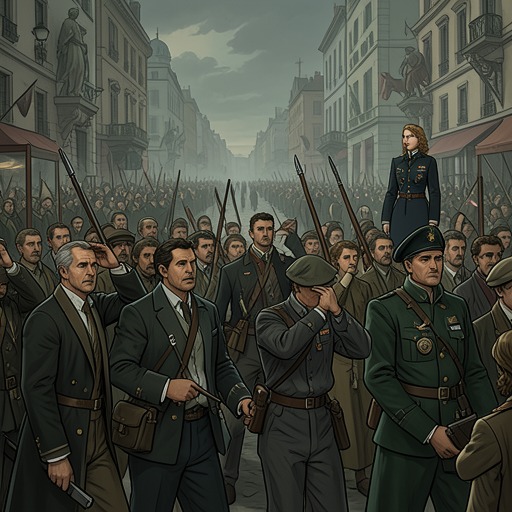
Molching prepares for Hitler's Birthday as though the entire town were assembling a single ceremonial body. The celebration is scheduled to include a parade, marching, music, singing, speeches, and a fire, with local Hitler Youth divisions attending in organized groups. The occasion is presented as more than a birthday party: the Nazi partisans want it to honor Hitler's victorious position in the developing war, celebrate victory over Germany's enemies, and proclaim release from the restraints associated with the period since the end of World War I.
The preparations reveal how political identity is manufactured through ordinary materials and public participation. While Liesel carries out washing and ironing around Molching, Nazi Party members gather fuel. Men and women knock on doors to solicit anything regarded as fit for destruction. The Molching Express calls for newspapers, posters, books, flags, and enemy propaganda to be delivered to the Nazi Party office on Munich Street. Even Schiller Strasse, still awaiting renovation after the persecution of its Jewish residents, is searched for something that can be burned in the Führer's glory. The celebration thus depends on collecting and destroying objects that preserve competing memories or ideas.
The regime's love of burning creates the event's central irony. Shops, synagogues, houses, personal belongings, people, and books can all be consumed by fire, yet the destruction of books also creates an opening for someone willing to retrieve them. Liesel's first stolen book, The Grave Digger's Handbook, dates from January 13, 1939; the second, The Shoulder Shrug, is stolen on April 20, 1940, after an interval of 463 days. The birthday supplies the spectacular setting in which state violence and private book thievery briefly occupy the same space.
The Ceremony in Molching
On the day itself, Liesel continues checking the mailbox for news of Paula Meminger, despite being told that the foster care office has lost contact with her mother. That unanswered search places the public celebration against a private absence. The town prepares to say “Happy birthday, Herr Hitler,” while Liesel remains fixed on a mother whose suffering and disappearance have not been explained to her.
Hans Hubermann tells Liesel to forget Max Vandenburg and asks whether she is ready to attend the bonfire. She changes into her Hitler Youth uniform, and she and Hans leave for the BDM headquarters, where the children are to be taken in groups to the town square. The uniform and the organized movement of children show how the celebration folds young people into the state's pageantry. Speeches will be made and a fire will be lit; for Liesel, however, those public acts are about to produce a wholly different result.
The event's emotional pressure gathers around a small chain of associations. Liesel has heard that her father was a communist, although she does not understand the label; she has seen the suffering of her mother, endured the death of her brother, and watched letters fail to arrive. The narrative condenses her growing understanding into an equation: the word communist, a large bonfire, dead letters, her mother's suffering, and her brother's death lead to the Führer. Hitler's Birthday is therefore not merely the day when Liesel learns more about politics. It is the day when scattered signs begin to form a single explanation for the losses surrounding her.
The Fire and the Second Theft
The public fire is meant to erase the enemies of the regime, but Liesel approaches it with anger and dark hatred. After the afternoon's excitement, a blood-soaked ankle, and a slap from a trusted hand, she takes The Shoulder Shrug from beneath a steaming heap of ashes. The book is blue, with red writing engraved on its cover and a small red cuckoo bird beneath the title. Its physical details matter because the object survives the ceremony's attempt to reduce books to fuel: it emerges from destruction marked by heat, smoke, and the danger of being handled.
Liesel does not feel ashamed. Her response is pride, joined to the anger that motivated the theft. The book is not simply another possession added to her growing collection. It is taken on Hitler's Birthday, from a fire staged in his honor, at the moment when Liesel has begun to identify the Führer with the ideological and personal harms she has known without understanding. The theft consequently changes the meaning of her earlier book stealing. What began as an illicit encounter with a book at her brother's burial becomes, on this date, an act aimed against the symbolic machinery of Nazi Germany.
Hans remains beside Liesel while smoke rises over his shoulder, and the narrator describes the gates of thievery as opening slightly, with Liesel widening the gap and squeezing through. That image gives the date a threshold function. The birthday does not complete Liesel's development, but it marks her passage from isolated impulse toward a more conscious relationship with words, books, and power. The state opens a ritual space for obedience; Liesel enters it and leaves carrying a forbidden remainder.
Historical Violence Behind the Festivity
The birthday celebration cannot be separated from the exclusionary politics that make its symbols effective. Liesel's dark brown eyes already distinguish her from the preferred image of German blondness, and the label “communist” attached to her father remains an unexplained stain in her family history. Around the same period, the persecution of Jews shows how state categories are turned into physical consequences. Max Vandenburg and Walter Kugler, once childhood opponents who became genuine friends, can no longer treat their old relationship as ordinary after the Nuremberg Laws forbid Jews from holding German citizenship and from marrying Germans. Max loses his job with other Jewish workers, and a star on his sleeve replaces the social world in which he and Walter once fought freely.
Hans's position also exposes the coercive structure beneath the celebration. After Kristallnacht, the Gestapo searches his house, and his pending application for Nazi Party membership helps him remain tolerated. Later, the application is approved, arriving as a letter that looks like good news but functions as a punishment to his conscience. Hitler's Birthday belongs to the same system of forms, labels, uniforms, party offices, fires, and official permissions. Its bright public ceremony rests on a machinery that sorts people into acceptable and dangerous categories.
The later sight of Jewish prisoners being forced down Munich Street gives the birthday fire an even darker retrospective meaning. The prisoners move under soldiers' hands, their starving bodies and dirt-covered legs displaying the human cost concealed by the town's marching and cheering. Hans and Liesel watch from the crowd. In that later scene, the categories invoked by the birthday celebration are no longer abstract materials or slogans; they have become exhausted people being driven through the street.
Narrative and Thematic Significance
Hitler's Birthday is a hinge between conformity and recognition. Liesel still wears the Hitler Youth uniform and attends the organized celebration, yet the meaning of the event turns inward as she links the regime to her father's disappearance, her mother's suffering, and her brother's death. The day shows how political spectacle can be absorbed by a child without producing the obedience it demands. Its symbols become evidence against themselves.
The date also connects destruction with authorship. The Nazi celebration seeks to control the public record by identifying materials for burning, while Liesel preserves one of those materials and later writes The Book Thief. Her book theft begins in the cemetery and develops through the fire: a grave-digging manual establishes the career, and The Shoulder Shrug gives that career its first unmistakably political charge. The manuscript she eventually begins with a pencil on its first page is thus linked to a long struggle over which words may survive.
For Liesel, April 20, 1940 is the moment when a national birthday becomes a personal reckoning. The town intends to celebrate Hitler's power through fire; Liesel takes a book from the remains. In that contrast, the event defines the novel's larger conflict between official language that commands, classifies, and destroys, and private reading that remembers, interprets, and keeps what power wants erased.