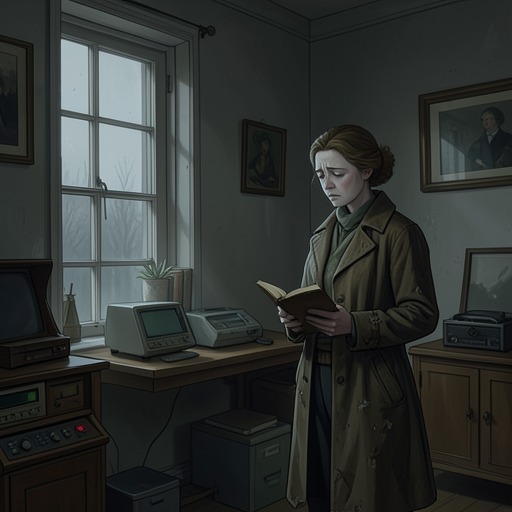
Liesel Meminger
The Book ThiefLiesel Meminger is the book thief, but the title first describes her as a child without words. She arrives on Himmel Street carrying hunger, grief, an unexplained communist label attached to her absent father, and a black copy of The Grave Digger’s Handbook stolen from the snow beside her brother Werner’s burial. Across the story, books change from mute relics into instruments of memory and power; finally, Liesel writes The Book Thief herself, turning a life shaped by loss into a record that can outlast it.
Identity and Introduction
Liesel enters the narrative through catastrophe. On the train, she sees Werner lying sideways and dead, his blue eyes fixed on the floor. That image becomes the wound around which her later identity forms: she is not merely a girl who takes books, but a child trying to hold on to the last physical link with someone death has taken from her. During the burial, she kneels, and the book thief howls; when the cleanup begins, the book is repeatedly stepped on before being thrown onto a garbage truck. Its recovery gives the narrator the object through which Liesel’s future can be remembered.
Her arrival at the Hubermanns’ home establishes both her physical vulnerability and her difference. She is undernourished, with wirelike shins and coat-hanger arms, though hunger can still produce a starving smile. Her hair is close enough to German blond, but her eyes are dark brown, a dangerous feature in Germany at that time. She cannot remember her father and knows only that he carried the strange label “Kommunist.” Thus Liesel is placed inside several identities before she can understand any of them: bereaved sister, foster child, German girl whose appearance is imperfectly acceptable, and daughter of a politically stigmatized man.
Books, Words, and Literacy
At first, The Grave Digger’s Handbook matters to Liesel not because she can read it. On her first night with the Hubermanns, she hides it beneath her mattress, periodically pulling it out, studying the letters on its cover, and touching the print inside without understanding the meaning. The book is valuable as an object and a memory: it is the last thing connected to Werner and the last thing carried from the scene of his death. Its significance precedes literacy.
That relationship changes through the care of Hans Hubermann and the repeated work of reading. The accordion’s sound announces safety and daylight, while Liesel’s private grief returns in the small washroom, where she cries quietly for her brother. The contrast is important: waking life permits lessons, routine, and human company, but sleep still leaves her exposed to dreams of death. Words gradually give form to what she cannot initially explain. Later, the narrative calls her “the book thief without the words,” while also insisting that words are coming and that she will eventually hold and wring them out like rain.
The development of language is also an awakening to political cause and historical connection. By eleven, Liesel can calculate what the adults have left unexplained. The word communist, the large bonfire, the collection of dead letters, her mother’s suffering, and Werner’s death combine into an understanding that the Führer is connected to the losses surrounding her. This is not a simple lesson in politics; it is the moment when private grief begins to acquire a public explanation. The regime’s language has helped produce her family’s pain, and Liesel’s own education will eventually allow her to confront that language rather than remain trapped inside it.
Relationships and Shared Trauma
Liesel’s most important relationships are built through recognition of suffering. Max Vandenburg and Liesel occupy separate rooms but share nightmares: he wakes gasping for air beside a smoking fire, while she wakes from dreams of drowning. Hans Hubermann notices the similarity and tells her that Max dreams like she does. After hearing enough of Max’s history to understand the emotional shape of his visions, Liesel leaves her bed and quietly enters the living and bedroom. Her movement toward him is an act of fellowship before either character can solve the other’s pain.
Her relation to the political world is similarly shaped by a tension between imposed categories and lived loyalty. Alex Steiner is a member of the Nazi Party but does not hate Jews or anyone else. Liesel’s surrounding society, by contrast, turns identity into a weapon. Watching Jewish prisoners pass along Munich Street, she sees starving bodies forced forward by soldiers, while Hans watches above the crowd and Liesel looks through gaps and over shoulders. Her position is that of a child and spectator, yet the sight becomes part of the moral knowledge she carries. The word “book thief” may be attached to her as a label, but the label does not determine the ethics of her attention.
Liesel’s inner life remains populated by the dead and the absent. In the room where she lies awake, Werner appears among a cast of figures: Hans calls her half a woman, Max writes The Word Shaker, Rudy Steiner stands naked by the door, her mother appears on a bedside train platform, and Werner plays in cemetery snow far away. The visions gather family, friendship, guilt, and memory into one recurring space. Even after she smiles at the Amper River and mourns the fact that her brother no longer enters her sleep, the dead remain present in a form that is no longer only destructive.
Writing and Change
Liesel’s decisive transformation is from someone who guards another person’s book to someone who creates her own. Ilsa Hermann gives her not only a book but also a reason to spend time in the basement, first with Hans and then with Max, and a reason to understand that words have helped bring her to life. In the night, while Mama and Papa sleep, Liesel descends to the basement and turns on a kerosene lamp. For more than an hour she only watches the pencil and paper, forcing herself to remember without looking away.
She instructs herself to write. After more than two hours, she begins, uncertain how to make the story right and unaware that someone might one day carry it everywhere. She uses a small paint can as a seat and a large one as a table, then places the pencil on the first page. In the middle, she writes “THE BOOK THIEF” and identifies it as “a small story.” The gesture reverses the pattern established at the train and on Himmel Street: the child who once stole a book because it preserved the dead now makes a book that preserves the child she was, the people she loved, and the history that nearly erased them.
Narrative Significance
Liesel’s arc joins book thievery, literacy, trauma, and testimony. Her first book is meaningful before it is readable; her later writing becomes meaningful because she has learned to read suffering, ideology, friendship, and absence together. The narrative repeatedly places her beside objects and scenes that carry memory: the black handbook under folded clothes, letters whose significance arrives belatedly, nightmares that return in altered forms, starving prisoners moving through the street, and the basement page illuminated by a kerosene lamp.
Her significance therefore lies not in escaping history but in becoming capable of witnessing it. She is shaped by the same world that produces political labels, book burnings, forced marches, bereavement, and silence, yet she refuses to let those forces possess the final form of her story. Liesel remains a survivor surrounded by loss, but writing gives her a way to arrange what happened, preserve the people who are gone, and turn the words that once excluded and wounded her into an instrument of remembrance.