Liesel Meminger’s foster-child status
The Book ThiefLiesel Meminger’s foster-child status is the condition that carries her from the death of Werner into the Hubermann household and makes belonging both a material necessity and an emotional problem. She is not simply placed with a new family: she arrives after a train journey marked by her younger brother’s death, her mother’s disappearance from daily life, and the unresolved political label attached to her father. Foster care may save her from hunger and illness, yet it initially feels like abandonment, leaving Liesel to build a family among strangers while carrying the dead with her.
Circumstances of Placement
Liesel and Werner travel toward Munich to be handed over to foster parents. The train is crowded, and Werner dies in the third carriage. When Liesel wakes, she sees that her brother is lying sideways and dead, his blue eyes fixed on the floor. The death transforms the journey before the placement has even occurred: the children are supposed to arrive together, but Liesel reaches the destination alone, while her mother must continue with the memory of the boy she has lost.
The practical reason for the placement is poverty and illness. Liesel’s mother is constantly sick, and there is no money to repair the family’s circumstances. A foster home has apparently been found where the children could be fed somewhat better and educated properly. That promise of nourishment and schooling gives the arrangement a recognizable humanitarian purpose, but it does not make the separation acceptable to Liesel. Her mother’s decision is understandable as an act of survival and still registers to the child as proof of abandonment.
Arrival at the Hubermanns
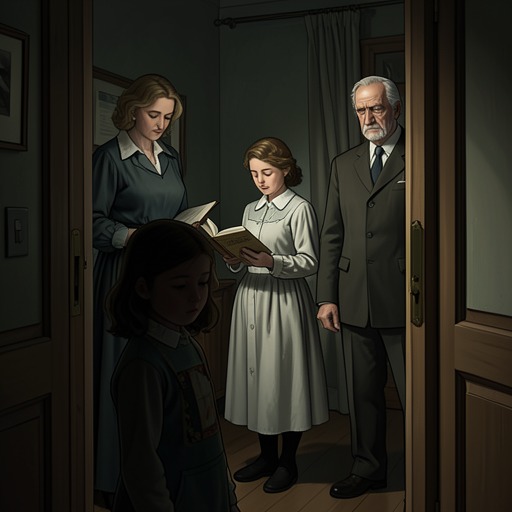
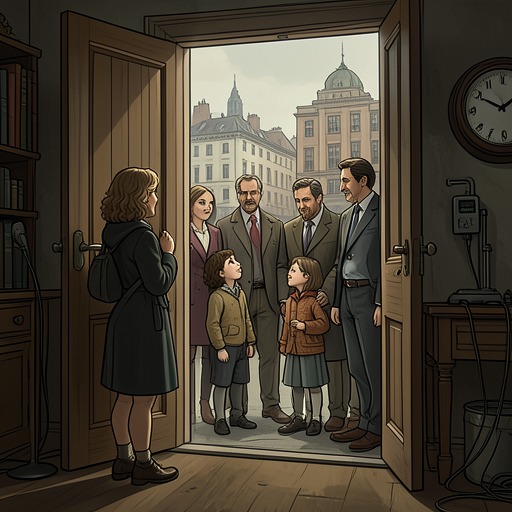
When Liesel arrives in Molching, Hans Hubermann and Rosa Hubermann are waiting on Himmel Street. They had expected both a girl and a boy and were to receive a small allowance for taking them in. Instead, only Liesel arrives, and nobody wants to be the person who tells Rosa that the boy did not survive the trip. Rosa has a difficult disposition, although she has previously had a good record with foster children and has managed to straighten some of them out. Liesel therefore enters a household prepared for two children but forced immediately to absorb one child’s death.
The setting itself carries an ironic pressure. Himmel means heaven, but Himmel Street is neither a living hell nor heaven. Liesel’s arrival there places her in a home whose name suggests salvation while its reality remains poor, tense, and historically dangerous. The foster household is not an uncomplicated refuge; it is a place where care, discipline, scarcity, and eventual intimacy must coexist.
A Child Marked by Loss and Stigma
Liesel reaches the Hubermanns physically undernourished, with wirelike shins, thin arms, snow-marked hands, and frosty blood on her fingers. Her body records the hardship of the journey and the poverty from which she has been removed. Even her smile is described as starving, so that the promise of rescue is inseparable from the visible evidence of deprivation.
Her appearance also exposes her to the racial and political rules of Nazi Germany. Her hair is sufficiently German blond, but her eyes are dark brown, a dangerous difference in that period. She cannot know whether she inherited them from her father because she cannot remember him. What she does know is a label associated with him: “Communist.” The word follows her through boardinghouses and family explanations as an ominous presence she can sense but cannot spell or understand. A healthier woman once tries to teach the children to write with charcoal on a wall, but the woman is taken away for questioning and never returns, reinforcing the danger surrounding knowledge, family history, and political identity.
Liesel’s later understanding joins these fragments into a devastating equation: the word communist, a large bonfire, dead letters, her mother’s suffering, and Werner’s death become connected with the Führer. Her foster-child status is thus shaped not only by domestic displacement but also by a national system that turns family labels into threats. She is a poor, bereaved child entering a household within a society that classifies people before it sees them as individuals.
Belonging Through Shared Suffering
The foster arrangement gradually becomes more than an economic transaction. Liesel’s life with the Hubermanns develops through repeated encounters with grief, fear, and the effort to give suffering a form. Her similarity with Max Vandenburg is especially important: at night, each dreams nightmares in a separate room, Liesel waking with a scream in drowning sheets while Max gasps for air beside a smoking fire. Hans notices that Max dreams like Liesel, and Liesel recognizes his anxiety through the history he has told her. The foster home consequently becomes a place where two displaced children can recognize one another through bodily terror before either can fully master the language of trauma.
That shared atmosphere also connects Liesel to the larger violence outside the house. In Munich Street, she and Hans watch Jewish prisoners being driven along the road. The prisoners appear starved and exhausted, their bones seeming like smoke and their souls trailing behind them, while soldiers force them into brief, stumbling runs before they return to a malnourished walk. Liesel’s position as a foster child does not isolate her from history; it places her close enough to witness how the state treats other uprooted people, including those whose suffering intersects with Max’s hidden life and Hans’s moral choices.
Memory, Writing, and the Meaning of Home
Liesel’s foster-child identity remains active in memory even after the immediate shock of placement has receded. At the Amper River bridge, where Hans used to stand and lean, she finally releases the burden of Werner’s death. That night, Werner appears only before she closes her eyes; in her visions, Hans, Max, Rudy Steiner, and her mother also occupy the room, while Werner plays in cemetery snow. The dead and the living form a single remembered company, showing that foster care has not replaced Liesel’s first family but has become entangled with its absence.
The household ultimately gives her the conditions in which she can convert displacement into authorship. Ilsa Hermann gives Liesel a book and, through it, a reason to spend time in the basement, first with Hans and then with Max. The basement becomes a space where reading, companionship, and writing can coexist. One night, while Mama and Papa sleep, Liesel carries a kerosene lamp downstairs and stares at pencil and paper for an hour before forcing herself to remember. After more than two hours, she begins writing her story, uncertain how to make it right. The foster child who once arrived unable to accept why her mother had left her now finds a way to preserve the people and losses that made her life possible. Her placement therefore becomes the starting point of a difficult transformation: from being handed over to others, to possessing words with which to tell what happened.