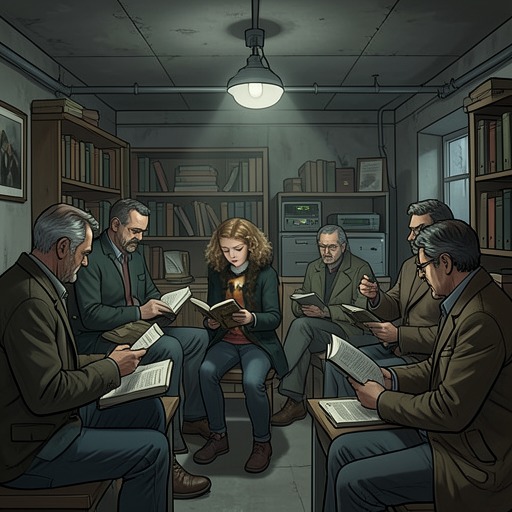
Liesel’s reading in the air-raid shelter
The Book ThiefLiesel’s reading in the air-raid shelter is one of the clearest instances in which language becomes a practical form of courage. During a raid threatening Molching, twenty-two people are compressed into the Fiedlers’ deep basement, where fear, noise, bodily discomfort, and the expectation of impact make ordinary speech almost useless. Liesel’s decision to read The Whistler aloud changes the social atmosphere of the shelter: the danger remains, but the people inside it acquire a common focus, and a frightened girl becomes the source of collective steadiness.
Causes and Setting
The reading occurs during the next raid after an earlier shelter gathering. A radio announcement identifies Molching as a possible target, sending Himmel Street into motion. People stream toward the Fiedlers’ basement six houses away, and Hans Hubermann once again leaves his accordion behind, refusing Rosa Hubermann’s reminder that he should take it because he had not taken it during the previous raid and had survived. The choice exposes how war has blurred the boundary between practical logic and superstition: even a familiar object associated with Hans’s identity and comfort becomes entangled with the rituals of survival.
The Fiedlers’ basement is deep enough to serve as a refuge, but it is far from comfortable or secure. Twenty-two people crowd into it, including the Steiner family, Frau Holtzapfel, Pfiffikus, a young man, and the Jenson family. Rosa Hubermann and Frau Holtzapfel are deliberately kept apart to prevent their ordinary quarrels from worsening the conditions, although the emergency places even long-standing resentments beneath a larger necessity. A single light globe hangs from the ceiling; the room is dank and cold, and jagged walls press into the bodies of those standing there. Sirens reach the basement in muffled, distorted form, and the three signals that will announce the raid’s end are both reassuring and frightening because safety depends on hearing them.
The Reading Begins
As the raid intensifies, the shelter becomes a physical and vocal struggle. Children cry, arms and elbows compete for space, and adults attempt to calm infants while failing to calm themselves. Frau Holtzapfel’s demand that someone silence a child disappears into the general chaos. The room is filled with the smells of night breath, sweat, and worn clothing, a human cauldron in which apprehension is shared but not easily controlled. Even Rudy Steiner stands rigidly, pretending not to be afraid.
Liesel is so tightly pressed against Rosa that she must call out to her mother and complain that Rosa is squashing her hand. When Rosa releases her, Liesel reaches for the book at the top of her pile. She opens The Whistler and begins to read aloud, partly to shut out the din and partly to give herself something deliberate to do. At first the opening paragraph barely registers in her own ears. Rosa calls back to ask what she has said, but Liesel ignores the interruption and keeps her attention on the first page. The act begins privately, as an attempt at concentration, before it becomes a public act of assistance.
From Individual Focus to Collective Silence
Rudy is the first to recognize what is happening. When Liesel reaches the second page, he watches her directly, taps his brother and sisters, and signals them to listen. Hans Hubermann then comes closer and calls out, and the effect spreads through the basement. By the third page, everyone is silent except Liesel. The transformation is not produced by an order from an official or by the arrival of a Luftschutzwart; it arises from the attention that the children and Hans help organize around her voice.
The reading does not falsify the danger. Everyone still waits for the ground to shake, and the immutable possibility of destruction remains in the room. Yet Liesel’s voice gives the frightened people a sequence to follow: page after page, sentence after sentence, the shelter’s inhabitants listen instead of scattering their attention across every cry and imagined impact. The turning of a page divides the noise, and the words become a temporary structure inside the unstable basement. Liesel does not need to dramatize the performance or accelerate it. She continues with the ordinary rhythm of reading, allowing the plain act itself to carry the group.
When one of the younger boys seems ready to begin crying again, Liesel imitates Hans or Rudy, winks at him, and resumes. The gesture shows that her authority is not abstract. She draws on the familiar behavior of the people around her and returns it to them in a form that can steady someone else. Only the sirens announcing renewed safety interrupt her. Mr. Jenson says that they are safe, but Frau Holtzapfel immediately tells him to be quiet. Liesel looks up only long enough to explain that two paragraphs remain before the end of the chapter, then continues without fanfare or increased speed. The shelter’s attention stays with the book until she has finished the immediate task she has set herself.
Consequences and Significance
The immediate consequence is emotional rather than military: Liesel’s reading cannot stop the raid, strengthen the basement, or guarantee survival, but it reduces the isolation of fear. The people listen together, and that shared listening briefly turns a packed refuge into a community. The event demonstrates that social resilience can emerge from small practices—bringing books, recognizing a child’s voice, tapping family members to listen, and protecting concentration—within an infrastructure that remains inadequate and frightening.
The scene also deepens Liesel’s development as a reader. Earlier, books are tied to grief, theft, instruction, and the difficult acquisition of literacy. Here, reading becomes something she can give to others. She is still afraid, but she converts fear into a controlled sequence of spoken words. The book is therefore neither an escape that erases history nor a decorative possession. It is an instrument through which Liesel witnesses the frightened people around her and helps them endure the interval before the sirens confirm that the danger has passed.
The episode’s wider meaning is reinforced by the novel’s later memory of Rosa Hubermann. In the retrospective account, Rosa is remembered as a woman whose harsh language concealed a large heart, a woman who fed a Jewish man on his first night in Molching and reached deep into a mattress to deliver a sketchbook to a teenage girl. Against that background, the shelter reading belongs to the same pattern of concealed care: amid war, poverty, and terror, ordinary objects and gestures carry moral weight. Hans’s absent accordion, Liesel’s open book, Rudy’s signal to the children, and the demanded silence all show people making fragile forms of order inside danger. The reading’s decisive achievement is not that it makes the basement safe, but that it makes the endangered people present to one another.