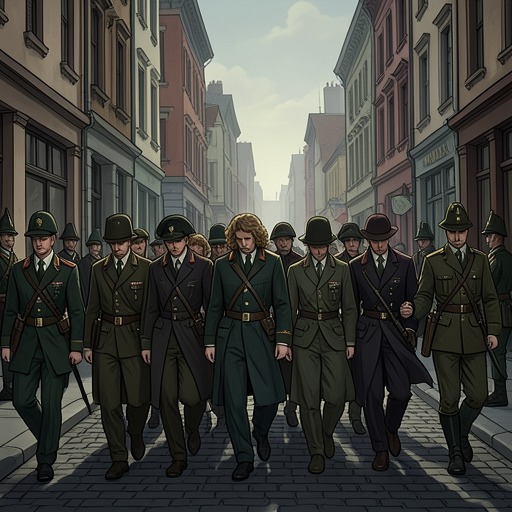
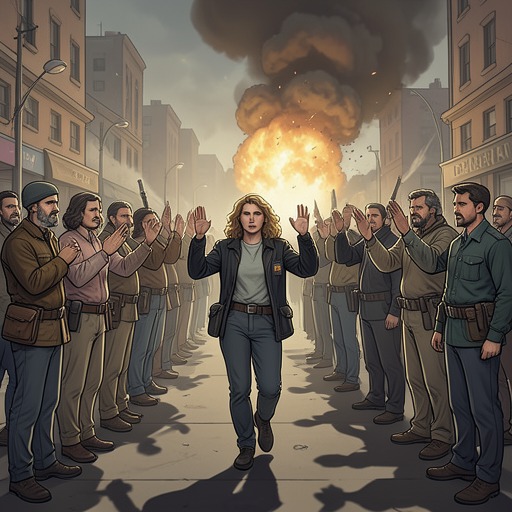
Liesel’s reunion with Max in the parade
The Book ThiefLiesel’s reunion with Max in the parade transforms a passing column of prisoners into a crisis of recognition, responsibility, and physical courage. Amid the dying eyes, scuffing feet, and ragged uniforms of the Jewish prisoners, Liesel recognizes Max not by ordinary facial resemblance but by the purposeful way he studies the German spectators. She enters the procession to reach him, and the reunion becomes inseparable from the punishment imposed by the soldiers who guard it.
Recognition Within the Prisoner Column
Liesel searches the crowd of prisoners and initially finds no simple visual sign by which to identify Max. What distinguishes him is the behavior of his face: he is fixed in concentration and looks directly into the German spectators, examining them with purpose. His gaze breaks the anonymity of the procession. People near Liesel notice that he is looking outward and point him out, but Liesel understands the look personally. Max is not merely scanning the crowd; he is searching for her.
The recognition is therefore reciprocal before it becomes verbal. Liesel steps onto the road, treating the movement of the prisoners and the watching crowd as a barrier she must cross. The narration emphasizes the bodily cost of this decision: movement becomes a burden, and her adolescent heart feels unusually definite and large. She identifies herself as the person Max is looking for, then has to recover her voice before calling his name. The repeated call of “Max” makes recognition an act rather than a private realization.
Entering the Parade
Once she has found him, Liesel turns away from the crowd and enters the tide of Jewish prisoners, weaving through them until she can seize Max’s arm with her left hand. The gesture places her inside the same physical danger as the man she has recognized. Max’s face falls toward her, and when she trips, he reaches down to help her up despite his weakness. His assistance is so strenuous that it reveals the condition of his body: he is starving, exhausted, and still trying to protect her even within the procession that has reduced him to hunger and motion.
Max responds with disbelief and grief. He tells Liesel how much she has grown and explains that the authorities captured him months earlier, halfway to Stuttgart. His speech is impaired by suffering, yet it continues toward her. He warns her to let go, even trying to push her away, because he understands the danger more clearly than she does. Liesel refuses to release him. Max’s starving arms cannot move her, and she continues walking beside him through the filth, hunger, and confusion of the column.
Loyalty Against Military Force
The reunion lasts only until the first soldier notices Liesel. He calls to her, points with his whip, and orders her to leave the prisoners. She ignores him. The soldier then forces his way through the people, separating bodies with his arm as he approaches. His authority is expressed not through argument but through the physical control of the crowd, and his looming presence turns Liesel’s refusal into an immediate confrontation.
Liesel sees fear in Max’s face of a kind she has never seen before. The encounter thus reverses the emotional balance between them: she acts from attachment and urgency, while Max, already familiar with persecution, recognizes the consequences that may follow. When the soldier grabs her by the hair and pulls her away, Liesel still tries to hold on. The moment is not a successful rescue; it is a refusal to let the machinery of persecution erase their relationship without resistance.
Shared Witness and Punishment
After Liesel is separated, Max confirms his identity through touch and speech. He kisses her palm, holds her hand against his face, and cries onto her fingers while the soldiers arrive. His gesture makes the reunion intimate but also publicly visible. A small group of Jewish prisoners watches, and the spectators are forced to witness a bond that the authorities have tried to destroy through capture, confinement, and forced removal.
The consequence is immediate violence. Max is beaten while standing, and Liesel weeps his name as she is dragged away. The scene offers no safe embrace and no completed return to ordinary life. Instead, recognition leads directly to punishment: Liesel’s loyalty brings her into the procession, Max’s response confirms their connection, and the soldiers answer that connection with the whip. The reunion’s emotional fulfillment and its physical devastation occur in the same sequence.
Narrative and Thematic Significance
The event concentrates the larger conflict between human recognition and systems that reduce people to categories. Max appears within a mass of dying prisoners, but the purpose in his gaze restores his individuality before Liesel reaches him. Liesel’s response similarly refuses the distance expected of a German spectator. She does not remain safely among the observers; she crosses into the prisoners’ stream and accepts the danger of being seen with him.
The scene also makes witnessing reciprocal. Max looks for Liesel, Liesel identifies Max, nearby people point him out, soldiers observe and intervene, and the prisoners watch the punishment. No one can fully control what the others see. Against the spectacle of persecution, the reunion creates a smaller counter-scene in which a name, a hand, and a face carry more meaning than the official categories imposed upon the prisoners. Its ending is painful precisely because the recognition succeeds: Liesel finds Max, Max knows her, and that recovered connection survives even though the soldiers forcibly separate them.