Max Vandenburg
The Book ThiefMax Vandenburg is introduced as a starving Jewish man hidden in a small black room, but his significance quickly exceeds that of a protected fugitive. He carries the violence of Nazi Germany in his body, history, and enforced silence, yet he also brings friendship, stories, humor, and an alternative use of words into the Hubermann household. His arrival connects Liesel Meminger’s private losses to the public machinery of persecution: the label attached to her absent father, the bonfire of books, Hitler’s Mein Kampf, and the suffering of Jews become part of one increasingly intelligible political pattern.
Identity and Background
Max Vandenburg was born in 1916 and grew up in Stuttgart. Before becoming a hunted Jew, he was known as a fighter. He fought Walter Kugler thirteen times over several years, losing the overall record 10–3, while Walter continued to seek revenge for Max’s first victory and Max tried to reproduce the glory of that original triumph. Their rivalry eventually changed into genuine friendship, and they stopped fighting by 1933, when both were seventeen. The history matters because it gives Max an identity formed through physical courage and companionship before Nazi policy reduced him to a persecuted category.
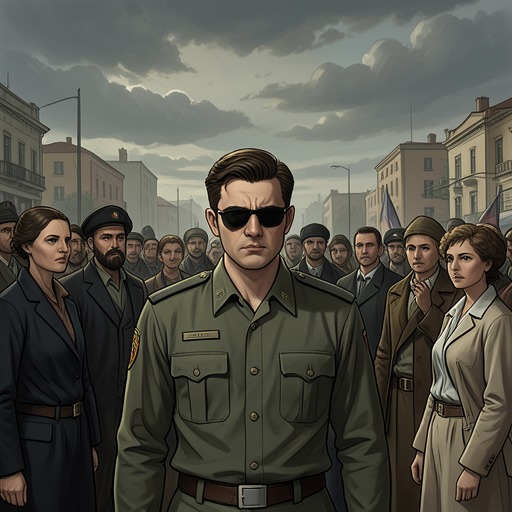
That reduction became materially real after the Nuremberg Laws forbade Jews from holding German citizenship and from marrying Germans. Max was dismissed, along with other Jews, from the Jedermann Engineering Factory in 1935. When Walter saw the star on Max’s sleeve, he recognized that the old world of ordinary fights had been replaced by a world in which the state regulated belonging. Max’s reply—that marriage to a Jew was forbidden but fighting one was not—preserves his characteristic defiance, but it also exposes the shrinking space in which such defiance can operate.
Max’s Jewish identity also intersects with Liesel’s incomplete understanding of her own past. Liesel cannot remember her father; the only thing she knows is a label she does not understand: “Kommunist.” Later, the word communist, the bonfire, the dead letters, her mother’s suffering, and her brother’s death combine in her mind into an accusation directed toward the Führer. Max therefore enters a consciousness already prepared to connect personal grief with political persecution, even though Liesel does not yet possess the language to explain the connection.
Arrival and Hidden Life
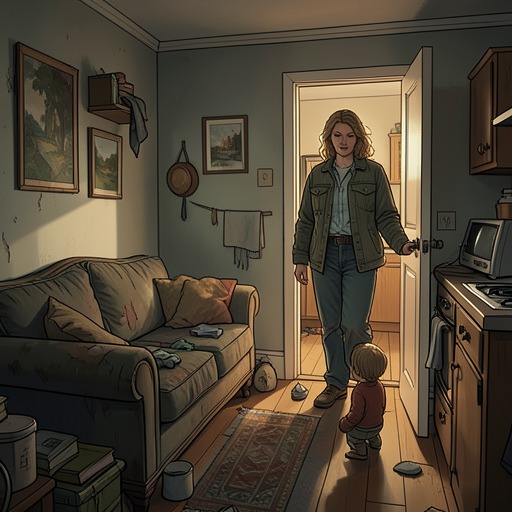
In November 1940, Max arrived in the kitchen of 33 Himmel Street at the age of twenty-four. His clothes seemed to weigh him down, and his exhaustion was so profound that even an itch could nearly break him; he stood shaking and shaken in the doorway. His arrival turns the house into a site of acute danger. A Jew appearing at a residence in the birthplace of Nazism could provoke anxiety, disbelief, paranoia, and fear of a catastrophic consequence, yet the Hubermanns resist hysteria. Rosa Hubermann orders Liesel away in a calm but firm voice, treating secrecy itself as an immediate household duty.
Max’s safety depends on the family’s ability to make an extraordinary situation look ordinary. Hans Hubermann must continue playing his accordion several times a week because the household needs the money and because stopping would arouse suspicion. The family’s life has altered radically, but everyone must behave as though nothing has happened. Max’s hiding thus creates a double existence: the basement contains the truth, while the street demands a performance of normality. The danger is not confined to the hidden man; it reorganizes the gestures, schedules, speech, and emotional discipline of everyone protecting him.
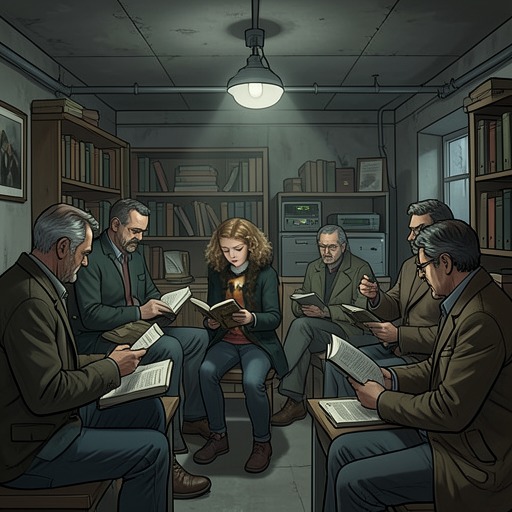
His awakening in the basement captures the bodily reality of this condition. A door opens and closes, a figure crouches over him, and a voice whispers his name: “Max, wake up.” His eyes do not spring open as they would from an ordinary bad dream; they drag themselves from darkness into dimness because he is waking into an ongoing nightmare. The scene makes his persecution physical before it becomes explanatory. Fear appears as cold clothing, exhausted movement, and a body that reacts before consciousness can organize what is happening.
Writing and Relationship with Liesel
Max’s relationship with Liesel develops through words, observation, and the shared recognition of suffering. While he is hidden, he becomes not merely someone Liesel visits but someone who teaches her that language can be remade against the power that has used it to classify and destroy. His most concrete act of imaginative resistance is the creation of The Standover Man. He cuts pages from Mein Kampf, paints over them in white, hangs them across the basement to dry, and writes on the bubbled, misshapen paper with a small black paintbrush.
The process is painstaking. Max calculates that he needs thirteen pages, paints forty because he expects repeated mistakes, and practices his artwork on pages from the Molching Express. He is educated enough to manage the task but does not regard himself as a writer or artist; he forms the sentences in his head until he can recite them without error before committing them to paper. Liesel contributes to the making of the story through a remembered description of hair like feathers. When the work is complete, Max pierces the pages with a knife and binds them with string into a thirteen-page booklet.
The material transformation of Mein Kampf is crucial. A book associated with Hitler’s ideology becomes the surface on which Max writes a counter-story. The pages are not destroyed; they are overwritten. In the hidden basement, the instrument of political domination is made to carry an intimate account of friendship, fear, and the figure who stands over another person. Max’s authorship does not erase the danger represented by the original book, but it refuses to let that book possess the final meaning of words.
Liesel’s presence gives Max a relationship beyond the official categories imposed upon him. Her reading and listening create a form of companionship that neither requires him to deny his vulnerability nor confines him to it. The story’s later question of when books and words began to mean everything to Liesel remains deliberately unresolved: it might have begun with the shelves of books, with Max’s arrival carrying suffering and Mein Kampf, with reading in air-raid shelters, with the Dachau parade, or with The Word Shaker. Max is therefore not one isolated influence among many; he is central to the chain through which Liesel’s literacy becomes moral and emotional understanding.
Danger, Separation, and Return
Max’s hiding imposes an unbearable contradiction on the Hubermann family. They must shelter a man whose presence could bring death while continuing to work, speak, and move through the world without visible alteration. The pressure culminates when a seven-punch knock strikes the door of 33 Himmel Street and it is too late to move anyone anywhere. The sound turns secrecy into immediate exposure. The boundary between the protected basement and the public world can no longer be trusted to hold.
The danger later expands beyond the house. During an air-raid evacuation, sirens send people from their homes into the streets, carrying babies, photographs, boxes, and other precious possessions. Liesel carries her books between her arm and ribs, while Hans returns for Frau Holtzapfel’s heavy suitcase after realizing he has forgotten even his accordion. The scene places Max’s hidden existence within a wider landscape of wartime displacement: everyone is forced to carry what matters, but Max has already become someone whose very body must be concealed.
Max is eventually encountered again during the passage of Jewish prisoners through Munich Street. The prisoners come down the road in a catalog of colors, pushed by soldiers, their starving eyes enormous in their skulls and dirt molded to their bodies. Hans watches above the crowd, while Liesel looks through gaps and over shoulders. This public procession reveals the scale of the system that had previously appeared inside one basement. The hidden man is no longer only a private risk; he belongs to a mass of people being driven toward death.
In August 1943, Liesel calls out, “Max, I’m here!” He hears her. The recognition restores their personal relationship within a scene designed to erase individuality. The details Liesel notices—twigs of hair and the swampy eyes she remembers—make reunion depend on bodily memory rather than official identity. Max’s return to the narrative therefore converts the persecuted crowd back into a person, while Liesel’s cry asserts that he remains known and addressed despite the machinery attempting to make him anonymous.
Narrative and Thematic Significance
Max embodies the collision between imposed identity and chosen relation. Nazi ideology classifies him as a Jew and strips him of citizenship, employment, safety, and movement; the Hubermann household instead recognizes him as a friend, a fighter, a guest, and a maker of stories. Alex Steiner’s contradictory politics—membership in the Nazi Party without hatred of Jews—shows how public affiliation and private belief can coexist uneasily, but Max’s presence tests whether such private distinctions can produce action. The Hubermanns’ decision to shelter him demonstrates that sympathy becomes meaningful only when it accepts material danger.
His character also gives the novel a distinctive image of resistance. Max does not resist by defeating the state in open combat. He survives through concealment, endurance, remembered friendship, and the transformation of confiscated language. His Jewish fist-fighting history supplies one form of resistance, while The Standover Man supplies another: the first uses the body against an opponent, the second uses narrative against an ideology. Both are attempts to preserve agency when political power insists that Max is only a target.
For Liesel, Max is the person through whom private reading becomes an encounter with another person’s vulnerability. His arrival deepens the meaning of the books she steals or reads, and his story-making demonstrates that words can wound, manipulate, shelter, and oppose. Max’s importance finally lies in this paradox: he is physically reduced by persecution, yet his presence enlarges the moral and imaginative world of 33 Himmel Street. In a novel where the persecuted are repeatedly converted into a faceless procession, Max remains a singular human being whose friendship, fear, and words cannot be fully absorbed by the categories imposed upon him.