Molching
The Book ThiefMolching is the town beyond the outskirts of Munich to which Liesel Meminger is taken after the chaotic farewell to her mother. It becomes the governing setting of her new life: a place of foster care, poverty, childhood friendship, political spectacle, and public violence. The town’s apparent ordinariness makes its transformation especially revealing, because the same streets that host soccer games and domestic routines also become routes for racialized exclusion and the forced passage of starving prisoners.
Setting and Arrival
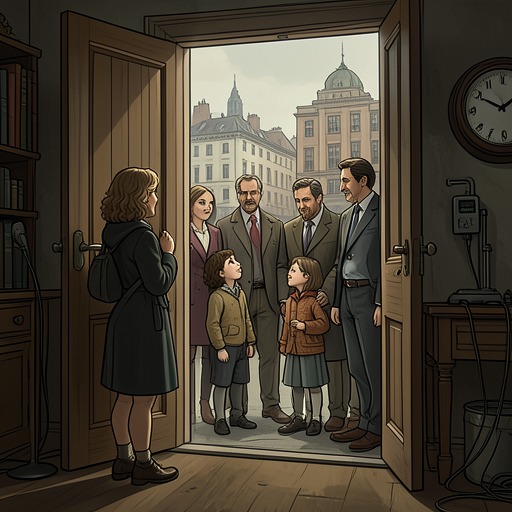
Molching is introduced as a town whose name is pronounced, in the narrator’s playful rendering, like “Molking.” Liesel is transported there after her mother’s wet, desperate goodbye, and the destination is identified through Himmel Street, where her foster parents are waiting. The journey marks a decisive break: she leaves the known world of her mother and enters a town whose social order she does not yet understand.
The Hubermanns are expecting both a girl and a boy and are to receive a small allowance for fostering them, but Liesel’s brother has died during the trip. The arrangement therefore begins under the pressure of an absence that no one wants to explain to Rosa Hubermann. For Liesel, Molching is also associated with unfamiliar modernity: the ride is taken by car, something she has never experienced before. Her arrival is physically marked by cold and deprivation. She has snow-bite marks on her hands, frosty blood on her fingers, an undernourished body, wirelike shins, and coat-hanger arms. The town receives her not as a secure homecoming but as the next location in a forced displacement.
Social Landscape
Molching is a poor town despite the apparent rise of Germany’s economy under Adolf Hitler. The existence of poor quarters exposes the gap between official national optimism and the material conditions of ordinary residents. Himmel Street, where the Hubermanns live, is consequently a compact social world shaped by scarcity. Children generally remain outdoors because their homes are small and contain very little; soccer is played in the street, with garbage cans serving as goalposts.
This setting brings Liesel into contact with the Steiner family next door. The Steiners have six children, including Rudy Steiner, who soon becomes Liesel’s best friend, later her partner in theft, and at times a catalyst for her actions. Their friendship begins in the public space of the street, where children form relationships regardless of weather or domestic limitations. Molching’s street life thus provides both a symptom of poverty and the conditions for durable human connection.
The town also contains people whose positions expose different forms of social contradiction. Alex Steiner is a member of the Nazi Party, yet he does not hate Jews or anyone else. His political affiliation therefore does not map neatly onto private feeling. The contrast between institutional membership and personal conduct becomes part of Molching’s broader moral pattern: public identity is increasingly governed by compulsory categories, while individual relationships remain more complicated than those categories allow.
Political Spectacle and Exclusion
In 1940, Molching is absorbed in preparations for Hitler’s birthday. Because the war is developing and Adolf Hitler is considered victorious, local Nazi partisans plan a particularly impressive celebration, complete with a parade, marching, music, singing, and a fire. While Liesel walks through the town collecting and delivering washing and ironing, party members gather fuel and knock on doors seeking newspapers, posters, books, flags, and enemy propaganda to destroy.
The Molching Express announces that the celebratory fire will take place in the town square and will be attended by all local Hitler Youth divisions. It is presented as a commemoration not only of Hitler’s birthday but also of victory over enemies and over the restraints that had supposedly held Germany back since the end of World War I. Even Schiller Strasse, described as the road of yellow stars, is ransacked for material that can be burned in the Führer’s glory. Molching’s public ritual therefore turns destruction into celebration and makes ideological obedience visible as a community event.
For Liesel, the political meaning of the town’s spectacle gradually becomes legible through accumulation rather than immediate explanation. The word “communist,” her mother’s suffering, the death of her brother, a collection of dead letters, and the great bonfire combine into an understanding that the Führer is connected to the losses shaping her life. Molching is where private grief begins to acquire a political cause. The town’s ceremonies teach her that national power does not remain abstract; it enters family memory, public language, and the fate of children.
The Prisoner Parade
Molching later becomes a site where persecution is made visible in the street. A collection of Jews and other prisoners has already been forced past the townspeople. Although the death camps may be kept secret, the population is sometimes shown the supposed glory of a labor camp such as Dachau. The town’s public space becomes a threshold between concealment and revelation: residents may not know the full machinery of extermination, but they can see bodies being degraded and driven through their midst.
On Munich Street, Liesel and Rudy watch as the prisoners come down the road. The narrator describes them as a catalog of colors, while emphasizing that many will die. Their bones appear smoke-like, their souls seem to trail behind them, and their starving faces are marked by enormous eyes and dirt molded to their bodies. Soldiers’ hands force them into brief, unsteady runs before they return to a malnourished walk. The passage is not merely a background event in Molching; it changes the ethical character of the town by making its inhabitants witnesses to organized suffering.
Hans Hubermann sees the prisoners above the heads of the crowd, while Liesel looks through gaps and over shoulders. Farther along the road, she recognizes her father with his paint cart. His presence links the persecuted procession to her own household and makes the town’s violence intimate. Molching is therefore not only where Liesel begins again; it is where the political order repeatedly crosses the doorstep of the family that shelters her, compelling recognition of what public ideology does to individual bodies.
Narrative Significance
Molching functions as a compressed model of Germany under Nazism. It contains poverty beneath claims of economic progress, private decency alongside party membership, childhood play alongside forced displacement, and festive civic ceremony alongside the humiliation of Jews. Its name initially suggests a place Liesel must simply reach, but the town becomes a moral landscape whose streets continually test the difference between belonging and exclusion.
The setting also supports the novel’s movement from innocence toward historical awareness. Liesel arrives unable to interpret the label attached to her father and unable to understand why her family has been broken apart. In Molching, words, rituals, signs, and public actions gradually assemble an explanation. The town’s fires, streets, crowds, and parades teach her that violence can be institutional, communal, and theatrical at once. Yet the same local world produces friendship and acts of personal recognition, preventing Molching from becoming a simple symbol of collective evil. Its decisive significance lies in that contradiction: the town shows how ordinary places can accommodate tenderness and persecution simultaneously, and how moral choices emerge within, rather than outside, the structures of everyday life.