Nazi Germany
The Book ThiefNazi Germany is the political order that transforms ordinary life into a machinery of belonging and exclusion. In Molching, its authority appears through flags, uniforms, songs, party membership, public ceremonies, racial law, military expansion, and the threat of punishment. The regime demands visible conformity while making private compassion dangerous, so that a household’s missing flag, a child’s gesture, or a hidden man can become a matter of survival.
Ideology in the Street
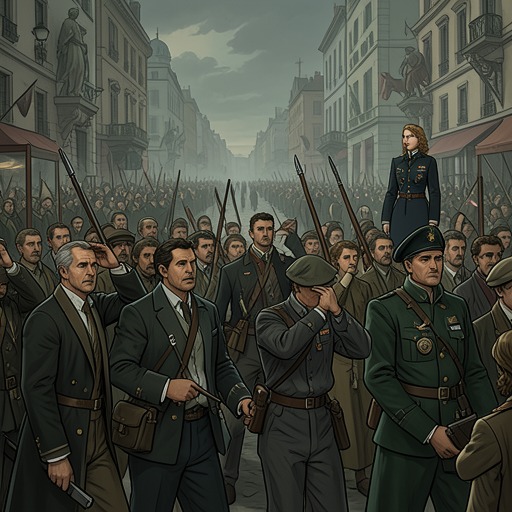
Nazi Germany makes nationalism a daily performance. In late May 1939, brownshirted members of the Nazi Party marched down Munich Street beneath banners, singing “Deutschland über Alles.” The parade presented political doctrine as communal celebration: the street became a stage on which uniforms, music, flags, and raised voices manufactured the appearance of a single, enthusiastic people.
The same pressure filled Molching in preparation for Hitler’s Birthday in 1940. Party supporters planned marching, music, singing, and a fire, while residents were asked to surrender newspapers, posters, books, flags, and alleged enemy propaganda for destruction. Even Schiller Strasse, associated with yellow stars, was searched for material that could be burned. The campaign joined celebration to purification, defining loyalty not only by what citizens displayed but also by what they were required to erase.
Every window in Molching was expected to carry the regime’s emblem. At Frau Diller’s, the glass was washed until the swastika shone against red and white; elsewhere, the flag hung from a ledge like laundry. When the Hubermanns could not find their own flag, Rosa Hubermann warned that officials might come and take them away. It was eventually discovered behind Hans Hubermann’s accordion, but the incident exposes the regime’s method: a household could be endangered by the absence of a small public sign.
Ritual, War, and Political Belonging
The regime’s ceremonies turn obedience into bodily routine. At the Molching celebration, the crowd was surrounded by Nazi flags and uniforms and pressed into a shared physical rhythm. A brown-uniformed speaker requested silence, began with “Heil Hitler!”, and followed the words with the salute to the Führer. The formula is brief, but its repetition makes political allegiance visible, synchronized, and difficult to refuse.
This nationalism is linked to war and triumph. In 1936, the Olympics were presented as Hitler’s games, even as Jesse Owens won four gold medals and racist claims about his supposed inferiority were exposed by his performance. By September to November 1939, World War Two had begun. The chronology places international aggression beside the local world of schoolyard games, showing how quickly the political order extends from spectacle into history-changing violence.
The regime also sorts people through labels. Liesel Meminger knows almost nothing about her father except a word she cannot understand: “Kommunist.” That unexplained designation connects family loss to political persecution before she possesses the knowledge to interpret it. Later, when she adds the word communist to a bonfire, dead letters, her mother’s suffering, and her brother’s death, the Führer becomes the figure behind a chain of grief. Political power is therefore experienced not only through speeches, but through the gaps it creates in a child’s biography.
Law, Race, and Exclusion
Nazi Germany gives prejudice an administrative form. Max Vandenburg and Walter Kugler had once fought repeatedly as boys, eventually developing genuine friendship. Their world changed when Jews were dismissed from the Jedermann Engineering Factory in 1935, shortly after the Nuremberg Laws forbade Jews from holding German citizenship and prohibited marriage between Germans and Jews. The law converts an old friendship and a shared workplace into a relationship constrained by racial classification.
Walter’s slap at the star on Max’s sleeve and Max’s reply that there was no law against fighting a Jew reveal the narrowing of permitted human contact. Their joking exchange carries the pressure of a society in which Jewish identity has become a legal and public mark. Friendship survives, but it survives against an order designed to make ordinary equality impossible.
The consequences of that order are visible in the Jewish prisoners forced through Munich Street. They appear as a procession of starving bodies in ragged uniforms, with enormous eyes, dirt molded to their skin, and legs staggering under soldiers’ hands. The crowd witnesses them, while soldiers control their movement. Nazi Germany’s categories thus become physical: exclusion is translated into hunger, forced running, exhaustion, and the reduction of people to a mass to be driven along a road.
Surveillance and Complicity
The regime governs through fear as well as belief. When Hans Hubermann discovers the danger surrounding the hidden Max Vandenburg, he gives Liesel a list of consequences if she tells anyone, including her teacher and Rudy Steiner. The warning shows how Nazi Germany reorganizes trust inside a family: protecting a persecuted person requires secrecy, while an accidental disclosure could expose the entire household.
Alex Steiner offers a different form of contradiction. He is a member of the Nazi Party, yet he does not hate Jews or anyone else. His membership demonstrates that political conformity does not always equal complete private conviction, but it also shows how participation can coexist with moral hesitation. Nazi Germany leaves room for private contradiction while demanding public alignment; the gap between the two becomes one of the regime’s central pressures.
Hans Hubermann’s punishment after Max’s discovery illustrates the same system. His immediate punishment is conscience, expressed through his silence, neglected accordion, and wounded optimism. Then an official letter arrives announcing that his application to join the NSDAP has been approved. What appears to be good news is inseparable from danger and coercion: party membership becomes the price of remaining useful, acceptable, and perhaps safe after his act of compassion has drawn attention.
War and the Production of Death
By 1942, the narrator’s account of war widens from Himmel Street to Poland, Russia, Africa, and the cities destroyed by bombs, guns, and gas chambers. The regime’s violence is not confined to a single policy or battlefield. It produces bodies and displaced survivors, strips people of their homes, and brings the consequences of distant military and exterminatory operations back toward Himmel Street.
That return is most stark in the prisoner parade. On Munich Street, Hans and Liesel watch Jews being driven through the town, while the narrator identifies the procession as a passage of people many of whom will die. Max, once hidden in the Hubermann basement, is later encountered among these prisoners. Liesel enters the stream despite the soldier’s order to leave and struggles beside him until the soldier notices her. The encounter makes the regime’s violence personal and reverses the distance that public spectacle tries to preserve: the persecuted are no longer an anonymous category, but Max’s starving body and familiar voice.
Nazi Germany’s decisive significance lies in this movement between abstraction and intimacy. It names people, sorts them, celebrates their exclusion, and turns their suffering into a public display, yet its pressure is repeatedly answered by fragile private loyalties: a friendship across racial law, a family hiding Max, a child refusing to abandon him, and compassion that persists even when official language has declared some lives disposable.