Nazism
The Book ThiefNazism is the ideological and social order that reshapes everyday life in Germany around racial hierarchy, political obedience, militarized nationalism, and the persecution of those marked as enemies. In the novel, its decisive power lies in the way it turns language and ceremony into instruments of control: a salute, a flag, a radio proclamation, a school lesson, or a single stigmatizing word can organize public feeling and direct private conduct. At the same time, the story reveals the instability beneath that spectacle, showing individuals who comply outwardly, resist inwardly, or discover too late that participation has consequences for real human beings.
Ideology Made Ordinary
Nazism reaches Liesel Meminger before she can understand it. Her father is remembered through the unexplained label “Kommunist,” a word associated with dark rooms, suited men, and the suffering surrounding her childhood. When she later hears the word in a Nazi political speech, it connects her father’s disappearance, her mother’s distress, her brother’s death, and a bonfire of books to the Führer. The ideology therefore appears first as a vocabulary of loss: political categories are not distant concepts but labels attached to the people who have vanished from her life.
The regime also makes itself visible through national spectacle. In 1936, the Olympics are presented as Hitler’s games, while Jesse Owens’s four gold medals and the racist claim that he was subhuman expose the contradiction between Nazi racial doctrine and athletic achievement. Rudy Steiner is impressed by Owens rather than by the ideology meant to define him, and his later charcoal imitation of the runner turns an international sporting event into a private act of identification. The episode shows how Nazi nationalism tries to control the meaning of bodies while admiration crosses the boundary that propaganda establishes.
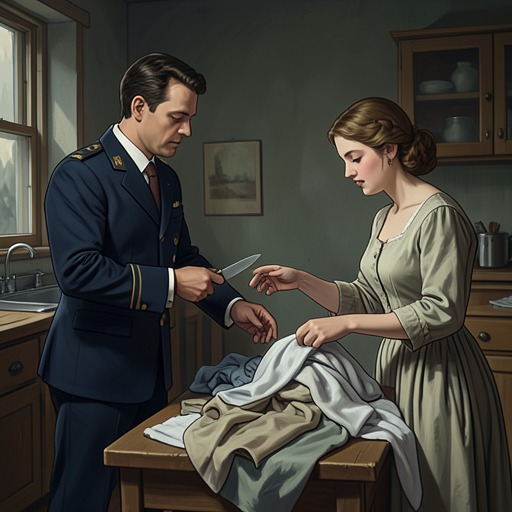
By the summer and autumn of 1939, the political order has fused with the rhythms of ordinary life. Liesel plays soccer, carries ironing with Mama, and learns words while World War Two begins. Radio headlines announce the invasion of Poland, rationing becomes official, and Munich Street fills with the sounds and smells of war. The war is presented through triumphant public language, including the Führer’s promise that Germany will not give up and will be victorious. The cheerfulness of the slogan stands against the material reality of scarcity, making propaganda a performance that must continually cover the costs of its own policies.
Ritual, Language, and Consent
Nazism produces belonging through repeated public forms. On the Führer’s birthday, the streets of Molching display flags in every window. Some flags are carefully presented, with Frau Diller’s window washed so that the swastika appears jewel-like; elsewhere, the fabric hangs as casually as laundry. Yet its presence is compulsory enough that the Hubermanns fear the authorities will come for them when their flag goes missing. They search for it until it is found behind Hans Hubermann’s accordion, an ordinary household object temporarily concealing a symbol whose absence may itself be treated as political evidence.
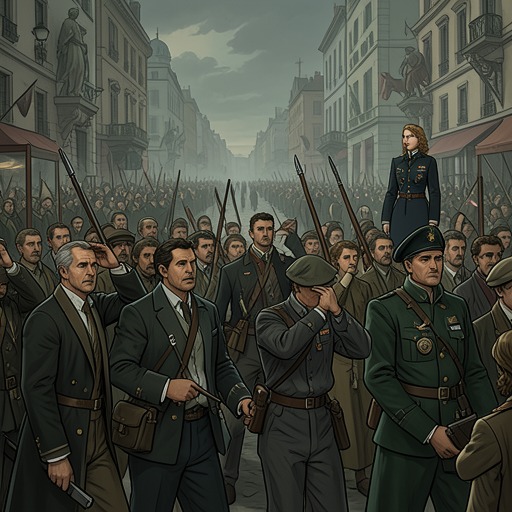
The public rally makes the same system more forceful. A crowd surrounded by Nazi flags and uniforms becomes a single collective body, one that breathes, sings, and waits for fire together. A uniformed speaker demands silence, opens with “Heil Hitler!”, and performs the salute to the Führer before declaring the day beautiful because it celebrates the leader and the defeat of enemies. His speech describes an alleged disease spread through Germany and names “The immoral! The Kommunisten!” and “Die Juden—the Jews!” as objects to be watched, hunted, and destroyed. The language converts political disagreement and Jewish identity into contamination, making violence sound like national hygiene.
The ritual continues beyond speeches. At the Hitler Youth training grounds, a march, an anthem, and “Heil Hitler” create a standardized sequence of bodily obedience. Such repetition helps make the ideology feel natural: patriotism is not merely believed but enacted through posture, song, uniform, and timing. The novel’s attention to these details shows how Nazism constructs an imagined national community by giving millions of people the same gestures and formulas, while excluding others from the community those gestures claim to represent.
The regime’s most ambitious weapon is language itself. The narrative imagines the Führer discovering that words can soothe a crying child and then deciding that he can rule the world with them rather than firing a gun. He plants words throughout his homeland, cultivates them, and watches forests of organized thought rise across Germany. This image explains why propaganda is more than decoration: words prepare perception before institutions enforce it. Once a population has been taught to see neighbors as disease, filth, or enemies, punishment can present itself as common sense.
Exclusion and Persecution
Nazism classifies people through labels that carry legal, social, and physical consequences. The Nuremberg Laws forbid Jews from holding German citizenship and from marrying Germans, turning racial ideology into formal regulation. Max Vandenburg loses his job at Jedermann Engineering Factory after Jews are dismissed, while the old friendship between Max and Walter Kugler survives only in altered form. The two men can no longer inhabit the world of their earlier fights as equals; the star on Max’s sleeve makes the new political order visible on his body, even as Walter insists that the law has not forbidden fighting a Jew.
Persecution also operates through public humiliation and street violence. When Hans Hubermann submits an application to join the Party in 1937, he witnesses four men attack Kleinmann’s Jewish clothing store. Bricks shatter the windows, a Jewish shopkeeper cleans glass from the floor, and a mustard-colored star and the words “JEWISH FILTH” mark the door. Hans asks whether the man needs help, an act that places personal fairness against the political pressure he has just tried to accommodate. The scene exposes the relation between official ideology and unofficial violence: the regime’s categories authorize ordinary men to make exclusion material.
The consequences eventually become impossible to contain within slogans. Jews are forced through Molching in a starving, dirt-covered procession, pushed by soldiers and driven into a malnourished walk. The crowd watches them as a catalog of colors, while the narrative identifies them as people who will die and describes their bones, souls, and exhausted bodies. Hans watches above the crowd, and Liesel looks through gaps between spectators. The parade reveals the endpoint of the categories proclaimed at rallies: the abstract enemy becomes a procession of identifiable human beings, and spectators become witnesses to a system that has converted citizens into prisoners.
By the later stages of the war, Germany is paying heavily for its aggression, yet there is no reduction in war-making or in the extermination and punishment of the supposed Jewish plague. Camps remain in Germany as well as across Europe, where people are made to work and walk. Max Vandenburg is one of those Jews subjected to this system. The language of contamination thus culminates in organized confinement, forced labor, movement under guard, and mass death; the ideology’s metaphors become institutions that act upon bodies.
Complicity, Contradiction, and Resistance
The novel does not present Nazism as a system sustained only by fanatics. Alex Steiner is a member of the Nazi Party, yet he does not hate Jews or anyone else. His position exposes the distance between institutional membership and private belief, while also showing how membership can coexist with passivity. Hans Hubermann, by contrast, does not join the Party when Hitler rises to power in 1933. He is neither highly educated nor overtly political, but he values fairness and remembers that a Jew once saved his life. He cannot join a party that antagonizes people in that way, and his Jewish customers provide another concrete connection that resists the regime’s attempt to reduce them to a category.
That decision has material costs. As persecution begins, Hans’s painting business loses Jewish customers and gradually dries up. By 1937, after years of pressure and the terror inflicted on Jews across Germany, he finally applies to join the Party. His submission is not presented as a conversion to hatred but as a fearful compromise made within a society where economic survival and political conformity are increasingly linked. Yet the same man who seeks protection through membership immediately encounters the human result of the system in the wrecked shop and offers assistance. Nazism therefore creates contradictory political lives: outward compliance may coexist with inward refusal, but neither cancels the danger produced by the other.
The ideology’s power is especially clear in the Hubermanns’ fear over a missing flag. Their worry is not simply that officials might inspect their house; it is that the absence of a required symbol could make their loyalty illegible. The family must display the sign even when the sign does not express their convictions. This is how public conformity becomes a condition of safety, and how a regime recruits participation without requiring every participant to share its hatred.
Narrative and Thematic Significance
Nazism is also the framework through which the novel examines the power of words. Its language names enemies, organizes crowds, and cultivates what the narrative calls a nation of farmed thoughts. The book’s own recurring attention to words creates a counterpressure: if language can be planted to produce obedience, it can also be reclaimed to preserve memory, recognize suffering, and connect people across imposed boundaries. Liesel’s difficulty distinguishing political labels from personal loss becomes a way of showing how ideology enters consciousness before understanding is complete.
The narrative repeatedly places Nazi spectacle beside intimate acts that contradict it. Rudy’s admiration for Jesse Owens contests racial doctrine; Hans’s fairness contests antisemitic classification; Walter Kugler’s friendship with Max contests the legal separation of Jews from Germans; and Liesel’s recognition of prisoners contests the crowd’s reduction of them to a threatening mass. These moments do not erase the regime’s violence, but they prevent its categories from becoming the novel’s final vocabulary.
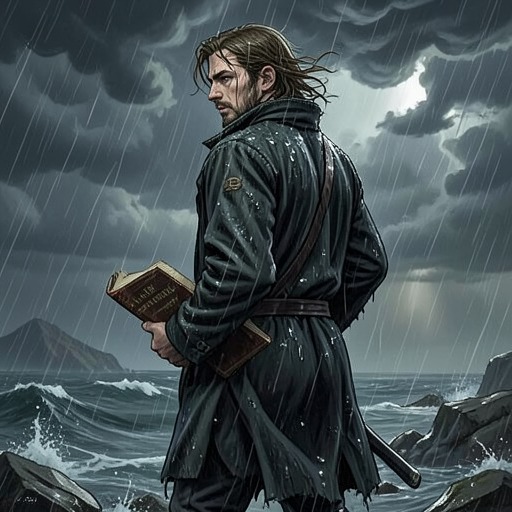
The ending preserves the scale of the damage. The world outside whistles while the rain is stained, and the black book carried through the narrator’s travels begins to disintegrate as the words fade. That decay gives Nazism a historical consequence beyond its slogans: its words have produced devastation, but the record of what they did remains necessary. The ideology seeks to rule by controlling language; the act of telling the story keeps language available for judgment, mourning, and remembrance.