Nuremberg Laws
The Book ThiefThe Nuremberg Laws are the Nazi legal framework that defines Jews as outsiders within Germany, removing citizenship and forbidding marriage between Jews and Germans. Their decisive significance in the story lies in the way an official rule becomes a daily social reality: it turns Max Vandenburg from a German schoolboy and worker into a marked, persecuted man, while forcing people such as Walter Kugler and Hans Hubermann to choose between imposed categories and personal responsibility.
Definition and Legal Exclusion
The evidence identifies the Nuremberg Laws as a measure that forbade Jews from holding German citizenship and prohibited intermarriage between Germans and Jews. This is not presented as an isolated technical regulation. It establishes a boundary between those entitled to belong to the national community and those who remain subject to its power without receiving its protection.
The law’s effect is visible in the treatment of Max Vandenburg. After the Nuremberg Laws came into force, Max was dismissed from the Jedermann Engineering Factory along with the other Jewish employees. Employment loss therefore appears alongside the loss of citizenship: the legal classification reaches into ordinary livelihood and makes Jewish identity a basis for exclusion from work.
From Personal Relations to Enforced Categories
Before persecution hardened the boundary, Max and Walter Kugler had been adolescent rivals. They fought thirteen times over several years, with Walter winning ten bouts and Max three, until their grudging respect became genuine friendship in 1933, when both were seventeen. The Nuremberg Laws did not erase their history, but they changed the conditions under which that friendship could exist.
When Walter later struck the star on Max’s sleeve and remarked that they could no longer fight as they once had, the symbol of legal persecution had entered the space where their friendship had been formed. Max answered that the law forbade a German to marry a Jew but did not forbid fighting one. His bitter reply exposes the law’s contradiction: it claims to regulate social relations while preserving the possibility of violence against the people it excludes.
The same pressure appears in the Hubermann household. Hans Hubermann is identified as a member of the Nazi Party who did not hate Jews or anyone else. His membership places him inside the official national category, while his conduct toward Max demonstrates that personal relationships can resist the hatred the regime attempts to make compulsory. The law thus produces a conflict not only between Germans and Jews but within Germans who must negotiate the gap between public conformity and private allegiance.
Public Enforcement and Social Atmosphere
The legal order is reinforced by public ritual. When World War Two begins in 1939, Liesel Meminger is also becoming a dominant presence in the schoolyard, while the streets of Molching are being covered with Nazi symbols. Every window displays the flag for the Führer; at Frau Diller’s, the glass is scrubbed so that the swastika gleams like a jewel. The regime’s classifications are therefore made visible through decoration, repetition, and compulsory belonging.
At a public gathering, a man in a shiny brown uniform requests silence, begins with the Nazi greeting, and salutes the Führer. Such ceremonies give legal exclusion an emotional and bodily form. The crowd is described as a collective presence that breathes and sings together, leaving little room for independent judgment. The Nuremberg Laws operate within this atmosphere of synchronized identity, where national membership is performed in public and Jewishness is marked as its opposite.
The same system reaches into private fear. When the Hubermanns cannot find their flag, Rosa Hubermann warns that officials may come for them and take them away. The missing emblem becomes a household crisis, and Hans considers painting one on a drop sheet before it is found behind his accordion. This episode shows how the regime’s public symbols create anxiety even among people who formally belong to the national community: protection depends on visible compliance.
Consequences for the Story’s Human Bonds
The laws help explain why Max must live in concealment and why Hans must warn Liesel about the consequences of revealing the hidden man. Hans gives her a list that includes her teacher and Rudy among the people she must not tell. The danger is not confined to a courtroom or government office; disclosure could expose an entire network of relationships to punishment.
The law also clarifies the significance of Liesel’s developing understanding of her own past. She remembers that her father carried the label “Kommunist,” while her brother’s death, her mother’s suffering, dead letters, and a large bonfire gradually lead her to identify the Führer as the source of the destruction surrounding her. Although this chain is not itself a legal explanation, it shows how political labels become attached to family memory and loss. Classification is experienced first as bewilderment, then as grief, and finally as recognition of the system producing both.
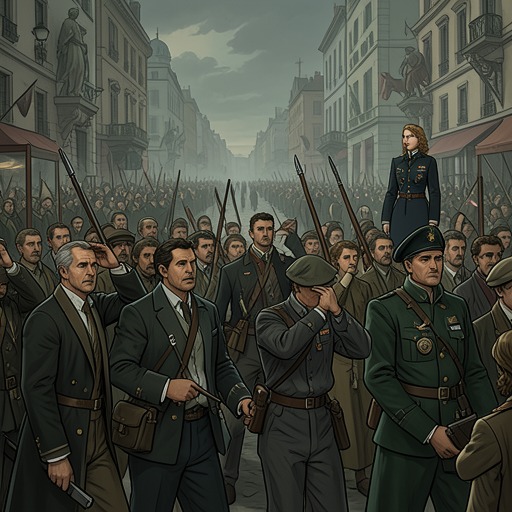
When Liesel later watches Jewish prisoners forced along Munich Street, the law’s abstract distinction has become visible in starving bodies. The prisoners move in ragged uniforms, covered in dirt, pushed by soldiers, while the crowd watches. Hans sees them above the heads of the spectators, and Liesel looks through gaps in the crowd. The scene demonstrates the progression from legal exclusion to administrative persecution and finally to public degradation: a category created by law is enforced upon human bodies in the street.
Political Conformity and Historical Significance
The Nuremberg Laws belong to a larger structure that includes Nazi Party membership, flags, uniforms, youth discipline, public greetings, and the monitoring of shelters. When Nazi officials mark doors with “LSR,” identifying air-raid spaces, administrative signs enter the neighborhood alongside political symbols. Later, after Hans’s actions have exposed the danger surrounding Max, an approval letter arrives confirming Hans’s application to join the NSDAP. What appears on paper as good news is also evidence of how the regime absorbs and disciplines its citizens through documents.
The laws’ ultimate significance is their transformation of prejudice into an organized order of belonging and exclusion. They sever citizenship from lived identity, make friendship politically dangerous, and give state authority a vocabulary for treating Jews as people present in Germany but denied equal membership. Yet the story also shows that legal categories never fully determine human responses. Walter remembers Max as a friend, Hans protects him, and Liesel refuses to abandon him when they meet during the Dachau prisoner parade, even as a soldier tries to force her away. Against the law’s attempt to reduce people to classifications, these acts restore particular faces and relationships to those whom the state has made legally disposable.