Poverty on Himmel Street
The Book ThiefPoverty on Himmel Street is not a background decoration but a governing condition of life. In the Germany of Adolf Hitler, prosperity may appear to be rising, yet poor districts remain, and Himmel Street is one of them: a place where hunger, rationing, insecure work, cramped housing, and wartime danger determine what people can do for one another and what they must risk to survive.
A Poor Street in a Rising Germany
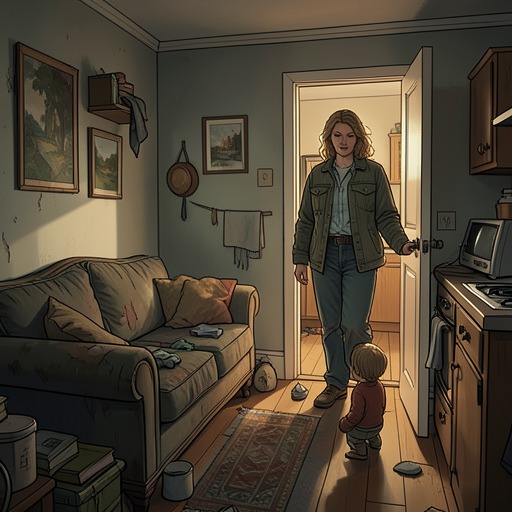
The residents of Himmel Street live on the poorer side of Molching, among people who have little despite the apparent improvement in Germany’s economy under Adolf Hitler. Their poverty is visible in the street’s population and in the limited resources of its households. The Hubermanns’ home is a small, boxlike structure with only a few rooms, a kitchen, and a shared outhouse. Its shallow basement is adequate for storage but not for protection, a distinction that becomes increasingly serious once air raids begin in 1942 and 1943. When danger comes, the residents must hurry down the street to a better shelter rather than rely on their own house.
The physical circumstances of the street make privacy and abundance equally scarce. The children rarely visit one another indoors because the houses are small and contain very little. Their social world therefore develops outside, where soccer goals are marked by garbage cans and friendship is practiced in public rather than in comfortable rooms. The street’s poverty becomes a shared environment: children play among its limitations, while adults organize their lives around whatever work, food, and protection remain available.
Hunger, Rationing, and Insecure Work
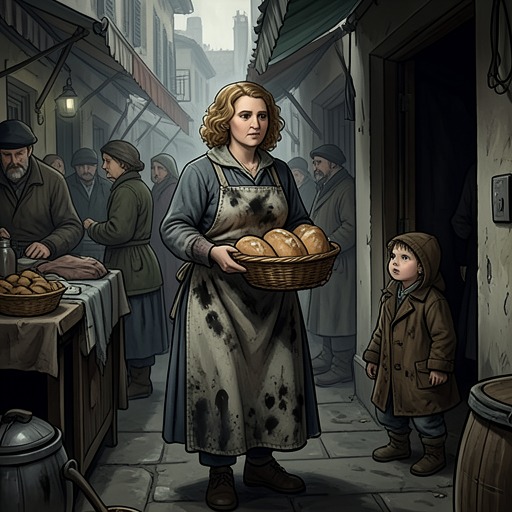
Food scarcity shapes the friendship between Liesel Meminger and Rudy Steiner. Their stealing is not merely an adventure or a childish game; it grows from Rudy’s persistent hunger. Wartime rationing has already narrowed the possibilities of ordinary meals, and the Steiner family’s economic position has worsened because Alex Steiner’s business has lost its Jewish customers after Jewish competition was removed. The family must piece together a living and trade where it can.
The Hubermanns are hardly able to provide a private solution. Rosa Hubermann generally cooks pea soup on Sundays in a quantity intended to last through the following Saturday, with bread and occasional potatoes or meat. The meal is planned across an entire week, not consumed according to appetite. Liesel could wish to give Rudy food, but there is no abundance in her own home to distribute. Their later thefts therefore arise from the intersection of affection and material necessity: hunger supplies the immediate force, while poverty supplies the limits within which their loyalty must operate.
The economic pressure also reaches the household’s washing work. Ernst Vogel tells Rosa Hubermann that he can no longer afford her washing and ironing, blaming the tightening times and the war. His remark is especially painful because it treats Liesel as a child for whom Rosa presumably receives an allowance, turning the foster arrangement into part of the economic calculation. The loss of a customer is not an isolated inconvenience; it signals the weakening of the small informal economy on which the street’s families depend.
Poverty Under Political and Military Pressure
Himmel Street’s deprivation exists within a system that classifies people before it assists them. Liesel knows only that her father carries the label of a communist, a word she does not understand, while her mother is chronically ill and there is no money to repair her health. The child’s abandonment is thus connected to both political persecution and poverty. Later, she links the word communist, a large bonfire, dead letters, her mother’s suffering, and her brother’s death to the Führer. Her understanding of national power begins not with abstract political theory but with the material consequences imposed on her family.
The same political system strips Max Vandenburg and other Jews of security and livelihood. Max is dismissed from the Jedermann Engineering Factory along with the other Jewish workers after the Nuremberg Laws deny Jews German citizenship and prohibit marriage between Germans and Jews. His poverty is therefore not simply personal misfortune: it is produced by laws that remove a population from ordinary civic and economic life. When Max eventually arrives at 33 Himmel Street, twenty-four years old, exhausted, shaking, and burdened by clothes that seem to weigh him down, his physical condition embodies the consequences of that exclusion.
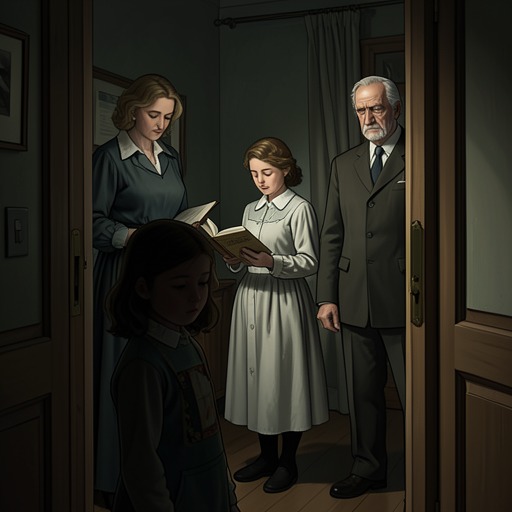
His arrival also transforms poverty into a condition of dangerous secrecy. The Hubermanns resist the immediate impulse toward hysteria, but their household must pretend that ordinary life continues. Hans Hubermann still has to work and play the accordion several times a week because the family needs the money and sudden absence might arouse suspicion. The most extreme form of deprivation is therefore accompanied by forced performance: the family must smile after catastrophe and behave as if nothing has changed while hiding a Jewish man in their home.
Improvised Protection and Mutual Aid
War turns inadequate housing into a matter of life and death. When sirens sound, the people of Himmel Street run toward shelter carrying the possessions they consider most precious: babies, photo albums, wooden boxes, or, in Liesel’s case, books. Their possessions reveal both scarcity and attachment. Because the street’s houses cannot safely protect them, survival depends on movement and on access to better communal spaces.
Work on the street also becomes a form of improvised mutual aid. Hans Hubermann’s painting business briefly finds more demand because householders want their blinds painted to conceal light from enemy aircraft. Yet black paint is scarce, so Hans mixes coal dust into other colors. As he and Liesel carry the paint through Molching, they encounter hunger in some streets and wealth in others. Women with children and almost no money come out to plead for his help.
Hans repeatedly extends his labor beyond what payment can justify. He paints blinds for nothing, or in exchange for a cookie or a warm cup of tea; sometimes he accepts half a cigarette and shares it with the occupant while they talk and laugh. He does not tell poor families to cover their windows with spare blankets, because he knows those blankets will be needed for winter. His work cannot end poverty, but it redistributes small amounts of protection and dignity within it. The gesture is practical rather than grand: a darker window, a little warmth, a shared smoke, and one less demand placed upon a household already near its limit.
The Street’s Poverty and the Cost of Survival
Poverty on Himmel Street magnifies every danger. Max’s confinement in the basement is sustained by the family’s willingness to share scarce space and resources, but the basement’s inadequacy also makes concealment and safety precarious. Max experiences cool cement and an excess of time, and his health declines into constant coldness, trembling hands, failed exercise, weight loss, and swelling cheekbones. His illness is inseparable from the conditions of hiding: the family cannot simply seek ordinary medical care without exposing him and endangering everyone.
The seven-punch knock at the door of 33 Himmel Street demonstrates how quickly this fragile arrangement can collapse. There is no time to move Max anywhere before the demand to open the door arrives. Poverty, political terror, and cramped domestic space converge in that moment: the family has few rooms, no secure escape, and no safe institutional refuge. Their survival depends on improvisation, silence, and the hope that the outside world will not look too closely.
The largest consequences appear when the street’s residents confront the victims of the Nazi system directly. On Munich Street, they watch Jewish prisoners pass in starving, dirt-covered bodies, pushed and forced into movement by soldiers. The prisoners are described as people who will largely die, and their visible physical exhaustion places the economic deprivation of Himmel Street within a wider structure of organized persecution. The residents may be poor, but the prisoners have been reduced even further by a regime that controls their movement, bodies, and right to belong.
Poverty therefore functions in the narrative as both limitation and test. It drives hunger, theft, lost employment, inadequate shelter, and physical decline, yet it also makes acts of reciprocity legible: food is shared when there is barely enough, labor is offered for a cookie or a cigarette, and a dangerous stranger is given concealment despite the cost. Himmel Street’s poverty exposes the difference between official prosperity and lived reality, while showing how ordinary people create narrow spaces of care inside conditions designed to make care difficult.