Rosa Hubermann
The Book ThiefRosa Hubermann is the Hubermann household’s fierce, abrasive center: Liesel Meminger’s foster mother, Hans Hubermann’s wife, and a woman whose insults and wooden-spoon discipline conceal a powerful capacity for attachment. Her decisive significance lies in the gap between her public manner and her private actions. She looks like a hostile piece of furniture, speaks in verbal blows, and aggravates nearly everyone she meets; yet when danger enters 33 Himmel Street in the form of Max Vandenburg, she becomes a careful protector, a provider, and a participant in resistance. Her love is rarely gentle in appearance, but it is sustained by choices that place the family at risk.
Identity and Introduction
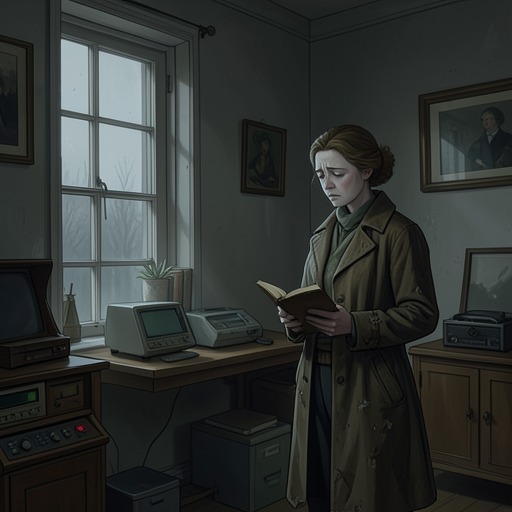
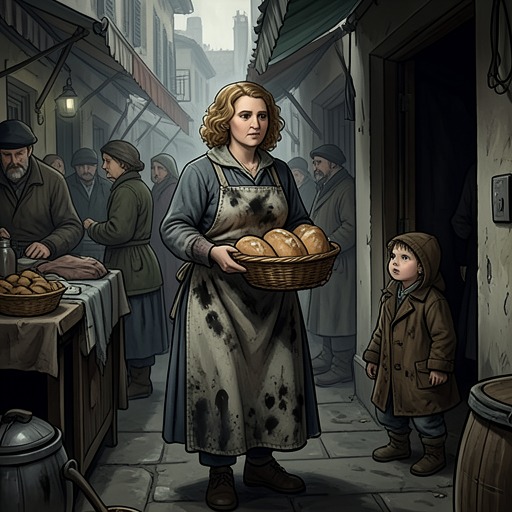
Rosa first appears beside Hans Hubermann and Frau Heinrich as a squat, waddling figure whose body is compared to a small wardrobe beneath a coat. Her face seems creased and annoyed, as though she is merely tolerating the circumstances around her, while Hans stands straight with a hand-rolled cigarette smoldering between his fingers. This visual contrast establishes the household’s marital and emotional balance: Hans carries visible calm, whereas Rosa projects irritation as a permanent defensive posture.
Her domestic competence is limited in at least one obvious respect: her cooking is atrocious. She also possesses the distinctive ability to aggravate almost anyone she meets. These traits make her seem comic and difficult, but they do not exhaust her character. Beneath the hostility, she genuinely loves Liesel. The narrative therefore presents her harshness not as proof of emotional emptiness but as the strange language through which she expresses care.
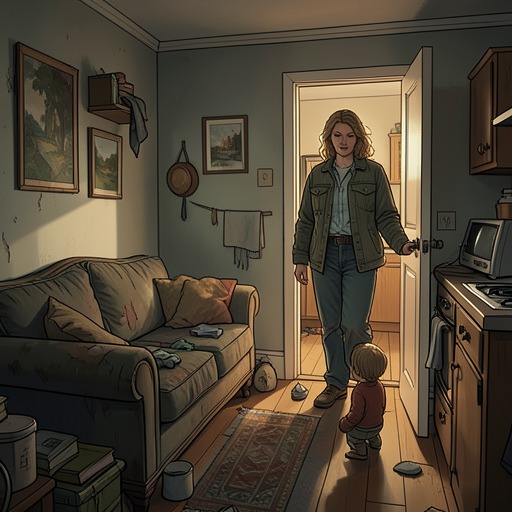
Rosa’s treatment of Liesel makes that contradiction physical. After Liesel has lived on Himmel Street for two weeks, Rosa gives her an enormous hug that nearly chokes and injures her, then addresses her with the insult “Saumensch, du dreckiges—it’s about time!” The embrace is both violence and welcome: Rosa’s affection arrives wrapped in the same force that defines her anger. A few months later, she formally changes the relationship by telling Liesel that she must call her Mama. When Liesel explains that she called her birth mother Mama as well, the new name becomes not a replacement without remainder but a second maternal bond.
Crisis and the Hidden Guest
Rosa’s most revealing development begins when Max Vandenburg arrives in the kitchen of 33 Himmel Street in November 1940. He is twenty-four, exhausted, shaking, and burdened by clothes that seem to weigh him down. The question about whether Hans still plays the accordion is understood as a question about whether Hans will still help him. Max’s arrival transforms the Hubermann home from a poor family residence into a place of concealment, and Rosa must absorb the danger without allowing ordinary life to visibly change.
The family’s first response is remarkable precisely because fear does not become hysteria. Rosa orders Liesel away in a calm but firm voice, an unusual restraint for a woman famous for her verbal aggression. The calm is not evidence that she feels no terror; it is a method of containing terror. Once Max is hidden, the Hubermanns must behave as though nothing has happened. Hans still needs to play the accordion several times a week because the household needs the money, and stopping would provoke suspicion. Hiding a Jewish man thus requires Rosa to maintain an outward performance of normality while the private reality of the home has become radically dangerous.
Rosa’s response is practical rather than theatrical. She divides the food carefully, muzzles her notorious mouth, and develops a gentler expression beneath the familiar cardboard-like face. The change shocks Liesel because it reveals an aspect of Rosa that ordinary domestic friction has concealed: she is, in the crisis, a good woman. The family has lost a son and gained a replacement of immense danger, and Rosa’s care for Max becomes part of the cost of that exchange. Her courage is expressed through rationing, silence, routine, and the refusal to let fear dictate every action.
Public Performance and Moral Risk
Rosa’s protection of Max depends on managing boundaries between the hidden household and the public world. At home, she must make space for a hunted man; outside, she must preserve the appearance of an ordinary German family. The contradiction is especially stark because Nazi Germany organizes people through rigid labels. Liesel’s brown eyes are treated as dangerous in the Germany of the period, while the word “Kommunist” attached to her father remains an unexplained mark that eventually connects her family’s losses, the book burning, and Hitler in her understanding. Against such classifications, Rosa’s conduct insists on personal obligation.
The danger reaches the threshold of 33 Himmel Street when a seven-punch knock strikes the door and a voice calls for it to be opened. There is no longer time to move anyone. The scene compresses Rosa’s entire moral position into a practical emergency: the household’s hidden truth may become visible, and every person inside is vulnerable to the consequences. Her earlier discipline, food division, and suppression of speech are not minor domestic details; they are the habits that make continued concealment possible.
The same pressure governs the air-raid sequences. When sirens howl and residents of Himmel Street hurry toward shelter carrying babies, photo albums, wooden boxes, suitcases, and books, Liesel carries her books between her arm and ribs. Hans, who has forgotten even his accordion, turns back to rescue Frau Holtzapfel’s suitcase. Rosa belongs to this world of possessions, fear, and hurried movement, where ordinary objects become the measures of what people refuse to abandon. The public street is full of watchers, and the private household remains exposed to scrutiny from every direction.
Relationships and the Shape of Love
Rosa’s relationship with Hans is built on contrast rather than sameness. His visible steadiness and musical identity differ from her bluntness, but the two share responsibility for the household and for the risks created by Max’s presence. Their marriage is not sentimentalized; it is shown as a partnership in which courage may appear as music for Hans and as controlled routine, rationing, or silence for Rosa. Together they must act as though nothing has changed even while everything has changed.
With Liesel, Rosa creates a relationship that is both coercive and protective. She disciplines the girl with a wooden spoon and words, calls her names associated with contempt, and nevertheless insists that Liesel occupy the intimate position of daughter. The apparent contradiction is clarified after Rosa’s death, when the narrator recalls that she used terms such as “Saukerl” and “Saumensch,” especially for people she loved. Her vocabulary is abusive in surface form but relational in function: it marks the people she has taken into the hard, crowded circle of her attachment.
Rosa’s relationship with Max is less verbally documented but morally unmistakable. She is a Jew feeder from the first night of Max’s arrival in Molching, and that fact places her against the racial and political system surrounding the family. Max is not merely an abstract victim in her home; he is someone for whom food must be divided, danger must be endured, and daily habits must be altered. Her protection does not erase fear, but it prevents fear from becoming an excuse for abandonment.
Change, Death, and Reassessment
Rosa’s change is not a conversion from evil to goodness. The narrative instead exposes goodness that was already present but obscured by her manner. Her insults, anger, and aggravating behavior remain part of her identity, yet crisis gives those traits a new frame. The force that makes her difficult also helps her withstand pressure. She can command Liesel away, control the household’s supplies, and maintain a suspiciously ordinary routine because she is accustomed to imposing order through blunt authority.
Her moral significance becomes clearest after the bombing of Himmel Street. When Death encounters her, there is no Liesel present in the house, only Rosa sleeping with her mouth open and her papery lips still moving. The sleeping body recalls the public image of the wardrobe-like woman, but the narrator refuses to leave her there. Rosa’s elastic hair is loose, her body rises with the beating of her heart, and the narration insists that she has a heart—larger than people would imagine, with much stored inside it. The image turns her apparent hardness into a container for hidden feeling.
The final reassessment gathers several of Rosa’s earlier actions into one moral portrait. She was the woman who carried an instrument strapped to her body through a long, moonlit night; the woman who fed a Jewish man without hesitation on his first night in Molching; and the woman who reached deep into a mattress to deliver a sketchbook to a teenage girl. These gestures join endurance, shelter, and tenderness. Rosa’s love is therefore not best measured by the softness of her speech. It is measured by what she carries, hides, divides, and retrieves for others when the world makes care dangerous.
Narrative Role and Significance
Rosa functions as a deliberately misleading surface. At first she can be read as a comic tyrant, a domestic obstacle, or a woman defined by foul language and physical severity. Her later conduct forces a rereading of those first impressions. She is a rounded character because her apparent identity as an unpleasant woman repeatedly gives way to convincing, consequential acts of care.
Her character also dramatizes the difference between social labels and lived relationships. The surrounding political order reduces people to categories such as Jew, German, Communist, or party member; Rosa’s household life restores particularity through names, food, habits, and obligations. Her goodness is not abstract purity. It is a sequence of risky decisions made inside poverty, war, surveillance, grief, and scarcity.
For Liesel, Rosa becomes proof that love can arrive in an ungainly form. The foster mother’s embrace nearly chokes her, her language wounds as often as it comforts, and yet Rosa claims Liesel as Mama claims a daughter. By the end, the apparent contradiction has become the point: Rosa Hubermann’s heart is not absent beneath the cardboard face. It is crowded, guarded, and larger than her manner allows the world to see.