The Book Thief manuscript
The Book ThiefThe Book Thief manuscript is Liesel Meminger’s attempt to make a durable form out of experiences that have otherwise been marked by loss, secrecy, and violence. It begins as a gift from Ilsa Hermann after Liesel’s angry destruction of one of Ilsa’s books, and it ends as the physical record that Liesel is still holding when the bombing of Himmel Street destroys her home and kills the people she loves.
Origin and Material Form
The manuscript begins with a rupture between Liesel and Ilsa Hermann. After returning to Ilsa’s library, Liesel writes a final letter admitting that she has been there again and has ruined one of Ilsa’s books. She explains that she was angry and afraid and wanted to destroy the words themselves; she also acknowledges that she has stolen from Ilsa and damaged her property. Liesel considers stopping her visits as a punishment, but recognizes that the library is both a place she loves and a place she hates because it is full of words. Ilsa does not accept Liesel’s proposed self-punishment. When they meet again, she gives Liesel a small black book containing lined paper rather than a story. The gift transforms their relationship: instead of merely borrowing or stealing books, Liesel is invited to become a writer. Ilsa tells her that she can write well and urges her not to punish herself or become like Ilsa. The manuscript therefore originates in remorse, but its deeper function is restorative. It gives Liesel a way to answer damage with creation.
Writing and Structure
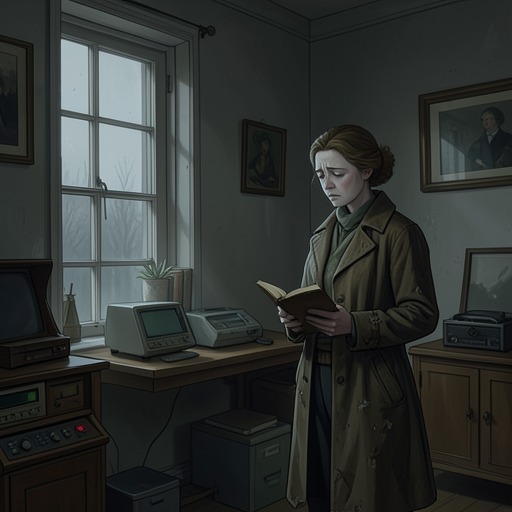
Liesel makes the manuscript under austere conditions. She uses a small paint can as a seat and a large one as a table, then places a pencil on the first page. In the center she writes the title, The Book Thief, followed by the modest description “a small story.” The physical setting matters because the book is not produced in a protected literary environment; it is made with improvised furniture and limited materials, by a girl whose life has been shaped by war. Her hand is already sore by the third page, yet she completes eleven pages during the first night. The manuscript begins with the train, the snow, and her earliest remembered experience, linking its composition to the origins of her grief and to the circumstances that brought her to the Hubermanns. Writing does not erase those memories. It gives them sequence, language, and a form that Liesel can revisit. By the next raid, on October 2, the manuscript is nearly complete. Only a few dozen pages remain blank. It is divided into ten parts, each named for a book or story, with every part describing the effect that a particular book had on Liesel’s life. Its structure is thus autobiographical and literary at once: Liesel records events, but she also understands those events through the books that helped shape her.
Words, Memory, and Survival
The manuscript gathers together the central conflict of Liesel’s life: words can wound, manipulate, and destroy, but they can also preserve human connection. Her anger at Ilsa’s book expresses a desire to “kill the words,” yet the act of writing reverses that impulse. The same girl who once steals books and damages one of them now builds a book of her own, converting her relationship with language from illicit possession into deliberate testimony. Its meaning becomes especially stark during the bombing. The narrator imagines Liesel reading or rereading her pages when the first bomb falls, with images associated with Max Vandenburg and the Führer present in her surroundings and memory. This imagined moment places the manuscript between private recollection and public catastrophe. Liesel’s written words continue while the outside world is about to obliterate the physical setting in which they were produced. When the LSE men find her after the bombing, Liesel speaks of rescuing Hans Hubermann, Rosa Hubermann, and Max Vandenburg from the basement or hallway. Her body then buckles, and the man who catches her notices what is heavy and hurting in her hand: the book, and the words. The manuscript is not treated as an abstract symbol at that instant. It is a real burden carried through shock, an object whose weight registers the accumulated pressure of memory.
Loss and Preservation
After Liesel is taken away, she continues to weep. The dead are attended to, and the accordion is remembered, but no one notices the manuscript. Along with other materials, it is stepped on several times, picked up without a glance, and thrown onto a garbage truck. Its near-disposal creates a final reversal: the book that contains Liesel’s life is momentarily treated as refuse, while the ordinary objects of the destroyed household receive more immediate recognition. The manuscript survives only because the narrator retrieves it just before the truck leaves. Its preservation is therefore accidental rather than guaranteed by its apparent value. Liesel has written to prevent her experiences from vanishing, but the book itself nearly vanishes through neglect. The survival of the manuscript makes possible the survival of her story, including the intertwined histories of the people and places that the bombing has erased.
Narrative Significance
The Book Thief manuscript is both a character’s artifact and the structural explanation for why Liesel’s story can be told. It transforms the events of her childhood into a retrospective record organized by books, memory, and consequence. Its title echoes Liesel’s identity as a thief while also revising that identity: she no longer merely takes words from others, but creates a text that bears her own account. The manuscript also joins material fragility to moral endurance. It is made from a small black notebook, written with a pencil by a sore-handed child, nearly destroyed in a bombing, and almost discarded with the rubble. Yet it outlasts the physical world that surrounds Liesel. Its survival does not make the losses reversible, but it prevents them from becoming wholly silent. In that sense, the manuscript’s decisive achievement is not escape from death; it is the preservation of human particularity after death has done its work.