The Dachau prisoner parade
The Book ThiefThe Dachau prisoner parade is the forced movement of Jewish prisoners through Molching toward Dachau. It is decisive because persecution, usually kept at a distance through secrecy, rumor, and official language, becomes visible in the town’s public space: starving people stagger past soldiers, their bodies marked by dirt, exhaustion, and deprivation. Liesel Meminger’s decision to approach and accompany one prisoner transforms the parade from a spectacle observed by a crowd into a direct human encounter, while Hans Hubermann’s troubled presence reveals the danger and cost of compassion under Nazi rule.
Causes and Historical Setting
The parade occurs after Liesel Meminger has calculated that only four more reading sessions with Frau Holtzapfel remain before the Jews are marched through Molching. The prisoners are being taken to Dachau, described as a place of concentration, and the interval is measured not only in days but in the possibility of moral reversal: two weeks might be enough to change the world, or to ruin it. The movement therefore enters the story as an approaching historical pressure rather than an isolated surprise.
The procession belongs to the organized violence of Nazi Germany. Jews and other prisoners have already been pushed along the road, and although the death camps may be concealed from the public, the labor camp at Dachau is sometimes displayed as if its existence were a source of glory. That contradiction is central to the event: the system hides its ultimate purposes while publicly exposing enough suffering to normalize coercion, forced labor, and the reduction of human beings to a managed column of bodies.
The narrative also places the parade within a wider route. Soldiers and Jewish prisoners pass through several towns before arriving in Molching, carrying a new group of exhausted people toward Dachau. The text leaves the immediate administrative reason uncertain: perhaps additional labor is needed, or perhaps prisoners have died. That uncertainty does not lessen the violence. Instead, it shows how the prisoners’ lives have been absorbed into an impersonal process in which bodies can be added, removed, transported, or replaced without explanation.
The Procession Through Molching
Liesel Meminger runs to Munich Street with the usual onlookers, making the parade part of the town’s recurring public life. Hans Hubermann is there with his paint cart, and Liesel points him out to Rudy Steiner. When Hans first tries to take the children away, he recognizes the danger of their remaining. He ultimately understands that Liesel is determined to stay and that the scene may be something she should see, so he stands beside her in silence.
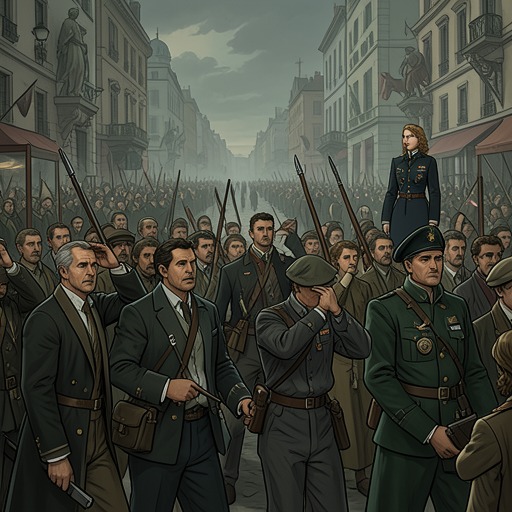
From Munich Street, the crowd watches the prisoners descend the road. More people gather around and in front of Liesel Meminger and Hans Hubermann, turning suffering into a public display. The narrator resists the easy distance of a generalized description, insisting that the Jews appear as a catalog of distinct colors and that many will die. Their eyes are enormous in starving skulls; dirt is molded to their bodies; their legs stagger as soldiers force them into brief, broken runs before they fall back into a malnourished walk. The physical details make deprivation impossible to treat as an abstraction.
The prisoners’ movement is controlled by soldiers’ hands and by the demands of the road. Their feet produce a throbbing noise as they arrive in full, while the crowd looks through gaps and over shoulders. Hans Hubermann watches above the heads of the onlookers, his eyes described as strained, and Liesel Meminger tries to see through the crowd. The scene thus contains two kinds of movement: the prisoners are compelled forward, while the spectators shift into position to look. The contrast makes observation itself morally charged.
Liesel Meminger’s Intervention
The parade becomes an encounter when Liesel Meminger moves beyond the role of spectator. In the wider account of the event, Jews are marched through the outskirts of Munich, and a teenage girl makes her way through to walk with them. Soldiers pull her away and throw her to the ground, but she stands again and continues. Her action is physically small beside the organized force surrounding the prisoners, yet its repetition gives it meaning: falling does not end her attempt to remain beside them.
Liesel Meminger’s response is shaped by her prior connection to Max Vandenburg. Max has endured concealment in a basement, where cool cement and the passage of time become forms of punishment. His health later declines severely: he suffers constant coldness and numb hands, develops increasingly intense visions of boxing with the Führer, cannot warm himself even after exercise, loses weight, and eventually struggles to wake beside the fire. The parade therefore confronts Liesel with the public form of a condition she has known privately. The prisoners she sees are not an anonymous category; they belong to the same persecuted population as Max Vandenburg.
The encounter also recalls the earlier intimacy between Liesel Meminger and Max Vandenburg. Max has remembered her descending the basement steps with a snowman in her hands, an act of imaginative care that interrupted his confinement. In the parade, her movement toward the prisoners reverses the direction of that earlier gesture. Instead of bringing something into hiding, she walks outward into danger, attempting to share the prisoners’ forced path even when soldiers can remove her.
Bodies, War, and Consequence
The parade’s violence is part of a larger pattern of bodily destruction. A small war story concerns Frau Holtzapfel’s son Robert, whose legs are blown off at the shins before he dies. Elsewhere, damage from military transport is cataloged in blunt terms: six men are burned by cigarettes and two suffer broken hands. These fragments place the prisoners’ starvation and forced marching alongside other injuries produced by the war, from battlefield wounds to the careless handling of human bodies in military systems.
The event’s physical emphasis prevents suffering from becoming merely symbolic. Cold, hunger, damaged limbs, exhaustion, and collapse are not interchangeable metaphors; they are conditions imposed on particular bodies. The prisoners’ dirt, swollen deprivation, and failing gait reveal the material operation of persecution. Their suffering has been produced through confinement, transport, labor, and the denial of ordinary care, while the soldiers and spectators occupy the positions from which that suffering is administered or witnessed.
For the town, the parade exposes a moral division that had previously been easier to avoid. The onlookers see the prisoners, but seeing does not automatically become solidarity. Hans Hubermann’s silence suggests that recognition may coexist with fear, and Liesel Meminger’s persistence shows how direct identification can break through the crowd’s passive arrangement. The danger is not only that the prisoners are being marched toward Dachau; it is also that public familiarity with their degradation could make cruelty appear ordinary.
Narrative and Thematic Significance
The narrator interrupts ordinary distance by asserting personal presence at the beginning of the long walk to Dachau: the account rejects a rumor that the transport truck broke down and insists on firsthand witnessing. This creates a layered narrative perspective. The parade is told as a historical occurrence within Liesel Meminger’s world, but it is also framed by a narrator who claims to have seen it and who repeatedly directs attention to what the prisoners’ bodies reveal. The result is neither detached chronicle nor simple eyewitness report; it is a morally urgent act of testimony.
The parade also reverses the usual meaning of a public procession. A parade normally promises order, display, and communal participation. Here, the route is organized by soldiers, but the participants are unwilling prisoners whose movement records their dispossession. The morning is warm and beautiful, yet the beauty of the day stands beside starvation and forced marching. That contrast makes the event more disturbing: the world’s surface remains attractive while the political order uses it as a road toward Dachau.
For Liesel Meminger, the parade is a threshold between knowing about persecution and confronting it in person. She cannot stop the transport, release the prisoners, or undo the system that sends them toward Dachau. She can nevertheless refuse the safe position of an onlooker. Her repeated attempt to stand and continue after being thrown down gives the event its clearest human answer: resistance may be powerless against the machinery of persecution, but it can still reject the machinery’s demand that victims be treated as anonymous objects.