The Power of Words
The Book ThiefThe Power of Words is the novel’s central moral and political concept, linking Adolf Hitler’s rise through language with Liesel Meminger’s gradual discovery that words can both injure and sustain. Words organize Nazi Germany into a nation of obedient thoughts, but they also help Liesel understand grief, form bonds across persecution, and finally write herself into survival.
Words as Political Weapons
The concept first becomes legible through Liesel Meminger’s childhood attempt to connect scattered signs of suffering. Her father is remembered only through the unexplained label “Kommunist”; her mother has disappeared; her brother has died; and a bonfire has consumed books and letters. She eventually adds these fragments together with the Führer, recognizing Adolf Hitler as the figure behind the losses that have shaped her life. Her conclusion is not an abstract political lesson. It is an eleven-year-old’s realization that public language and private catastrophe belong to the same system.
Adolf Hitler’s power is presented as deliberately verbal before it is military. He imagines ruling the world without firing a gun because words can be planted throughout his homeland, cultivated, and made to grow into forests of collective thought. The image turns ideology into an agricultural industry: language is seeded, tended, distributed, and eventually harvested as obedience. Nazi Germany is therefore not controlled only by weapons or uniforms. It is populated by thoughts that have been farmed into people.
The political environment makes that cultivation visible in ordinary public rituals. On the streets of Molching, windows display flags for the Führer, with some swastikas presented as carefully as jewels and others hanging with the limpness of household laundry. A crowd later rises as a horizon of Nazi flags and uniforms, singing together and waiting for fire. The speaker’s polished brown uniform requests silence, then begins with “Heil Hitler!” and the salute to the Führer. The formula is brief, but its repetition turns speech into discipline and collective bodily action.
The Word Shakers and the Powerless
The story within The Word Shaker gives the concept its clearest symbolic form. The people who climb the trees of Hitler’s word forests are called word shakers, and the best of them understand the genuine power of words. Their skill is measured by how high they can climb, but the decisive word shaker is a small, skinny girl who knows how powerless a person can be without words. Her hunger is therefore double: she desires language because it has been used to rule the world, and because lacking language has left her exposed to that rule.
The allegory also distinguishes between words that dominate and words that create an alternative relation. The word shaker meets a man despised by his homeland even though he was born there. They become friends, and when he is ill, a tear falls on his face as a sign of friendship. That single word becomes a seed planted among the other trees and watered repeatedly. Against the Führer’s cultivated forests of ideological thought, the seed represents language grown from personal loyalty rather than mass hatred. It does not erase the surrounding forest, but it establishes another possible use for words.
This contrast gives the concept its main tension. Language is not morally harmless simply because it is intangible; it can classify, exclude, command, and make violence appear natural. Yet language is not permanently owned by the regime that weaponizes it. The same medium can name suffering, preserve affection, and allow a person who has been reduced to a category to become visible as an individual.
Learning to Resist and Rebuild Meaning
Liesel Meminger’s development follows this double structure. Her dark brown eyes are dangerous in Germany because they do not conform to the appearance expected of a German child, and her father’s communist label remains a word she cannot initially understand. The regime’s categories precede her knowledge of herself. As she learns words, she begins not merely to read the world but to test the labels imposed upon it.
The 1936 Summer Olympics provide an early counterpoint to Nazi racial language. Jesse Owens wins his fourth gold medal after the 4 × 100-metre relay, despite the claim that he is subhuman because he is Black and Adolf Hitler’s refusal to shake his hand. Even racist Germans are impressed by Owens’s achievement, and the news reaches Rudy Steiner. The event exposes a crack between official definitions of human worth and an experience that those definitions cannot successfully contain. Rudy’s response shows how athletic achievement can interrupt propaganda, even when the surrounding political order tries to dictate what bodies and identities mean.
When Liesel recognizes the Führer’s role in her family’s suffering, language becomes an instrument of direct emotional resistance. She says that she hates him, converting the previously mysterious “they” into a named source of rage. Naming does not immediately undo the regime or restore the dead, but it changes the shape of her grief: pain that had been diffuse can now be directed toward the person and system she has identified.
The Hubermanns’ fear demonstrates the opposite side of resistance: language must often be managed as carefully as a physical secret. When Max Vandenburg arrives at 33 Himmel Street in November 1940, the family experiences anxiety, disbelief, paranoia, and fear, yet resists hysteria. Rosa Hubermann sends Liesel away, while the household must continue acting as though ordinary life has not changed. Hans Hubermann still needs to play the accordion often enough to avoid suspicion, even though the family is hiding a Jewish man. Their survival depends on a public performance whose words and routines conceal a private allegiance.
A seven-punch knock at the door of 33 Himmel Street shows how quickly that linguistic and domestic protection can fail. The sound announces that there is no longer time to move anyone, and the command to open the door transforms the house from refuge into a threatened boundary. In this world, speech, silence, knocks, greetings, and official formulas all carry material consequences.
Words, Destruction, and Writing
The power of words becomes most painful when Liesel turns against books themselves. After devastating losses and uncertainty about whether Max Vandenburg and Alex Steiner are alive and safe, she tears a page from a book, then rips a chapter, leaving scraps of words across the floor. She asks what good words are. Her anger identifies the contradiction at the heart of the novel: if words helped make Adolf Hitler powerful, and if they have accompanied persecution, marching prisoners, and the need for consolation, language can seem responsible for the world’s cruelty as well as its attempts to repair it.
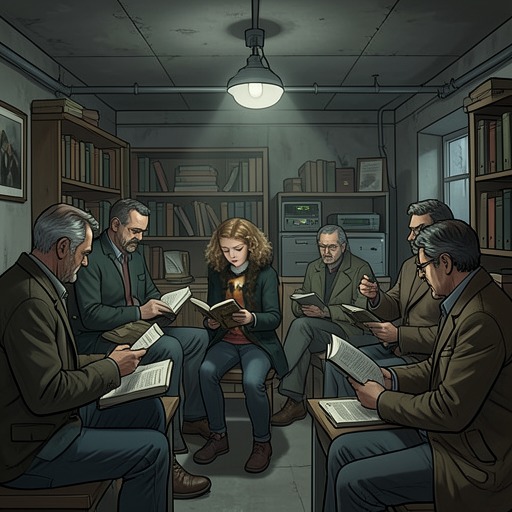
Yet Liesel’s destruction of the book does not end her relationship with language. Ilsa Hermann gives her a book and, with it, a reason to spend time in the basement, a place first associated with Hans Hubermann and later with Max Vandenburg. The basement becomes a space where words shift from public ideology to private memory. There Liesel begins to write her own words, recognizing that language has also brought her to life. Writing contains punishment and pain, but also happiness; it becomes a practice through which experience can be faced rather than merely endured.
The movement from torn pages to written pages is therefore not a simple rejection of language. Liesel learns to distinguish between language imposed from above and language made through attention, friendship, mourning, and testimony. The regime plants words in crowds; Liesel writes them in a basement. Its language demands conformity; hers preserves singular lives. Its vocabulary makes people disposable; hers tries to keep them present.
Narrative Meaning and Human Consequence
The novel’s narrator extends the concept beyond Liesel’s personal education. The narrator describes Adolf Hitler’s words as a force that creates a nation of farmed thoughts, while also recognizing the beauty and brutality that human beings place into words and stories. The final truth offered to Liesel Meminger is not a claim that language can solve history. It is an admission of lasting disturbance: “I am haunted by humans.” That conclusion returns the power of words to the people who use them, showing that language is neither an autonomous cure nor a purely evil instrument.
The concept is consequently inseparable from responsibility. Words can produce political consent, turn prejudice into common sense, and prepare people to accept violence; the Nazi slogans, flags, salutes, anthems, and racial classifications demonstrate that process in public life. But words can also expose the damage caused by those classifications, make friendship possible across enforced boundaries, comfort the suffering, and give Liesel a form in which the dead and endangered remain narratable. The Power of Words lies in that unstable capacity: language can build a forest of obedience, but a single human word can also become a seed of resistance.