The Shoulder Shrug
The Book ThiefThe Shoulder Shrug is the second book stolen by Liesel Meminger, and its importance lies in the circumstances of its survival. Recovered from a burning heap on April 20, Adolf Hitler’s birthday, it becomes a compact record of the conflict between Nazi control of language and Liesel’s growing determination to claim words for herself. The book is not merely read; it is rescued, hidden, examined, and later spoken aloud in a shelter, where its presence helps transform collective fear into attentive silence.
Appearance and Recovery
The Shoulder Shrug is identified as Liesel Meminger’s second stolen book, following the first theft on January 13, 1939. Its second theft occurs on April 20, 1940, after a public ceremony in which books are burned as part of a broader culture of Nazi destruction. The burning is presented alongside the destruction of shops, synagogues, houses, personal belongings, and people, making the book part of a material landscape in which objects are deliberately turned into evidence of ideological power.
Liesel does not take the book from an ordinary shelf. After the fire has burned down, workers shovel the heap from a truck, reducing it at the sides until a small section of living material slips from the ash. That remnant includes half a red flag, two posters advertising a Jewish poet, three books, and a wooden sign bearing Hebrew writing. The books therefore emerge beside symbols and traces of persecuted Jewish culture, not in isolation from them.
The heat remains strong enough to warm Liesel as she approaches. Her first attempt to reach into the pile is punished by a bite from the fire; on the second, she moves quickly and catches the nearest book. It is hot and wet, burned at the edges but otherwise unhurt. Its blue cover is textured like hundreds of tightly drawn strings, with red letters pressed into the surface and a small red cuckoo beneath the title. In the smoke, Liesel can read only the word “Shoulder.” The incomplete reading mirrors the book’s damaged condition: its identity is partly obscured, yet its material presence is unmistakable.
Theft and Meaning
Liesel’s theft is driven by more than curiosity. The book is taken after an afternoon of excitement, a blood-soaked ankle, and a slap from a trusted hand; the account describes her feeling not as shame but as pride, with anger and dark hatred fueling the act. The object’s value is thus created through a collision between its public destruction and her private seizure of it. The fire is intended to erase forbidden words, but it gives Liesel an opportunity to possess one of the books that would otherwise have been lost.
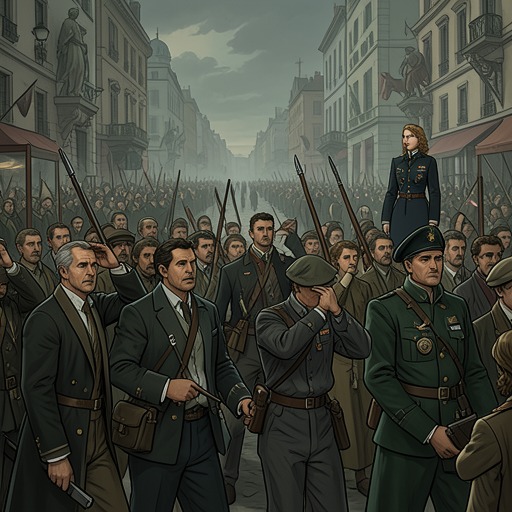
The political setting makes the theft more dangerous and more revealing. At Hitler’s birthday celebration, a speaker describes the fire as an effort to stop enemies from reaching into German minds and denounces “The immoral! The Kommunisten!” before naming Jews as enemies of the national ideal. Liesel is unable to absorb the speech as a whole because the word communist has seized her attention. The word recalls dark rooms, suited men, her mother’s suffering, and the death of her brother. In her developing understanding, the word communist, the bonfire, dead letters, her mother’s suffering, and her brother’s death converge on the Führer.
The Shoulder Shrug therefore becomes attached to a newly personal political awareness. Liesel’s dark eyes have already marked her as potentially suspect in Nazi Germany, and her father’s label as a communist remains a mystery she cannot explain. The book’s recovery from the fire gives that inherited, unexplained label a physical counterpart. What the regime presents as a cleansing of German thought becomes, for Liesel, an encounter in which the destruction of language exposes the people and memories the regime wants erased.
Examination in the Hubermann Home
When Liesel brings the book home, Hans Hubermann recognizes immediately that she has taken it from the fire. The book is hot and wet, with blue and red covering and scorched edges, and he opens it to pages thirty-eight and thirty-nine. His brief inspection requires no elaborate explanation: the object itself preserves the story of the theft. Its damage functions as a trace of the fire, while its survival confirms Liesel’s act.
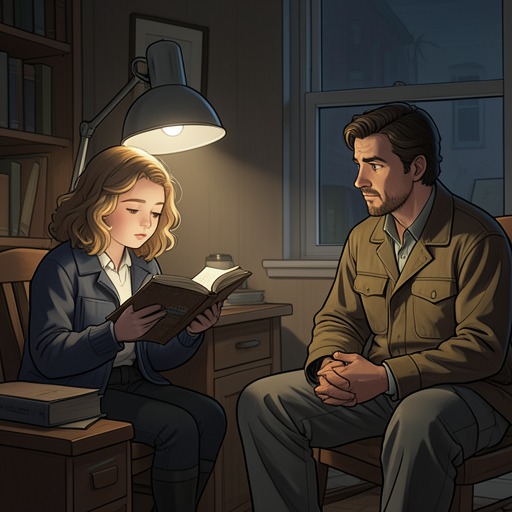
Hans’s response also places the book within the Hubermanns’ private world of reading and secrecy. Liesel’s stolen object is not displayed as a political trophy; it is handled, opened, and absorbed into the household where Hans teaches her words. The book consequently shifts from public spectacle to intimate use. Its transition across that boundary matters: a thing meant to be destroyed by the state becomes part of the shared, guarded relationship between Liesel and Hans.
Reading During the Air Raid
The Shoulder Shrug belongs to the same larger practice of reading that later allows Liesel to steady people during air raids. In the Fiedlers’ deep basement, twenty-two people crowd together, including the Steiner family, Frau Holtzapfel, Pfiffikus, a young man, and the Jenson family. The room is dank and cold, its jagged walls pressing into those who stand inside, while distorted sirens enter from outside. When a later raid becomes real and Molching is listed as a possible target, the residents again move through Himmel Street toward shelter.
During that crisis, Liesel opens one of her books and reads The Whistler aloud to concentrate. The reading becomes communal: Rudy Steiner notices, draws the attention of his siblings, Hans moves closer, and by the third page everyone is silent except Liesel. The scene does not identify The Shoulder Shrug as the volume used on that particular occasion, but it establishes the function made possible by Liesel’s growing collection of books, including the one rescued from the fire. A book that first appeared as a burned object becomes part of a practice through which words impose order on fear without denying the danger outside.
Material and Narrative Significance
The Shoulder Shrug’s central irony is that Nazi destruction helps create the conditions of its private afterlife. The regime burns books to control minds, yet the fire exposes one book to Liesel and intensifies her desire to take it. Its blue-and-red cover, wet pages, scorched edges, and painful heat retain the physical history of the burning. It is an object whose material damage refuses the clean finality promised by the ceremony.
The book also connects personal grief with historical violence. Liesel’s inability to understand the label attached to her father, the recurrence of the word communist, the death of her brother, and the suffering of her mother all become legible against the public language of Nazi persecution. Later scenes of Jewish prisoners being forced down Munich Street, with starving bodies and dirt molded to them, reveal the human consequences of the categories and rhetoric that the book-burning ceremony helps enforce. The Shoulder Shrug stands at the earlier point where those abstractions first become materially and emotionally joined for Liesel.
Its significance extends beyond the moment of theft. Liesel’s books gradually come to mean not merely something but everything, though the narrative refuses to assign one precise instant when that transformation occurs. The Shoulder Shrug is one possible beginning: a damaged book taken from ash, carried into the Hubermann home, and absorbed into a life in which reading becomes memory, resistance, companionship, and testimony. Even after the war’s violence reaches the people of Himmel Street, the rescued book remains part of the chain by which Liesel’s words survive what the fire intended to silence.