Tommy Müller
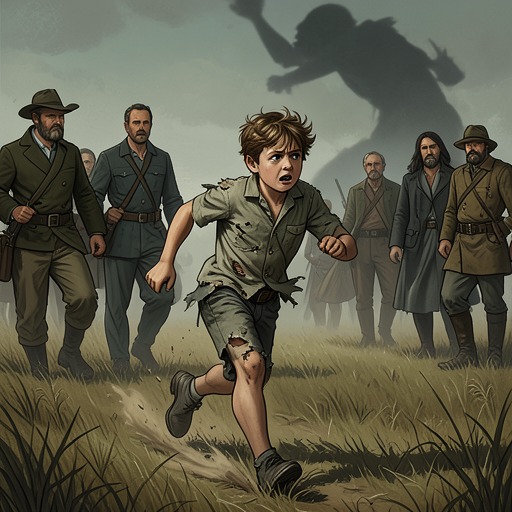
The Book ThiefTommy Müller is a child marked by chronic ear infections, several operations, impaired hearing, and an involuntary twitch. Known to other children as “the twitcher,” he is not merely a comic neighbor or an obstacle in military-style exercises: his body becomes a precise measure of how brutally Nazi Germany treats any deviation from its image of disciplined, “pure” German youth. Through Tommy, ordinary disability is converted into public embarrassment, punishment, and danger.
Identity and Background
Tommy lives on Himmel Street and belongs to the same poor neighborhood as Liesel Meminger and Rudy Steiner. His face bears a pink river of skin left by the operations performed after his ears became infected, and his nerves were damaged in the process. The account of his childhood explains that he became lost at a market when he was five, on the coldest day of the year; he was found three hours later frozen solid and suffering from an earache caused by the cold. The subsequent infections led to three or four operations, which left him with the twitch and the hearing difficulty that shape his treatment by others.
His condition is introduced through Rudy Steiner, who points out Tommy’s apartment while walking Liesel to school. Rudy explains the history matter-of-factly, identifying Tommy by the nickname “the twitcher,” and Liesel adds that Tommy is bad at soccer. Rudy agrees that he is “The worst.” The exchange places Tommy within the children’s ordinary social world, where physical difference is folded into teasing and neighborhood knowledge, but it also establishes that his difficulty is not a matter of laziness or unwillingness.
Life Under Discipline
Tommy’s hearing becomes especially consequential when he joins the organized youth culture of Nazi Germany. During a public march toward the town hall and square, the children are instructed to halt. The rest of the regiment stops, but Tommy continues forward and collides with the boy in front of him. The boy calls him “Dummkopf!” Tommy apologizes and explains that he could not hear. What appears to be a small error is instead a preview of the larger troubles awaiting both Tommy and Rudy: the marching system recognizes only obedience that can be visibly performed, not the bodily conditions that make obedience difficult.
By early 1941, Tommy was repeatedly returning from Hitler Youth meetings in a considerably worse condition than when he had arrived. His ears were one part of what the narrative calls a three-tiered problem; the other two were Franz Deutscher, the irate Hitler Youth leader, and Rudy Steiner’s inability to stay out of conflicts. Tommy’s hearing impairment therefore becomes entangled with institutional violence and with Rudy’s instinct to defend or intervene. The danger does not arise from Tommy’s character but from the collision between his body and a regime that turns conformity into a test of moral worth.
Relationships and Conflict
Tommy is closely associated with Rudy, who repeatedly appears beside him in the aftermath of Hitler Youth meetings. Their shared suffering gives Tommy a place in Rudy’s circle, while Rudy’s refusal to remain uninvolved makes Tommy’s problem visible to others. The friendship is not presented as sentimental rescue; it is a practical alliance formed under pressure, with Rudy’s impulsiveness increasing the likelihood of confrontation even as it prevents Tommy from being isolated.
Tommy also belongs to the wider network of children on Himmel Street, where Liesel learns about him through Rudy and where physical vulnerability is noticed quickly. The street is populated by relatively poor people despite the apparent economic rise under Adolf Hitler, so Tommy’s difficulties occur within a community already familiar with scarcity and hardship. Yet poverty does not erase the hierarchy imposed by Nazi institutions. At the marches and youth meetings, the child who cannot hear properly is made to appear personally defective, even though the cause lies in injury and medical damage.
Narrative Function and Significance
Tommy’s story exposes the contradiction between Nazi claims about ideal German bodies and the actual lives of German children. The regime’s language of racial and national purity depends on sorting people into acceptable and unacceptable forms, but Tommy demonstrates that exclusion can be produced by an ordinary physical difference within the supposed national community itself. His darkly comic introduction, his failed soccer reputation, and his humiliating collision during the march gradually acquire a harsher meaning as the Hitler Youth turns his impairment into a recurring source of punishment.
The narrative also treats Tommy’s twitch and hearing loss as concrete lived conditions rather than as a supernatural sign or a simple moral metaphor. The operations, the scarred face, the damaged nerves, and the inability to hear a command all remain materially specific. At the same time, the repeated institutional demand that he march, halt, and respond correctly shows how disability is intensified by an environment designed without accommodation. Tommy is not transformed into a heroic rebel or granted a neat resolution in the supplied episodes. His importance lies in the vulnerability he makes impossible to overlook: in Nazi Germany, even a child who belongs to the racial majority can become a problem when his body fails to perform the required script.