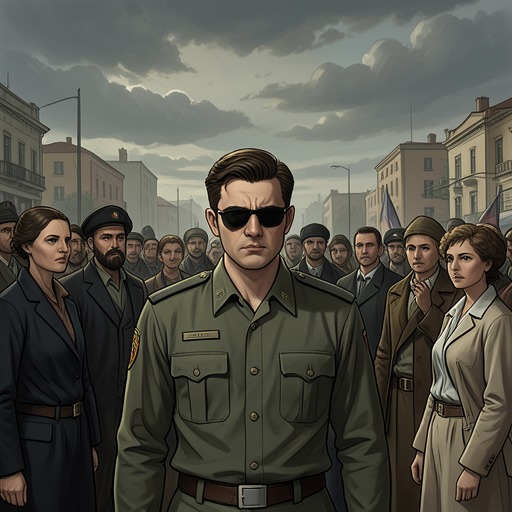
Walter Kugler
The Book ThiefWalter Kugler is Max Vandenburg’s childhood friend, former fighting companion, and crucial intermediary in the arrangements that bring Max to 33 Himmel Street. His importance lies less in the amount of time he spends onstage than in the risks he accepts: he verifies that Hans Hubermann remains trustworthy, carries money and information between Stuttgart and Molching, and helps transform an old promise into a means of survival. Through Walter, personal loyalty persists beneath the increasingly violent classifications of Nazi Germany.
Identity and Background
Walter comes from Stuttgart and has known Max since adolescence. Their relationship begins in physical rivalry rather than sentiment. At fifteen, Walter has already defeated Max four times, but Max wins their fifth fight, discovering in himself the frightening exhilaration of victory. The contest takes place before a tight circle of onlookers, amid dirty ground, wagers, shouts, fear, and delight; the violence is also a form of shared vitality, a world in which both boys can still meet as equals.
The rivalry continues for several years. Walter and Max fight thirteen times in all, with Walter eventually holding a 10–3 record. Walter’s repeated pursuit of revenge and Max’s desire to recover the feeling of his first triumph keep the bond alive until the urge to fight gives way to genuine friendship. They hold jobs together until 1935, when both are dismissed from the Jedermann Engineering Factory because they are Jewish. The Nuremberg Laws have by then forbidden Jews from holding German citizenship and from marrying Germans, turning a former friendship between boys into a relationship endangered by official policy. Walter’s remark that they can no longer fight as they once did, and Max’s answer that no law forbids fighting a Jew, expose the grotesque narrowing of ordinary life under persecution.
Loyalty Under Persecution
Walter’s most consequential role begins when the danger around Max becomes impossible to ignore. He tells Max that they may soon be discovered and admits that he is afraid to ask anyone else for help because the person approached might betray them or place them in hiding as well. Rather than remain paralyzed, Walter offers to travel to Molching and investigate Hans Hubermann. He establishes a condition for the mission: if Hans has become a Nazi, Walter will turn around. The decision makes him both messenger and threshold guardian, testing whether the proposed refuge is truly safe.
Walter spends Max’s last pfennigs on the journey. When he returns, he reports that Hans is trustworthy, still plays the accordion Max’s father had known, is not a Nazi Party member, and has given him money. At this stage Hans is only a list of facts: poor, married, and the father of a child. Walter’s report therefore does more than convey reassurance. It gives Max a humanly legible picture of a possible protector at a moment when every unfamiliar household may conceal surveillance, betrayal, or arrest.
A week later Walter receives Hans’s letter promising to send supplies whenever possible. The letter includes a map of Molching and Greater Munich, a route from Pasing station to Hans’s front door, and the warning to be careful. In May 1940, Mein Kampf arrives with a key taped inside its cover. Walter has thus helped coordinate a chain of objects—a letter, map, money, book, and key—that turns distance into a navigable escape route. He does not merely express friendship; he builds the material conditions by which Max can reach safety.
The Final Meeting with Max
Walter’s last meeting with Max is marked by tenderness and restraint. He places a hand on Max’s shoulder and says that circumstances could be worse, adding that he could be Max. The statement acknowledges both intimacy and the boundary separating their positions: Walter is frightened by persecution, but Max is the one directly marked as a Jew and forced into flight.
Before they part, Walter leaves a final package and a ticket. He opens Mein Kampf and slips the ticket inside beside the map that accompanied the book. The ticket charts the route from Stuttgart to Munich and then to Pasing, with departure scheduled for two days later at night so Max can make the last connection before walking onward. Walter smiles at the page number chosen for luck, and the two friends embrace. Max then studies the ticket, already holding the map in his mind, while the key remains taped inside the book’s cover. The meeting ends not with certainty but with preparation: friendship has supplied a route, while danger still governs every mile.
Political and Social Context
Walter’s actions stand in sharp contrast to the public machinery surrounding them. In Molching, preparations for Hitler’s birthday include marching, music, singing, and a celebratory fire. Party members collect newspapers, posters, books, flags, and alleged enemy propaganda, while Schiller Strasse is searched for more material to burn. The town’s public celebration treats destruction as patriotic renewal, whereas Walter’s private movement of a map and a key preserves a persecuted person’s future.
The same society that burns books and expels Jews also records people through political labels. Liesel Meminger’s dark brown eyes and her father’s unexplained label of communist become part of her understanding of loss; the word communist, the bonfire, dead letters, her mother’s suffering, and her brother’s death finally converge in her recognition of the Führer’s responsibility. Walter’s friendship with Max resists that logic of reduction. The state sees categories—Jew, German, party member, enemy—while Walter acts from remembered history and individual knowledge.
Walter’s position remains precarious because even Hans’s apparent reliability is surrounded by institutional suspicion. After Kristallnacht, the Gestapo searches the Hubermanns’ home, and Hans is allowed to stay partly because his application to the Nazi Party is still pending. Later, the application is approved. That development does not erase Hans’s earlier help, but it shows how narrow the space for moral action has become. Walter’s decision to trust him precedes the approval and depends on conduct rather than official identity; the state’s later classification threatens to overtake the human evidence on which Walter based his choice.
Narrative Significance
Walter functions as a bridge between Max’s past and his hidden future. He is connected to Max through shared adolescence, work, rivalry, and friendship, yet his most important contribution is logistical: he travels, investigates, reports, delivers, and helps interpret the route to 33 Himmel Street. His courage is therefore quiet and procedural rather than spectacular. Each practical act carries the possibility of arrest, and each ordinary object becomes dangerous because it is part of the rescue.
His role also belongs to the book’s larger conflict between official records and private testimony. Nazi notices, party applications, laws, and bonfires attempt to decide which people and words may remain visible. Walter’s letter, map, ticket, and remembered promise create a competing record—small, secret, and directed toward preserving a life. Against the mass procession of starving Jewish prisoners later watched on Munich Street, where people appear to the narrator as a catalog of colors and many are destined to die, Walter’s earlier intervention insists on the irreducibility of one person’s history.
Walter’s final significance is consequently measured through absence as much as presence. After the ticket and embrace, he disappears from Max’s immediate story, but the route he helped establish leads to the kitchen at 33 Himmel Street, where Max arrives in November 1940 at twenty-four, exhausted and shaking. Walter is not the person who shelters Max, yet without Walter’s verification and preparations the shelter would not have become reachable. He represents the form of resistance made from friendship, memory, and carefully executed promises: vulnerable to the surrounding system, but strong enough to move a hunted man across the map.