Wartime rationing and scarcity
The Book ThiefWartime rationing and scarcity is not merely background hardship in Molching; it is a material system that steadily reorganizes ordinary life and exposes the unequal cost of war. Announced alongside the German invasion of Poland, rationing turns food, work, shelter, and even healthy bodies into scarce resources. Its effects range from the repetitive pea soup of the Hubermann household to the starvation and injury carried by soldiers, prisoners, and civilians, making scarcity a continuous force that pushes characters toward trade, theft, endurance, and mutual aid.
Wartime Economy and the Loss of Ordinary Security
Rationing begins only a few days before the announcement that England and France have declared war on Germany. On Munich Street, people gather around newspapers and radios while the Führer’s voice promises victory, and the streets become visibly alive with war. The timing makes rationing a political and economic warning: the conflict has not yet reached every home as physical destruction, but it has already entered kitchens, markets, and household calculations.
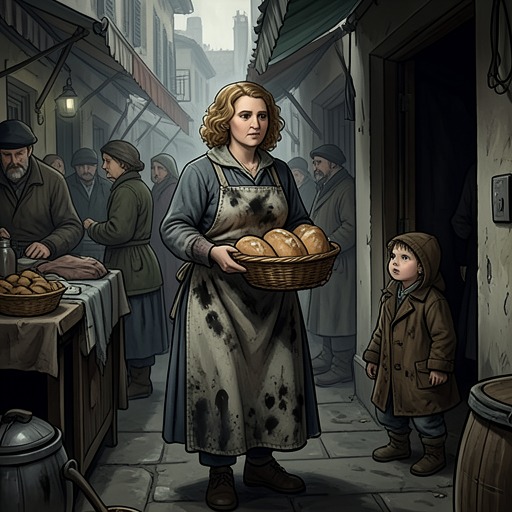
The first consequences appear in paid domestic labor. When Liesel Meminger accompanies Rosa Hubermann on washing and ironing deliveries across Molching, Ernst Vogel tells Rosa that he can no longer afford the service. He apologizes by saying that times are getting harder and that the war is making everything tight, then asks whether she receives an allowance for caring for the child. His remark turns the foster household into an item in an impoverished customer’s arithmetic. Rosa, ordinarily forceful and verbally aggressive, is left speechless, while Liesel experiences the cancellation as a direct threat to the family’s livelihood.
Scarcity also reaches the Steiner family through the collapse of business. The removal of Jewish competition does not produce security for Alex Steiner; it also removes Jewish customers, leaving the Steiners to scratch things together and rely on trade. This contradiction reveals how Nazi economic policy damages the community even when it is presented as national advantage. Discrimination may eliminate one visible competitor, but it simultaneously destroys customers, circulation, and the fragile exchanges on which poor families depend.
Hunger and Rudy and Liesel’s Theft
The strongest personal consequence of scarcity is Rudy Steiner’s hunger. In summer 1940, rationing combines with the Steiner family’s failing business, and Rudy is described as permanently desperate for something to eat. Games, bicycle rides, visits, and soccer can distract him temporarily, but they cannot remove the bodily fact of hunger. The friendship between Rudy and Liesel Meminger is therefore cemented not by an abstract shared rebelliousness but by a practical response to deprivation: stealing food.
The Hubermann household has little surplus to offer. Rosa’s weekly cooking follows a strict cycle: pea soup made on Sunday must last until the following Saturday, with bread and occasional small portions of potatoes or meat. Everyone eats what is provided, asks for no more, and does not complain. The routine gives scarcity a repetitive form. Hunger is not represented only as an emergency; it is built into the calendar, the pot, and the rules of the table.
Because Liesel cannot simply bring Rudy food from home, the children turn to theft. Their stealing grows out of a specific chain of causes—rationing, reduced family income, and Rudy’s hunger—and it changes the moral meaning of the word thief. Liesel’s first successful theft, The Grave Digger’s Handbook, is celebrated as the beginning of an illustrious career, but later thefts with Rudy are tied more directly to feeding themselves and resisting the limits imposed on poor children. The narrative thus places childhood theft beside the larger economic violence of the war: the children cross a legal boundary to obtain what scarcity withholds, while state policy and military power create the deprivation itself.
Scarcity as Bodily Deprivation
The deprivation of Max Vandenburg makes scarcity visible in a body kept hidden from public life. In the basement, he has cool cement and too much time, while the minutes and hours become physically punishing. His condition later declines severely: he remains constantly cold, his hands swim with weakness, and he develops visions of boxing with the Führer. Even exercise cannot warm him. His weight falls away, his regimen collapses, and he spends January holding himself together before reaching a dangerous state in early February. By mid-February, shortly before Liesel’s thirteenth birthday, he approaches the fireplace on the verge of collapse and nearly falls into it.
Max’s illness shows that scarcity is not limited to ration cards or empty cupboards. It includes inadequate warmth, confinement, restricted movement, and the absence of reliable medical care. His body becomes an account of the resources denied to a Jewish man in hiding. The basement protects him from immediate capture but cannot provide the conditions required for recovery, so safety itself becomes inseparable from physical deterioration.
The same logic governs the Jews forced through Molching. They come down the road in a starving procession, their eyes enormous in malnourished faces, dirt molded to their bodies, and legs staggering under soldiers’ hands. Their condition is not accidental poverty but organized persecution and forced movement. Rationing and scarcity therefore operate at different levels: civilians experience reduced food and work, while Jewish prisoners endure a system that converts deprivation into a weapon of racial persecution.
The short war story of Frau Holtzapfel’s son Robert extends this bodily economy to the front. His legs are blown off at the shins, and he dies after the injury. The damaged body is the final product of a military system that consumes men and distributes care according to wartime necessity. Scarcity is consequently joined to mutilation: food, warmth, medical attention, and human life are all treated as expendable under the demands of war.
Shelters, Labor, and Collective Survival
By summer 1942, Molching is preparing for air raids. Shelters are marked more clearly, windows are blacked out, and residents know the nearest basement or cellar. The preparations show a community adapting its infrastructure to expected destruction, but they also reveal how scarcity redirects available materials and labor. Hans Hubermann finds a temporary improvement in his painting business because people need their windows darkened. When black paint becomes difficult to find, he mixes coal dust into other paint and works cheaply, using trade skill to compensate for depleted supplies.
The Fiedlers’ basement becomes a shared survival space rather than a private room. Twenty-two people crowd into it, including the Steiner family, Frau Holtzapfel, Pfiffikus, a young man, and the Jenson family. Its single light globe, dank coldness, jagged walls, and unreliable acoustic separation from the sirens make clear that shelter is itself a scarce and imperfect resource. Rosa Hubermann and Frau Holtzapfel must be kept apart to preserve a civil environment, yet the danger is greater than their ordinary arguments. Scarcity produces crowding, discomfort, and conflict, but it also forces neighbors into common dependence.
When another raid is announced as a possible threat to Molching on September 19, the residents again stream from Himmel Street toward shelter. Even Hans’s refusal to take his accordion, after surviving the previous raid without it, shows how catastrophe distorts practical reasoning into a contest between logic and superstition. Inside the basement, Liesel opens The Whistler and reads aloud to block out the noise. Rudy Steiner notices first, draws others’ attention to the book, and Hans moves closer; by the third page, the crowded room has become quiet except for Liesel’s voice. Reading cannot end the raid or increase the food supply, but it redistributes attention and creates a temporary form of collective endurance within a materially inadequate shelter.
Military Scarcity and Its Aftermath
The scarcity affecting Molching is connected to the broader military economy. Alex Steiner is sent to an army hospital outside Vienna, where his tailoring expertise is redirected to repairing uniforms, socks, and shirts for soldiers suffering in Russia. The garments are mended even when their remaining use is reduced to underclothes. This detail shows an economy operating through relentless reuse: materials are repaired because replacement is unavailable, while soldiers’ bodies continue to be exposed to extreme need.
Hans Hubermann is sent first to Stuttgart and later to Essen for the LSE, one of the least desirable home-front positions. The work places him within the machinery of wartime damage and cleanup rather than ordinary painting. In Essen, an olive-green truck carrying men toward a camp crashes after its left front wheel is punctured. The damage report records six men burned by cigarettes and two broken hands, reducing human injury to a terse inventory. Scarcity here becomes institutional: transport, labor, and bodies are all managed under conditions in which accidents and suffering are absorbed as operational costs.
The state of scarcity reaches its most destructive form in the ending implied by the account of death. The narrative’s return to the “last luck” and to a single man after the devastation of Himmel Street places individual survival against mass destruction. What begins as rationing—less food, fewer customers, and harder work—ends in a world where shelters, roads, homes, bodies, and lives have been consumed by war. The progression makes scarcity a slow violence as well as a series of crises: it narrows choices day after day until hunger encourages theft, cold weakens the hidden, persecution starves the displaced, and military systems treat injury as another item to be counted.