World War I
The Book ThiefWorld War I, also called the Great War, functions in the novel as both a past conflict and a continuing force in the lives of those who survived it. Its decisive significance lies in the way it turns Hans Hubermann’s later kindness into an obligation: the war gives him the accordion, binds him to Erik Vandenburg, and helps explain why his private acts of loyalty become dangerous in Nazi Germany. It also establishes the book’s recurring pattern of survival, loss, and the uneasy sense that one escape from death can create responsibilities that last for decades.
Historical Presence and Narrative Memory
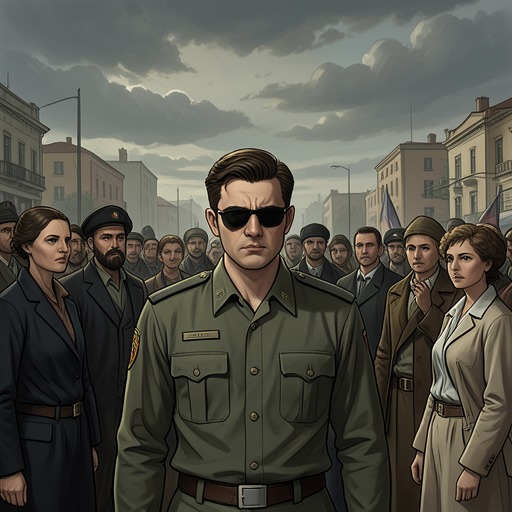
World War I is introduced not as a distant historical lesson but as the origin of stories that resist ordinary explanation. Wars are presented as places of blood and violence in which improbable survivals become personal legends: a soldier may believe that an animal saved him, or wonder why he alone remained alive when the men on either side were killed. This emphasis shifts attention from military history to the survivors’ unresolved questions. The war matters because it continues to live inside the memories and relationships of the people who passed through it.
The novel also gives the war a retrospective narrative force. Hans Hubermann had already escaped death in one world war, only to be placed in another later, described as a perverse reward for the earlier survival. His first escape is explicitly identified as the Great War, while a second escape is associated with Essen in 1943. The two conflicts therefore form a grim pair: separated by time, yet joined by the same survivor and by the narrator’s repeated expectation that Hans should have died.
Hans Hubermann and Erik Vandenburg
During World War I, Hans became friends with Erik Vandenburg, a German Jew one year older than him. Their friendship developed because neither man was especially interested in fighting. They preferred rolling cigarettes to combat, playing craps to shooting bullets, and sharing music and gambling as ways of preserving a human connection within military life. Their bond was built not on patriotic ambition but on a shared desire to survive.
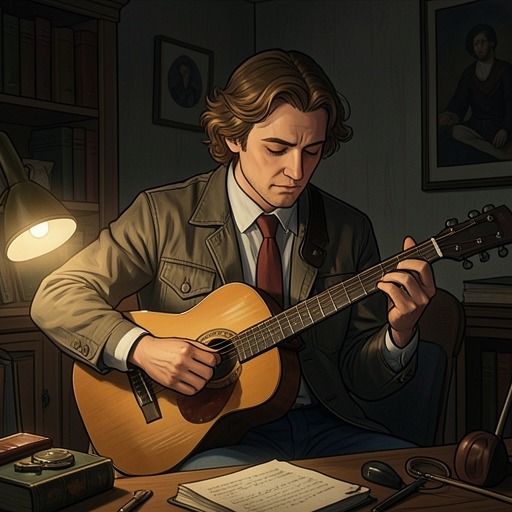
Erik taught Hans to play the accordion, creating the musical inheritance that later becomes central to Hans’s identity and household. The instrument survives even when Erik does not. Erik was eventually found in pieces on a grassy hill, with his eyes open and his wedding ring stolen. His personal belongings were sent home, but the accordion was considered too large to transport. It remained at the base camp and was given to Hans, the only man in their group to survive.
The accordion is thus more than a possession acquired during wartime. It is the material remainder of Erik’s death and the proof of a promise that outlives the battlefield. Hans carries the instrument into civilian life, where he plays it in the pubs of Molching during winter and earns occasional money as a painter and musician. Much later, the accordion’s sound announces safety to Liesel: during the day, its music helps distinguish waking life from the nightmares of her dead brother. A relic of World War I consequently becomes part of the emotional infrastructure of her new home.
Survival, Writing, and Obligation
Hans’s first escape from death occurs when he is ordered to write letters while the other men go into battle. His writing ability is described as doubtful, but he regards himself as lucky and does the work as best he can. None of the other men return. The episode makes survival inseparable from chance, duty, and guilt: Hans lives not because he defeats the war, but because he is temporarily assigned elsewhere.
The war also leaves him with a moral debt connected to Erik Vandenburg. That debt becomes crucial when Erik’s son, Max Vandenburg, later enters Hans’s life. The evidence surrounding World War I establishes why Hans’s relationship with the Vandenburg family carries the weight of an old promise rather than a casual act of charity. The accordion preserves Erik’s presence, while Hans’s later willingness to protect Max transforms wartime friendship into a dangerous obligation across generations.
Hans’s position in postwar Germany remains precarious. He is not immediately granted membership in the Nazi Party; instead, his application is placed on a waiting list and regarded with suspicion. After Kristallnacht, when Jews are cleared out, the Gestapo searches the Hubermanns’ house. Hans is allowed to remain, probably because local people know that he is at least waiting for his application to be approved. His apparent political usefulness protects him, but it also exposes the contradiction between public conformity and private loyalty that the earlier war has helped create.
Repeated War and the Civilian World
World War I forms the background against which the later war is experienced. In Molching, preparations for Hitler’s birthday include marching, music, singing, and a public fire intended to celebrate the Führer, victory over enemies, and Germany’s release from the restraints imposed since the end of World War I. The earlier conflict is therefore appropriated by Nazi public culture as a justification for renewed nationalism. Private memory and official propaganda give the same war radically different meanings.
The civilian population experiences the later conflict through raids, shelters, shortages, military labor, and the constant circulation of warnings. In the Fiedlers’ deep basement, twenty-two people crowd together beneath a dangling light globe while sirens and muffled sounds pass through the walls. During one raid, Liesel reads The Whistler aloud, and the frightened group gradually falls silent as the reading continues. The scene echoes the earlier role of music: art does not stop war, but it creates a temporary communal order inside fear.
Hans’s wartime fate also extends beyond the original battlefield. He is eventually sent to Stuttgart and then Essen to serve in the LSE, an undesirable home-front position. Alex Steiner, meanwhile, is sent to an army hospital outside Vienna, where his tailoring skills are used to repair uniforms, socks, and shirts for soldiers suffering in Russia. These assignments show how the later war absorbs civilians into its machinery even when they are not fighting at the front. The distinction between soldier and civilian becomes increasingly unstable.
Significance in the Novel’s Structure
World War I gives the novel one of its deepest patterns: survival is never presented as a clean victory. Hans survives the Great War, but that survival leaves him with Erik’s accordion and the obligations attached to it. He survives again in 1943, yet the repeated escape intensifies rather than resolves the question of why he was spared. The wars make survival appear at once fortunate, arbitrary, and morally demanding.
The conflict also demonstrates how historical time is carried through objects and gestures. An accordion, a letter, a remembered friendship, and a survivor’s later decision can bridge the years between the battlefield and Himmel Street. By the time war reaches the Fiedlers’ shelter and destroys the neighborhood, the earlier conflict has become part of a long chain of memory and consequence. World War I is therefore not merely background chronology. It is the first major link in the book’s network of debts, losses, and human attempts to preserve one another against systems that turn people into expendable bodies.