
Fact, Testimony, and Narrative Truth
The Book of MirrorsThis flow traces how different witnesses and investigators turn incomplete evidence into rival stories, and how each new account forces earlier conclusions to be reconsidered.
increasing Bearing strength in each event
 decreasing
Bearing strength in each eventdecreasingA Confident Manuscript
A Story Presented as Testimony
The Promise of Revelation
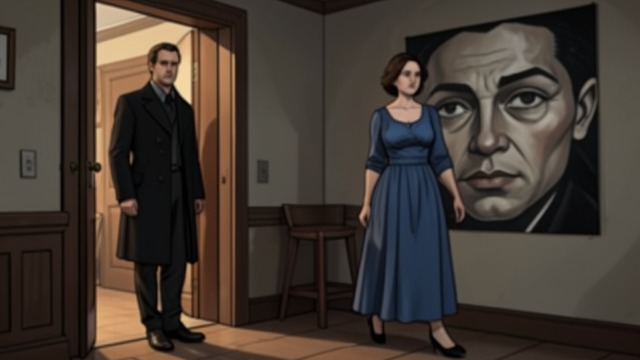
Richard Flynn introduces his manuscript as the truth about events that changed his life. He claims that a discovery revived memories of Laura Baines, Joseph Wieder, and the 1987 murder, and he frames the book as a belated account of what investigators never learned. His certainty gives the pages the force of confession before their claims can be checked.
A Narrative with Gaps
The excerpt ends as Flynn travels toward Wieder’s house, convinced that Laura has deceived him. It establishes motive, jealousy, and opportunity but withholds what happened next. Peter Katz must therefore decide whether he is reading a true-crime revelation, a confession, or a story designed to resemble both.
The manuscript demonstrates how narrative confidence can create an impression of completeness even when crucial facts are missing. Its form invites readers to fill the gap, while the investigation that follows reveals how dangerous it is to mistake a compelling account for a verified one.
Witnesses at Odds
Testimony as Rival Story
The Handyman’s Account
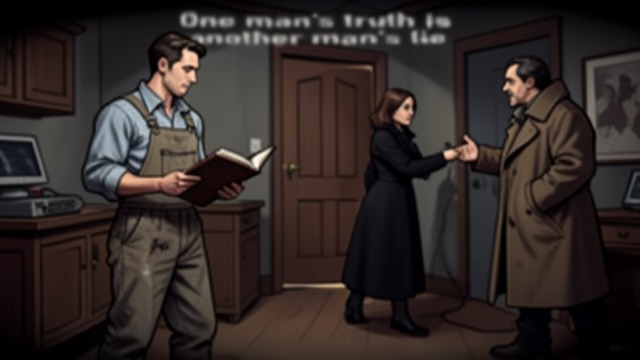
Derek Simmons tells John Keller that Richard Flynn argued with Joseph Wieder while Laura Baines was present, that Laura left, and that Flynn later killed the professor. Simmons presents the memory as clear and long-suppressed. His story appears to give the cold case the eyewitness account it has lacked.
The Conflicting Confession
Frank Spoel later says he attacked Wieder, saw Flynn with the professor, and fled when someone entered the house. He does not describe Laura or the argument Simmons remembers. The incompatible accounts place different people in the same setting and give the killing different motives, making the witness conflict itself central evidence.
Neither testimony is self-authenticating. Simmons has a history of amnesia; Spoel is a condemned killer with incentives to tell a dramatic story. Keller and then Roy Freeman must distinguish the existence of a witness account from its reliability, while recognizing that memory, self-interest, and observation may all shape what is reported.
The Detective’s Missing Link

A Case Reopened by a Detail
Evidence Across Separate Files
Roy Freeman returns to the records of the earlier case involving Derek Simmons’s wife and notices a phone number that had not seemed important in 1983. He recognizes the address as linked to Joseph Wieder’s later home. The call log makes a hidden connection between the two investigations visible after decades of separation.
Reframing the Suspect
The number reveals that Simmons contacted Wieder immediately after finding his wife dead. Freeman understands that Simmons had a prior relationship with the professor and may have used that connection to shape the insanity defense that led to his hospitalization. What looked like an isolated 1987 murder now has roots in an earlier story of possible deception and violence.
The revelation depends less on a dramatic confession than on an old record interpreted in a new context. The same document that once failed to guide investigators becomes decisive when someone asks a different question of it, showing that evidence can remain materially unchanged while its meaning shifts.
A Suspect’s Convenient Memory

Reconsidering the Witness
A Phrase from the Past
Derek Simmons repeats the phrase “Now it’s time to play ball” as he ends his conversation with Roy Freeman. Freeman recognizes that Simmons’s supposed recollection of hearing the phrase at a 1979 baseball game cannot have been learned through the biographical facts Simmons later collected. The detail makes his claim of complete amnesia less credible.
From Witness to Culprit
Freeman confronts Simmons with the call log and the contradictions in his accounts. Simmons admits to killing Joseph Wieder after Frank Spoel’s assault, but Freeman also concludes that Simmons likely murdered Anne and invented parts of the story about her past. The confession resolves the central mystery while opening another painful uncertainty about how much of Simmons’s remembered life was fantasy.
The reversal does not turn the detective into an all-knowing narrator. Freeman acts on a pattern of details and obtains a confession, but the story of Anne’s death remains colored by Simmons’s distortions. The distinction between solving a case and recovering an entire truth remains visible at the climax.
Truth Beyond the Verdict
Resolution Without Perfect Knowledge
The Solved Murder
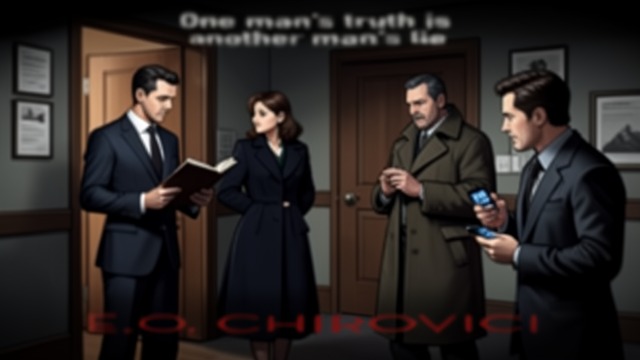
Roy Freeman’s investigation establishes a sequence in which Frank Spoel first attacks Joseph Wieder and Derek Simmons later delivers the fatal blow. Simmons’s confession changes the public understanding of the case, while the arrest gives Freeman the practical resolution he had sought for decades.
The Remaining Uncertainty
Other questions resist the same closure. Laura Westlake’s account of her work differs from Sarah Harper’s suspicion that she stole Wieder’s book; Simmons’s claims about Anne are exposed as unreliable, but the full truth of her death cannot be reconstructed with equal certainty. Even the returned manuscript arrives after its author can no longer clarify what he intended to claim.
The ending distinguishes a legal or investigative conclusion from omniscience. A compelling story can be overturned by new evidence, yet the replacement account still has limits. The novel’s final insistence is not that truth is impossible, but that responsible judgment must leave room for what the surviving record cannot settle.
Twenty-six years after the murder, when Richard Flynn writes to Peter Katz
During John Keller’s investigation, after Derek Simmons recounts the murder
Near the end, when Roy Freeman connects the two murder investigations
Near the ending, during Roy Freeman’s final confrontation with Derek Simmons
At the epilogue, after Derek Simmons’s arrest and the manuscript’s arrival
