1987
The Book of MirrorsIn The Book of Mirrors, 1987 is both the year of Joseph Wieder’s murder and the past that the novel repeatedly reopens. Set against Richard Flynn’s student life and Laura Baines’s disappearance, it becomes the point where love, violence, memory, and competing testimony converge. The year is not presented as a settled block of history: what happened in New Jersey Princeton is revisited decades later, when delayed memories and newly connected details alter the meaning of the original investigation.
The year of the murder
The novel first gives 1987 the shape of a public calendar: the stock market’s dramatic rise and fall, the continuing Iran–Contra affair, and the arrival of The Bold and the Beautiful in American homes. Richard Flynn measures the same year privately. A little over three years into his studies at Princeton University, he is living on Bayard Lane, within walking distance of McCosh Hall, when an October encounter in his kitchen brings him into contact with Laura Baines. The contrast between national events and a single young man’s experience frames the year as both historical setting and personal turning point.
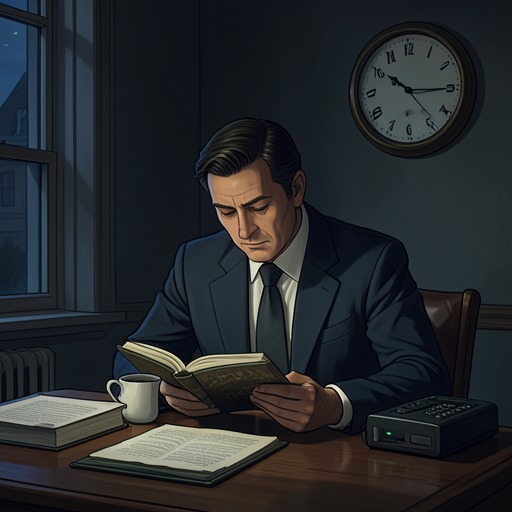
By December, that private story has become inseparable from a crime. Joseph Wieder, a renowned psychologist and professor, is murdered in his home on the night of 21–22 December 1987. The killing follows a dinner Richard attended at Wieder’s house a few days earlier. The police conduct extensive investigations but never identify the perpetrator, and Richard himself becomes one of the suspects because he had been at the house that evening. The case therefore marks 1987 not simply as the setting of a death, but as the start of a long uncertainty about who was present, what happened, and what the surviving accounts leave out.
The aftermath reaches into Richard’s life immediately. Laura disappears from home the morning after the murder, without saying goodbye, and he never sees her again. Detectives and reporters harass him; he eventually leaves Princeton for graduate study at Cornell, spending two years in Ithaca. In retrospect, he considers the disappearance a possible point at which his relationship with Laura—and the future he had imagined for himself—came apart, while recognizing that the deterioration had begun earlier. The year’s consequences thus extend beyond the unsolved case into a break in Richard’s personal and intellectual life.
A past reconstructed from later knowledge
The 1987 events acquire a different meaning when Richard looks back twenty-six years later. He describes the truth as something he was not seeking but that struck him unexpectedly. Three months before writing to literary agent Peter Katz, he says, he had stumbled upon it. The return to 1987 is consequently neither a straightforward diary of events nor an uninterrupted recollection: the older narrator writes with knowledge that the younger participant did not possess, and the past appears through a later act of discovery.
That act of writing is itself tied to the recovered past. Richard says that memories of the months in 1987 returned with unusual force and quickly overshadowed his present life. They seemed to him to have been silently gathering until he began writing about Laura, Joseph Wieder, and himself. He had once been questioned by police and reporters, but, as he understands it, the whole truth had never been discovered. The manuscript he offers Peter Katz is his attempt to disclose what he learned, written after anger and frustration had become material for a story. The gap between the year lived and the year narrated is central: what was once an unresolved public case becomes, for Richard, a personal history he can finally put into words.
The novel also stresses that a story’s beginning and ending are choices made by a narrator, not self-evident borders around events. That reflection bears directly on 1987. The murder is a dateable event, but its causes begin earlier, and its consequences continue long afterward; the later account can make an old scene newly legible without making every part of it certain. In this structure, the year functions as a fixed point that the narrative circles back to, while the interpretation of that point remains open to revision.
Testimony under suspicion
The accounts surrounding the murder show how difficult it is to turn 1987 into a single reliable version. Derek Simmons later tells an investigator that he knew who killed Wieder and that he had reported what he saw at the time. He also explains why he believed his statement was dismissed: he had previously been accused of murder, confined in a psychiatric institution, and given medication, so he expected authorities and lawyers to treat him as unreliable or delusional. His confidence in his own observation stands against the institutional record, which did not produce an arrest for Wieder’s murder.
Derek’s account places Richard at the house after an argument with Wieder and suggests that Laura may also have been there. Derek suspects Richard killed the professor, with Laura either participating or witnessing, but acknowledges that he did not tell police about her because he feared publicity would damage Wieder’s reputation. He says he saw her car nearby and believed she had returned to spend the night with the professor. These are Derek’s suspicions, not established facts. His further recollection—that he returned early the next morning, entered with his keys, and found Wieder’s body in the living room—adds a concrete sequence while leaving the central question of responsibility unresolved.
The investigation’s treatment of witnesses makes that uncertainty sharper. A former investigator says police knew of Laura and interviewed her, but her alibi, reportedly confirmed by a schoolmate, was considered strong; the alleged relationship with Wieder could not be proved. Derek’s statement was also discounted because he was ill and had amnesia. Later, when another investigator confronts him with discrepancies between his version and Frank Spoel’s, Derek answers that either man might have forgotten or lied. The competing stories do not simply supply different details: they expose how suspicion, illness, memory, and the desire to protect a dead man’s reputation shaped what investigators heard and what they could establish.
The year’s echoes across the timeline
Other dates make 1987 part of a wider pattern of memory and delayed recognition. In 1983, a fifteen-minute-and-forty-one-second telephone call recorded under the name Jesse E. Banks had seemed irrelevant to investigators. Years later, the address on the record catches an investigator’s attention while reviewing Derek Simmons’s call list, helping connect the Simmons and Wieder cases. The discovery depends on seeing a record from one case in the light of another; the apparent separation between events is itself part of what had concealed their significance.
Derek’s memories also reach further back. In March 1987, while watching NY1, he recognizes Stan Marini, a man from the maintenance crew at Siemens, in a report about a suicide. He understands that he is remembering something not supplied to him by another person and not learned from reading. That return of a specific memory precedes the December murder and complicates the assumption that Derek’s memory loss simply renders him incapable of knowing his own past. Later, an investigator challenges Derek over a recollection involving the Bronx, a stadium, and an announcement made in 1979, using the date to test whether he had truly forgotten or had concealed what he knew.
Across these intervals, 1987 is both the novel’s historical center and a measure of how incomplete any chronology can be. The murder remains unsolved by the original investigation; witnesses’ statements conflict, and remembered details emerge at different times. The year’s meaning therefore changes as records are reread and memories return. Its decisive role is not that it supplies a final, uncontested account, but that it anchors a story in which later knowledge repeatedly reopens the past.