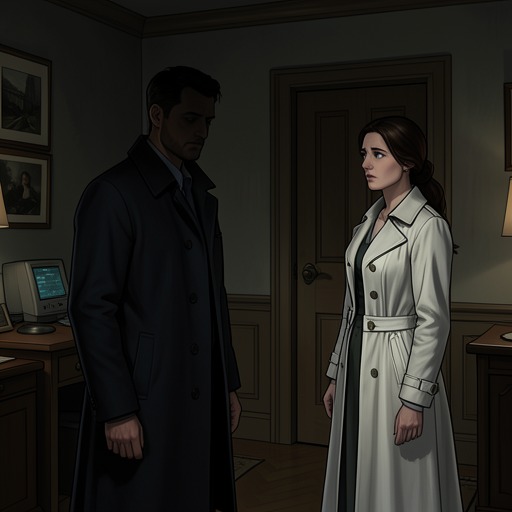
Anne
The Book of MirrorsAnne is Derek Simmons’s wife, but the reader encounters her chiefly through accounts that cannot be reconciled. Derek remembers a troubled past, betrayal, and cruelty; the police report cited by the narrator presents a different history. Even the circumstances of her death remain contested: Derek says he found her in a pool of blood and denies killing her, while the narrator directly accuses him. The gap between these versions makes Anne central to the novel’s scrutiny of memory without giving her an independent account of events.
Identity and disputed past
Derek describes Anne as having grown up in an orphanage in Rhode Island and left it at eighteen. In his version, she slept rough, became involved with gangs, and was working as a prostitute in Atlantic City by nineteen. He says he met her in a motel parking lot in Princeton, New Jersey, where he was repairing the heating system, shortly after she had reached what he regarded as rock bottom.
The narrator later challenges this history with the detectives’ report. Before meeting Derek, Anne had worked for about two years as a barmaid at Ruby’s Cafe in Atlantic City. The people interviewed described her as decent, intelligent, and kind. That discrepancy is consequential: details Derek treats as the foundation of their relationship may belong to his recollection rather than to Anne’s established past. The evidence does not explain every difference or independently reconstruct her life, but it makes his account impossible to accept as settled fact.
Courtship and marriage
In Derek’s telling, Anne moved in with him and they became lovers. About two weeks later, two armed men came to the door and said Anne owed them money. Derek says he went to the bank, withdrew his entire savings of $5,000, and gave it to them; they said they would leave her alone. This episode, like the account of Anne’s earlier life, is reported as Derek’s story, not confirmed by the narrator.
About two months later, before Christmas, Derek proposed and Anne accepted. He remembers the early period of their marriage as promising, a beginning that makes the deterioration he describes more stark. The relationship is presented through his explanation of why he stayed: he says he was deeply in love with her and believed he could not leave, even as he feared she might leave him. Anne’s own reasons for accepting his proposal, and her perspective on their shared life, are not supplied.
Marriage in Derek’s account
Derek says that after about two years the marriage began to unravel. He portrays Anne as drinking heavily and having casual sexual encounters with strangers, apparently without concern that he might discover them. He also says she kept up appearances in public but insulted and humiliated him in private, calling him crazy and a failure and criticizing their inexpensive life and his inability to earn more. In his account, she repeatedly threatened to leave.
He recalls wanting children and says Anne rejected the idea by referring to the prospect of having children like him. He describes himself as unable to make himself end the relationship, while imagining that other men in town might have slept with her and feeling that people laughed at him. These details convey the intensity of his jealousy and humiliation, but the narrative presents them as his recollections rather than an independently verified record of Anne’s conduct. The distinction matters especially because the later police report contradicts his claims about her background, and the narrator questions whether other parts of his story were real.
Derek also describes a later change in Anne. He says she began dressing better and wearing makeup, stopped drinking, and seemed happier, while becoming increasingly distant from him. She came home late and went out early, leaving them little time together; eventually, he says, she could not be bothered to argue. Derek interprets this shift as evidence that something had happened and says he soon discovered what was going on. The available account does not establish exactly what he discovered or confirm that Anne was having an affair.
Death and narrative significance
When asked directly whether he killed Anne, Derek denies it. He says he found her lying in a pool of blood, while adding that he knew she had been cheating on him. The narrator does not accept the denial and tells him that he believes Derek killed her. The accusation is firm, but the evidence presented here does not resolve the killing as an established fact.
The narrator also challenges Derek’s belief that Anne had been involved with Joseph Wieder, a professor. He allows that she may instead have asked Wieder for help, and says he is not sure that an affair took place. He links Derek’s recovered memories with the return of his nightmares, further placing the account of Anne within a story where recollection and painful experience are entangled. Anne’s history, marriage, alleged infidelity, and death therefore remain filtered through claims under dispute. That limitation is part of her narrative significance: the reader must distinguish Anne as a person from the version of her Derek remembers and uses to explain his own past.