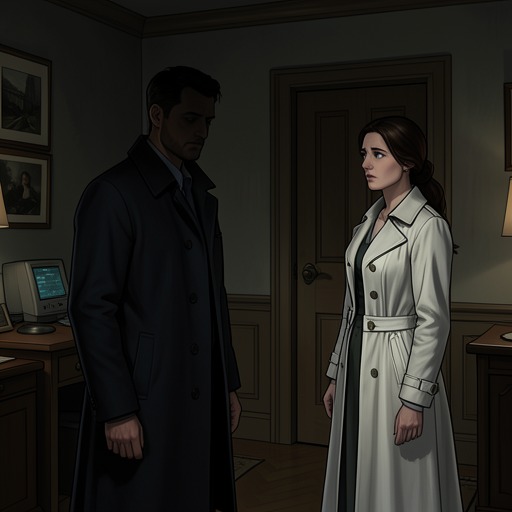
Derek Simmons’s Arrest and Hospitalization After His Wife’s Murder
The Book of MirrorsDerek Simmons’s arrest and hospitalization after Anne’s murder became a turning point in both his life and the later investigation of Joseph Wieder’s death: an attempt to use his psychiatric history as leverage gave way to a legal insanity finding, institutional confinement, an attack, and the loss of his memory. Recalled through Simmons’s account, the episode also explains why investigators treated his later claims as unreliable, even though he insisted he had witnessed crucial events.
The Call and the Arrest
On the morning Anne was killed, Simmons called Wieder after finding the professor’s home number among Anne’s belongings. He warned Wieder that the police might make him a scapegoat and threatened to involve him by disclosing what Simmons believed was an affair between Wieder and Anne. Simmons also pointed to his previous admission to a mental hospital, arguing that Wieder could help ensure he was found not guilty by reason of insanity and committed to a forensic psychiatric institution. The call turned the alleged relationship into leverage: Simmons was not merely accusing Wieder but invoking the possibility that Wieder could influence what happened to him.
Simmons was subsequently arrested on suspicion of murdering his wife. He was declared legally insane and committed to Trenton Psychiatric Hospital. The account establishes this sequence but does not resolve the underlying question of Anne’s death or prove that Wieder and Anne had been lovers. Simmons later described Wieder as rich, prominent, and much older than Anne, and said he believed Wieder would avoid a scandal; those were Simmons’s convictions, not independently confirmed facts.
Attack, Coma, and Amnesia
Before Simmons could be transferred to Marlboro Hospital, another patient attacked him at Trenton Psychiatric Hospital. The assault left him in a coma. On waking, he recognized no one, could not remember his name, and did not know how he had come to be in the hospital. Tests led staff to conclude that the amnesia was genuine rather than feigned.
The attack radically altered Simmons’s relationship to Wieder. Previously, Simmons had threatened to expose him; after waking, Simmons remembered none of that history and experienced Wieder as a kind, attentive doctor. Wieder said he would treat Simmons without charge and arrange his transfer to Marlboro Hospital. Simmons recalled being overwhelmed by this care, a response made possible by the very memory loss that had erased the earlier conflict.
Release and a New Life
Simmons stayed at Marlboro Hospital for several months without recovering his memories. He gradually learned basic facts about his past, including who his parents were and where he had attended high school. What he learned included his mother’s death, his psychiatric hospitalization, his difficult job, his wife’s alleged infidelity, and the accusation that he had murdered her. Overwhelmed by this history, he stopped trying to recover it and decided to begin again after release.
Wieder chaired the panel that approved Simmons’s release. Because Simmons had nowhere to go, Wieder found him lodging near his own home and gave him work as a handyman there. Simmons could still repair things despite being unable to remember when or how he had acquired those skills. His memory loss, as he described it, severed knowledge of his personal identity without erasing practical abilities. The arrangement placed him close to Wieder and made the professor both his benefactor and employer.
Testimony and Its Credibility
Simmons later said he knew who had killed Wieder and that he had told the police at the time. He believed his statement had been dismissed because he had previously faced a murder accusation, been confined to a psychiatric hospital, taken medication, and could therefore be portrayed as delusional or unreliable. His account of the night of Wieder’s death implicated Richard Flynn and suggested that Laura Baines might have been an accomplice or witness, but Simmons said he had withheld her name from police because he feared a scandal would tarnish Wieder’s reputation.
The surviving investigative discussion reinforces the credibility problem without resolving it. A police interviewer remembered that Simmons was ill and amnesiac and considered his statement of little practical value; the alleged affair and Laura Baines’s reported alibi could not be substantiated as proof that she had been at the scene. Later, when Simmons’s version was compared with Frank Spoel’s account of the same night, Simmons allowed that Spoel might have forgotten or might be lying. The discrepancies leave Simmons’s testimony contested rather than confirmed. His hospitalization thus functions not only as a biographical rupture but as part of the evidentiary history: the attack erased his memories, while his psychiatric record continued to shape how others judged what he said.