Derek Simmons’s Confession to Killing Wieder and Arrest
The Book of MirrorsDerek Simmons’s Confession to Killing Wieder and Arrest is the revelation that identifies Simmons as the person who delivered the final blow to Joseph Wieder. Roy Freeman’s renewed investigation links a previously overlooked telephone record to the old murder; when Freeman confronts Simmons, the confession both clarifies Wieder’s death and leaves the circumstances of Anne Simmons’s killing unresolved. The admission leads into Simmons’s arrest and collapses the appearance that Richard Flynn’s manuscript had explained the crime as straightforward fact.
The Overlooked Lead
The confession follows Freeman’s recognition that the Simmons and Wieder cases, separated by four years, belonged in the same investigation. A call listing showed that Simmons had telephoned Wieder on the morning in question. The call lasted fifteen minutes and forty-one seconds, but its number was still associated with Jesse E. Banks, the deceased former owner of Wieder’s newly purchased house. Investigators had reached a dead end while checking the calls and dropped the lead; at the time, even a connection to Wieder would not have seemed relevant to their case.
Once the significance of the address and number became clear, Freeman spent two hours assembling the details of the two cases. He laid out his papers during a long meeting with an assistant at the Mercer County Prosecutor’s Office; the assistant contacted Chief Brocato to confirm the details. This preparation turns the confession into the result of a recovered investigative connection, not a chance disclosure. Freeman approaches Simmons with a specific question grounded in the old call record, and Simmons recognizes that the detective has uncovered the conversation he made to Wieder.
The Confrontation and Simmons’s Denial
Before Simmons tells the story, Freeman waits rather than pressing him to speak. He believes Simmons has been waiting a long time to tell someone the whole account and expects that Simmons will leave town and not return. Freeman describes the moment as one in which a suspect seems ready to tell the truth, but insists that the telling must take its own course. The pause establishes the confession as a choice Simmons makes under questioning, after Freeman has shown that the abandoned telephone lead is no longer hidden.
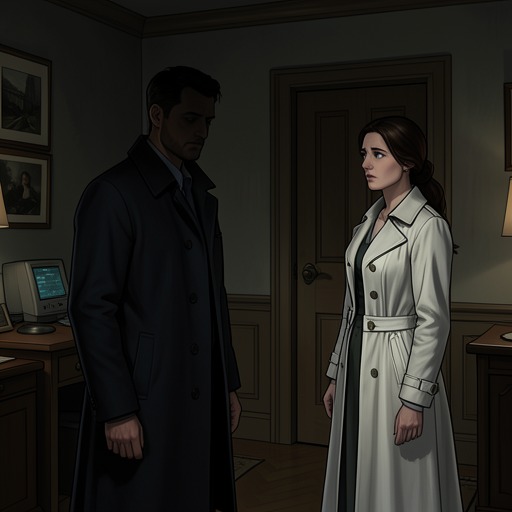
Freeman first asks whether Simmons killed his wife. Simmons shakes his head and denies it. He maintains that he found Anne in a pool of blood, although he says he knew she had been cheating on him and believed she deserved what happened. The denial is not an account that identifies Anne’s killer: it preserves the distinction between Simmons’s knowledge of her affair and responsibility for her death. That unresolved earlier crime is the emotional background to what he does admit about Wieder.
The Account of Wieder’s Death
Simmons says that he had long thought about killing Wieder after recovering his memory, but had refrained because he did not want to go to jail or a psychiatric hospital. On the night Wieder was attacked, Simmons had forgotten his toolbox at the house. He had repaired the downstairs toilet earlier, eaten lunch with Wieder, and needed the toolbox for a job near his own home the following morning. When he went to retrieve it, he first circled around to the backyard and saw the living-room lights on. Through the window, he saw Wieder at the table with Richard Flynn, then a student.
Simmons describes finding Wieder on the floor, gravely injured but not yet dead. He says he did not know whether to leave, call an ambulance, or do something else. As he leaned over Wieder, with a flashlight lit beside him, Wieder opened his eyes. Simmons says that look brought back the memory of following Anne to a hotel room and listening outside the door, as well as the humiliation and anger he associated with their relationship. He connects the remembered affair, Wieder’s role in his life, and his own resentment to the decision that followed. The confession thus distinguishes the person who first beat Wieder from the person who completed the attack.
Simmons admits that he took out a blackjack and struck Wieder once, hard. He locked the door, threw the blackjack into the lake, and went home. He recalls feeling no remorse, thinking instead that he had finished what another man had started. He returned to the house the next morning, but says he did not learn that Flynn had not been the person who beat Wieder until Freeman visited him days before the confession. Simmons had treated the matter as buried until the reporter’s arrival brought it back into view.
Recording, Arrest, and Consequences
Freeman tells Simmons that Wieder died two hours later, according to the medical examiner, and that an ambulance might have saved him. The detail fixes the consequence of Simmons’s decision not to summon help: his blow was delivered to an injured man who could still have been rescued, and Simmons knowingly left him there. The account also explains why the morning telephone call mattered. Simmons had contacted Wieder quickly from his home because he feared being seen and did not know whether police would arrest him when they arrived.
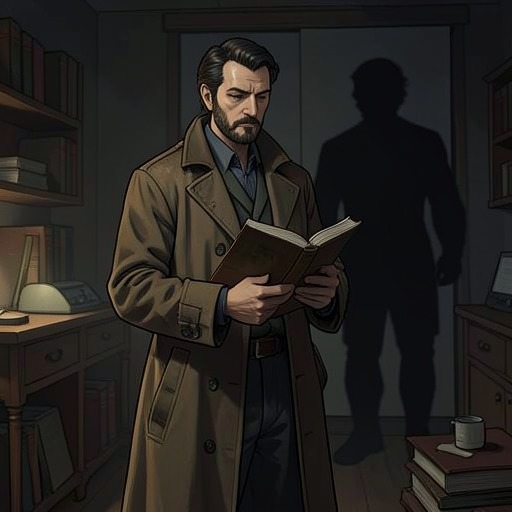
Freeman secretly records the confession with a special pencil in his jacket pocket, without wires. After he parts from Simmons and drives away from Witherspoon Street, he hears police sirens. The novel later identifies Simmons’s arrest as the consequence of the disclosure, although the sirens alone do not show the precise moment or procedure of his arrest. Freeman’s thoughts after leaving remain unsettled: he wonders whether Wieder had hypnotized Simmons, whether the professor understood his patient’s capacity for violence, and whether the apparent permanence of Simmons’s amnesia had concealed a danger that was present all along.
The Manuscript’s Reversal
Simmons’s confession changes the meaning of Flynn’s account without making every element of the earlier cases certain. After Simmons is arrested, Peter Katz understands that the premise of the manuscript as a true-crime solution has been blown apart: Flynn’s theory had embellished real events through his imagination. The arrest removes the mystery that had made the manuscript a possible explanation of Wieder’s death, but it does not turn Simmons’s denial about Anne into proof of who killed her.
The confession is therefore both a resolution and a limit. It identifies Simmons’s final blow, explains the discarded telephone lead, and supplies his stated reason for leaving Wieder without help. At the same time, it reaches the reader through a suspect’s retrospective account, secretly recorded by a detective whose own investigation has only recently joined the two cases. The conclusion replaces the apparent certainty of a manuscript with testimony that settles one decisive act while leaving another death unresolved.