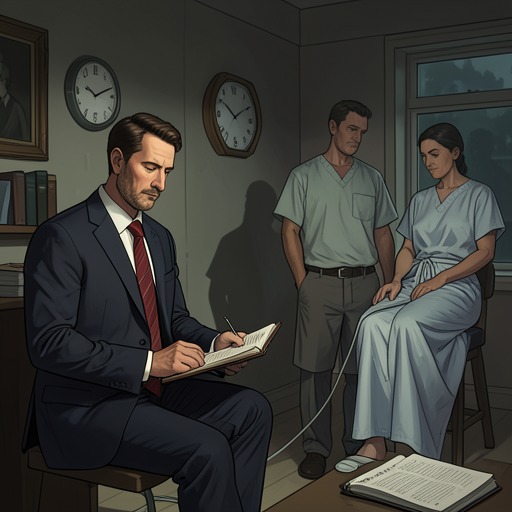
Frank Spoel’s Confession to the Wieder Murder
The Book of MirrorsFrank Spoel’s confession to the murder of Joseph Wieder seemed to supply the long-missing answer to a case built on incompatible memories and discounted testimony. In an interview arranged by Roy Freeman at Potosi Correctional Center, Spoel admitted that he had attacked Wieder with a baseball bat. He described a revenge plot and a brutal assault, but said he had intended to beat Wieder, not kill him. His account appeared to settle the question of who had entered the house that night; instead, its gaps and contradictions eventually exposed a second assailant and a different account of how Wieder died.
The confession and its circumstances
The confession reached Roy through Matt Dominis, who reported that someone had admitted to the murder. Still troubled by the case, Roy asked to interview Spoel before his scheduled execution. He was not convinced that the confession was genuine: Spoel might have heard about the case and hoped that an author investigating it would put his name in a book. Roy wanted to assess the man directly and hear his version of the West Windsor murder.
At the prison, cigarettes served as a practical overture. Roy brought a carton of Camels, knowing they were valuable currency inside, but explained that staff would have to inspect it before Spoel could receive it. Spoel said he had no one on the outside, had not seen his parents for more than twenty years, and was frightened by the prospect of his execution in four weeks. He then acknowledged killing Wieder, while distinguishing the intention he claimed to have had from the result: he had wanted to hurt the professor and take revenge, not send him to the morgue. He connected his sense of having become a killer to his earlier experience in a mental institution and the pills he had taken there.
A revenge plot and the night of the attack
Spoel said he had been released from the Trenton Psychiatric Hospital in October 1987. With his former belongings gone, his gang unwilling to associate with him, and little support beyond a few days of shelter from an acquaintance, he found work washing dishes near Princeton Junction. He said he believed Wieder, a man named Duanne, and perhaps others had involved him in a scheme using subjects for secret experiments. Convinced that Wieder had wronged him, Spoel followed the professor and decided to take revenge before leaving New Jersey. A friend, Chris Slade, had found work in St. Louis and invited him to go along, giving Spoel a reason to move his plans forward.
Spoel described choosing Wieder’s isolated house as the site of the assault after watching it over several evenings. He said he obtained a baseball bat from some children, wrapped it in an old towel to soften the blows, and hid it by the lake. On December 21, 1987, he left his job, went to Assunpink Creek, and waited in a woodshed until dark. From his stakeouts, he recognized two recurring visitors: a young man who appeared to be a student and a tall, bearded handyman. That evening, he said, he reached the house at about nine and saw Wieder drinking with the young man. He insisted that there was no woman present.
According to Spoel, the young man left at about eleven. Spoel waited another ten minutes, then entered through windows Wieder had opened onto the backyard and hid in the corridor. He said Wieder returned to the living room and sat looking through papers. Wearing a mask, Spoel crept up behind him and struck him with the bat. When Wieder got up, Spoel circled the couch and hit him repeatedly—ten or twelve times, by his recollection—until he fell. Hearing someone open the front door, Spoel fled without searching for money. He said he threw the bat into a half-frozen stream, spent the rest of the night in the woodshed, and left for Missouri with Slade the next morning. He later learned that Wieder had died.
Testimony that had already been set aside
The confession entered a case in which Derek Simmons had already claimed to know who killed the professor. Simmons had told Roy that Richard Flynn was the attacker and that Laura Baines had been a witness or accomplice. In his account, Flynn had argued with Wieder and stayed nearby after appearing to leave; Simmons also said he had found Wieder’s body the next morning. He acknowledged that he had not told police everything he believed about Laura, fearing that newspapers would exploit the allegation and tarnish Wieder’s name.
The earlier investigation had not treated Simmons’s account as dependable. One detective recalled that Simmons had amnesia, was ill, and could not offer much usable evidence. Laura had been interviewed, but investigators considered her alibi strong; although they knew of gossip that she and Wieder were lovers, they had no proof of an affair. Her possible presence therefore remained an unresolved lead, while Simmons’s claim about Flynn did not establish what had happened inside the house.
Spoel’s statement contradicted Simmons at precisely these points. Spoel placed Richard at the house but said he saw no Laura and noticed no argument. Roy also pressed him about the person Spoel said had opened the front door. Wieder died two or three hours after the attack, Roy observed, and a person entering at around midnight might have called for help. Spoel remained firm that someone had unlocked the door and walked in. The detail was not incidental: it left the possibility that another person had reached the injured professor after Spoel escaped.
The confession’s limit and the later revelation
When Roy compared the two accounts directly with Simmons, Simmons did not engage seriously with the discrepancies, suggesting that Spoel might have forgotten or might be lying. That response did not resolve the conflict. Spoel’s detailed account made him responsible for the baseball-bat assault, but his insistence that another person entered the house remained unexplained, and his denial of Laura’s presence sharply diverged from Simmons’s version.
The later disclosure supplied the missing action. Simmons eventually said that he had returned to the house and found Wieder badly injured. Seeing Wieder’s eyes brought back his memory of following his wife, Anne, to a hotel room and listening outside the door while she was with Wieder. Simmons then struck Wieder once, hard, with a blackjack. He said he locked the door, threw the blackjack into the lake, and went home. He returned the next morning and did not learn that Flynn had not been the man who first attacked Wieder until Roy confronted him. Although the medical examiner placed Wieder’s death about two hours after the assault, Simmons maintained that Wieder had died immediately and said he felt no remorse for finishing what someone else had begun.
Spoel’s confession was thus true but incomplete: he had attacked Wieder, yet Simmons’s later admission identified the final blow. The story’s sequence of statements also shows why neither a confession nor an apparently precise eyewitness account could settle the case on its own. Spoel’s claim that someone entered the house had seemed peripheral beside his admission; in retrospect, it pointed toward the act that completed the murder. The confession changed the investigation not by closing the account, but by making its remaining silence newly legible.