Frank Spoel’s Experimental Treatment at Trenton State Hospital
The Book of MirrorsFrank Spoel’s Experimental Treatment at Trenton State Hospital was a programme of experimental medication administered to Spoel and other inmates under the coordination of Joseph Wieder. Spoel’s account makes the treatment more than a background detail in the 1987 murder investigation: its reported harms, the restrictions on his release, and his conviction that Wieder had exploited him help explain why he later targeted the professor. The account also complicates the status of Spoel as a witness, since the very psychiatric history that shaped his testimony was used to diminish its credibility.
Entry into the Programme
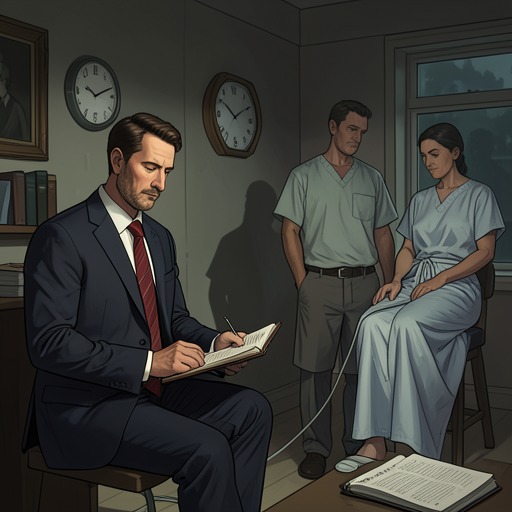
Three weeks after Spoel’s admission to Trenton Psychiatric Hospital, he said, he was transferred to a special ward with about ten other inmates. They were all between twenty and thirty years old and had been convicted of violent offences. Spoel later learned that the ward was being used for an experimental medication programme coordinated by Joseph Wieder. The patients were not, in Spoel’s description, there by choice or because they understood the purpose of what was being done to them; he presented them as subjects whose participation had not been meaningfully explained.
His placement followed a period of imprisonment and legal uncertainty. Spoel said that two men had stolen from him and that he had beaten one of them and taken eighty dollars from his wallet. He had expected that money to make up for his losses, but instead found himself facing at least a year in a psychiatric institution. His first lawyer, Duanne, told him that after a year he could apply to a judge for discharge or transfer to a less secure hospital. Spoel described the outcome as bewildering: a dispute over stolen cigarettes and money had led, in his view, to confinement and treatment far beyond what he believed his actions warranted.
Treatment and Reported Effects
Joseph Wieder sometimes came to the ward, where he questioned the inmates, asked them to select colours, and had them complete questionnaires. Spoel remembered confronting him about why he was being held and treated, insisting that he was mentally sound. According to Spoel, Wieder replied that he had mental problems and should take the treatment, and that Spoel would remain there for as long as Wieder considered appropriate. The recollection presents a stark imbalance: Wieder controlled important decisions about the treatment and Spoel’s prospects, while Spoel felt that his objections did not alter how the institution regarded him.
Spoel said the medication did not improve his condition. He began having terrible nightmares and could not always tell whether he was awake or dreaming. Other men on the ward, he reported, suffered severe headaches; as the treatment continued, many were restrained in their beds and hallucinated. Spoel also described vomiting and skin rashes among the patients. These effects are reported through his later account rather than through an independent clinical record in the material presented, but they are central to how he remembered the programme: not as a therapeutic intervention that had helped him, but as an ordeal that left him frightened, physically unwell, and distrustful of those responsible for his care.
About a year after his admission, a new lawyer took over Spoel’s case and sought a judicial review. Spoel said he was brought before Wieder again, but Wieder rejected both his application for discharge and his request to transfer to Marlboro Psychiatric Hospital, whose regime he understood to be less restrictive. He was sent back to Trenton Psychiatric Hospital. The refusal deepened his sense that the professor had power over his future without having to answer his complaints about the programme.
Closure, Recovery, and Release
About six months before Spoel left the hospital, he and the other inmates were moved to different wards and the experimental ward was closed. His treatment was changed. He reported that the nightmares and headaches then stopped, suggesting a marked difference between the period in the programme and the care that followed it. Yet he did not describe an uncomplicated recovery: he still woke without knowing who he was, and said that his nerves felt as if they were crawling. He tried to conceal his distress and behave in a way that would demonstrate that he was not insane, even as he felt he was being treated like an animal and ignored.
At a later review, Wieder was no longer on the commission considering Spoel’s case. This time, Spoel’s application for release under legal supervision was approved; he left the hospital a few weeks later, in October 1987. The sequence is consequential in his account: the experimental ward ended, his treatment changed, and the authority he associated with the programme was absent when his release was granted. The evidence does not establish that any single one of these changes caused the decision, but it marks a clear contrast between Wieder’s earlier refusals and the eventual approval.
Aftermath and Significance
Release did not give Spoel a settled home or an easy return to ordinary life. His previous belongings had been sold by his landlord to cover rent, and his former gang members kept their distance because they feared attracting police attention. After briefly receiving food and shelter from an acquaintance, he found work as a dishwasher at a diner near Princeton Junction. The owner let him sleep in the storeroom. Within weeks of leaving the hospital, Spoel began following Wieder, who lived nearby in West Windsor.
Spoel said he believed Wieder, Duanne, and perhaps others had been running a scheme that supplied subjects for secret experiments. He felt that he had been caught in their trap and wanted revenge; because he could not find Duanne, he decided Wieder would answer for it. That explanation is Spoel’s own account of his motive, not independent proof that such a scheme existed. It nevertheless connects the hospital experience directly to the later violence: the man Spoel blamed for the treatment became the person he chose to punish.
The programme also bears on the investigation’s treatment of testimony. When Spoel later claimed that he knew who had killed Joseph Wieder, he said investigators had dismissed his statement because he had previously been accused of murder, confined in a psychiatric hospital, and given medication. Another investigator likewise recalled that Spoel had amnesia and was ill, and therefore regarded his account as difficult to use. His reported experiences in the experimental ward thus operate on two levels: they form part of his explanation for his hostility toward Wieder, and they help account for why his testimony was treated with suspicion. The narrative leaves the programme’s medical rationale unresolved, while showing how institutional authority, a patient’s recollection, and the question of credibility converge in the mystery surrounding Wieder’s death.