John L. Monroe
The Book of MirrorsJohn L. Monroe is a professor at Princeton, New Jersey, and a former assistant to Joseph Wieder. In John Keller’s investigation, Monroe becomes a consequential but openly hostile witness: he attacks Wieder’s scientific standing while recalling institutional concerns about a book project and details of Wieder’s planned departure from Princeton.
Academic Background and Interview
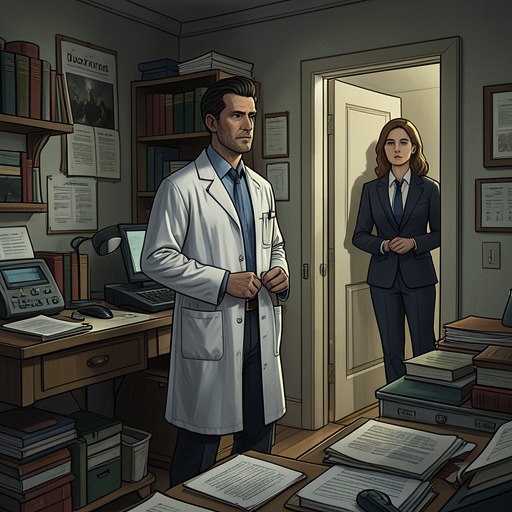
In the late 1980s, Monroe was preparing his doctoral thesis while working as one of Wieder’s assistants. By the time Keller interviewed him, he still taught at Princeton. Keller had first questioned Monroe at length by phone; when they met in Monroe’s office, the professor received him without offering coffee or tea and watched him with suspicion. Monroe’s disapproval registered in small, pointed gestures: he repeatedly glanced at Keller’s ripped jeans and turned up his nose at them. His voice was faint, as though he had trouble with his vocal cords.
Judgment of Wieder
Monroe described Wieder as a shameless maverick who stole other people’s work to keep himself in the limelight. He dismissed Wieder’s theories as scientifically weak and compared them to sensational claims made for a general audience on radio and television, rather than work respected by the scientific community. In Monroe’s view, developments in neuroscience, psychiatry, and psychology since Wieder’s death had only made the weakness of those theories more apparent. His sustained contempt led Keller to regard him as a man with no affection for Wieder, and perhaps someone grateful to have an audience for his denunciation.
The Book and the University Dispute
Although another account Keller had heard did not recall a dispute between Wieder and the university’s trustees, Monroe remembered that the board had discussed Wieder’s planned book. He said Wieder was accused of using university resources to collect data for a book intended to benefit him personally. Monroe identified the publisher as Allman & Limpkin, a press from Maryland, but did not know why the book was never published. He could only speculate that Wieder had not completed it or had refused changes requested by the publisher.
Monroe also explained the usual stages of such a publishing arrangement. An author would submit a proposal describing the project and its intended readership, generally including only two or three chapters of the proposed book. The remaining manuscript would be delivered later, according to an agreed schedule, and the final contract would be signed after the completed manuscript had been submitted and revised in response to the publisher’s suggestions. His explanation gives Keller a possible framework for understanding how a book could be planned and discussed without a finished manuscript reaching publication, but it does not establish what happened in Wieder’s particular case.
Wieder’s Departure and Monroe’s Limits
Monroe had not heard of Laura Baines. He nevertheless portrayed Wieder as a notorious womanizer with numerous affairs, including relationships with students. He added that the university board did not intend to renew Wieder’s contract for the following academic year, that Wieder was expected to leave Princeton in the summer of 1988, and that the Department of Psychology had already begun seeking a replacement professor.
His testimony is useful but not conclusive. Monroe could identify the publisher, recall the trustees’ discussions, and describe Wieder’s professional prospects, yet he could not explain why the book failed to appear and knew nothing of Laura Baines. The force of his account therefore lies as much in its limits and hostility as in the information it supplies: it adds a concrete institutional conflict to Keller’s inquiry while leaving the manuscript’s fate unresolved.