Joseph Wieder’s house
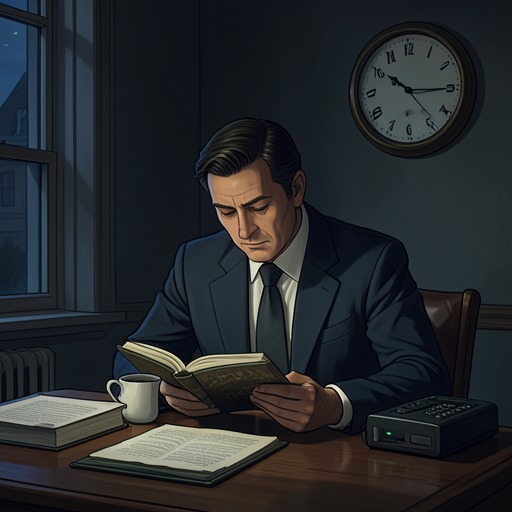
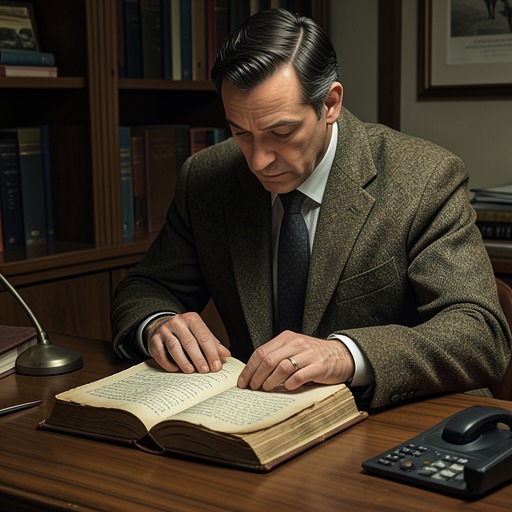
The Book of MirrorsJoseph Wieder’s house is the central physical setting of the Wieder murder investigation: a place where ordinary work and hospitality give way to concealed writing, violence, and conflicting accounts of what happened. Its carefully kept grounds and rooms appear to offer a stable scene, but the house becomes a maze of hidden spaces and uncertain entrances, where each witness’s version changes the meaning of the same night.
Setting and Work in the House
On a Saturday afternoon in mid-November, Richard Flynn and Laura Baines drove to the house in West Windsor Township to meet Joseph Wieder. They approached it along a gravel path crossing a well-tended lawn, with rose and blackberry bushes at its edge. A low stone wall enclosed the property; a small lake lay nearby, and a huge oak rose beside the Queen Anne-style house. The open gate and dusk-lit grounds frame Flynn’s first visit as both an invitation into Wieder’s private world and the beginning of his involvement in the events that would later make the house notorious.
Flynn began working there the following weekend, taking the bus from Trinity Station and visiting Wieder on his own. The two drank beer on a bench by the lake while Wieder explained how he wanted his few thousand books organized. His workroom was upstairs: a windowless chamber lined with long wooden shelves, where a new computer had been set up. Flynn was to create a searchable, coded record of the library, entering each book’s title, author, publisher, Library of Congress number, and other details, then organizing the collection by category. They estimated that the task would occupy every weekend for six months unless Flynn could add weekdays. Wieder paid him weekly and advanced three weeks’ wages; when Laura was absent, Wieder spoke more briefly and directly. The house thus first binds Flynn to the professor through paid research and access to a private scholarly collection.
The arrangement also gives Flynn a reason to move through the house alone. He worked there for three or four hours on most days, while his relationship with Laura became increasingly distant. That practical access would later matter: the house was not only the place where Flynn encountered Wieder’s work, but a setting in which he could discover material that had been deliberately hidden.
The Library and the Concealed Manuscript
One day, while looking for writing paper to diagram the final arrangement of the shelves, Flynn opened a small cupboard at the bottom of the shelves opposite the door. Among paper, old magazines, pencils, pens, and markers, he noticed that a pencil point seemed to be lodged in the wall where two sides of the cupboard should have joined. Moving the objects aside revealed that the cupboard’s left side was false and opened onto a niche about the size of a phonebook. Inside lay a sheaf of papers in a cardboard file.
The file had no identifying inscription. Flynn could tell from its contents that it concerned psychiatry or psychology, but found no title page or author’s name. Its physical form made its history uncertain: some pages were typed, others carried very small handwriting in black ink, and still others bore large, left-leaning blue-ballpoint writing. The pages had been corrected, and some additions, a paragraph or two at a time, were attached with clear adhesive tape. The hidden compartment turns the library from an orderly cataloguing project into a place of concealed authorship. The document’s mixed hands and revisions also leave open questions about who wrote it and how its contents came together.
The discovery took place as the house’s emotional atmosphere was changing. Flynn recalled that Laura had grown distant, made hushed telephone calls, and spent evenings surrounded by books and papers. He did not initially understand what the change meant. At the same time, he continued his daily work in the library, where the manuscript remained hidden until the accidental search for paper exposed it. The contrast between the room’s intended order—a searchable record of books—and the secret, unidentified file lodged behind a false wall gives the house one of its defining functions: it stores evidence, but does not explain it.
The Night of the Murder
Joseph Wieder was murdered in his home during the night of 21–22 December 1987. The house’s later reconstruction depends heavily on Derek Simmons’s account of the preceding day and evening. Simmons had gone there in the morning to repair a downstairs toilet. Wieder was packing for a holiday trip to the Midwest and invited him to stay for lunch, ordering Chinese food. Wieder appeared tired and worried; he told Simmons that he had found suspicious footprints in the snow-covered backyard. He also promised to continue caring for Simmons while away and reminded him to take his medication. Simmons left at about two in the afternoon to paint an apartment near campus.
After dinner, concerned about Wieder, Simmons returned to the house. He saw Laura Baines’s car nearby and heard an argument inside. Going around the back by the lake at about nine, he saw Wieder and Baines seated at a table while Richard Flynn stood over them, gesturing and shouting. Baines left a few minutes later; neither man stopped her. Flynn and Wieder continued arguing, then appeared to settle into a calmer interval of smoking, coffee, and drinks. The argument resumed after ten, and Simmons saw Wieder become angry. Flynn left. Simmons went around to the front shortly afterward, hoping to speak with him, but could not find him in the street.
Simmons then returned behind the house to check on Wieder. He saw him still in the living room and noticed him get up to open a window. Afraid of being seen, Simmons left. He later noticed that Baines’s car had returned and assumed she had come back to spend the night with the professor. The next morning he used his own set of keys after receiving no answer at the door, and found Wieder’s body in the living room. In the police account, Simmons was the person who discovered the death; his keys also establish that entry to the house was available to someone besides the professor.
Crime Scene and Conflicting Accounts
The police were called from the house at 6:44 a.m. on 22 December. Wieder was found in a pool of blood, and paramedics could do nothing to save him. The medical examiner estimated that he had died at around two in the morning from blood loss and severe brain injury caused by blows from a blunt object, probably a baseball bat. Investigators reconstructed an attack that began while Wieder sat on the living-room couch: the assailant approached from behind, and Wieder rose and tried to flee toward the lake-facing window, sustaining fractures to both forearms as he defended himself. During the struggle the television fell from its stand. The fatal blow struck the left temple after Wieder had turned to face his attacker. Investigators inferred that the assailant was probably right-handed; the perpetrator was never found through the police investigation.
Years later, Frank Spoel offered a different account of the house that night. He said he watched from outside and saw only Flynn and Wieder there, with Flynn leaving at about eleven. After waiting to ensure that Flynn was gone, Spoel saw Wieder open the backyard windows and go upstairs. Spoel entered through the house, hid in the corridor, and attacked Wieder from behind with a baseball bat when the professor returned to the living room. He said he struck him repeatedly, then fled through a glass door when he heard someone open the front door. He left the bat in a partly frozen stream and hid in a woodshed near Assunpink Creek. His account conflicts with Simmons’s observation that Baines returned to the property, and with Simmons’s claim that Wieder was still alive when he left the house.
The discrepancy turns the house’s doors and windows into evidence rather than mere architecture. Spoel said someone arrived while Wieder was still alive, entered with a key, and did not call for help. John Keller later considered whether Laura Baines might have entered after Spoel fled and taken the manuscript, leaving the doors and windows closed by the time Simmons arrived in the morning. Keller’s theory treated Flynn as the likely wielder of the bat and Baines as a possible accomplice, but Spoel’s version raised another possibility: Baines might have arrived after the assault and acted alone in removing the manuscript. Neither possibility is established simply by the house’s locked entrance or open glass door; each depends on testimony that conflicts with another account.
A House That Preserves Questions
The house connects the investigation’s major uncertainties: who attacked Wieder, who entered afterward, whether Baines was present, and what became of the manuscript concealed in the library. Its physical evidence seems precise—the false wall, the lake-facing window, the glass door, Simmons’s keys, and the rooms in which the struggle was reconstructed—but the chronology remains disputed. The same house can be read as the setting for Flynn’s final argument with Wieder, Spoel’s assault, Simmons’s discovery, and a possible later visit by someone seeking the manuscript.
That instability also shapes the investigation’s form. Keller began by pursuing Flynn’s missing book, but the trail brought Wieder and his house to the foreground, while the evidence gathered there refused to settle into a single coherent account. The house appears to contain the past in material form, from the catalogued books to the concealed file, yet access to those objects does not guarantee knowledge. Its significance lies in that contradiction: it is the most concrete place in the mystery and, at the same time, the place where the most consequential facts remain uncertain.