Joseph Wieder’s residence
The Book of MirrorsJoseph Wieder’s residence is the setting that joins the private and public strands of the story: Richard Flynn comes there first as Laura Baines’s companion, then as the professor’s paid assistant, and eventually discovers a manuscript hidden inside its library. The same house is the scene of Wieder’s murder. Its welcoming grounds, carefully organized books, concealed compartment, and locked doors give the residence a changing significance: it is at once a home, a workplace, a place of revelation, and an unresolved crime scene.
Setting and First Visit
In mid-November, Richard and Laura drive to the professor’s home in West Windsor Township with a bottle of wine. The approach is described in precise visual stages. A low stone wall surrounds the property; beyond an open gate, a gravel path crosses a tended lawn bordered by rose and blackberry bushes. A small lake catches the dusk nearby, while a huge oak spreads its leafless branches above the tiled roof of the Queen Anne-style house. Before the reader knows the house as the site of a murder, it is established as a secluded but carefully maintained domestic setting.
The house’s first human impression comes through its owner. Wieder opens the door as a tall, broad-built, nearly bald man with a long grey beard, dressed in jeans, trainers, and a green Timberland T-shirt. His informal appearance contrasts with Richard’s expectation of a celebrated professor preparing a major scientific revelation. Wieder greets Richard with a firm handshake and kisses Laura on both cheeks. This arrival makes the home a place where the academic reputation attached to Wieder meets the ease and familiarity of his private life.
A Home Turned into a Workplace
The following weekend, Richard begins cataloguing Wieder’s library, travelling there alone by bus. Before starting work, the two men drink beer on a bench by the lake, where Wieder explains how he wants several thousand books arranged. The grounds therefore serve not only as the backdrop to Richard and Laura’s first visit but also as the setting for the beginning of Richard’s employment and his direct association with Wieder.
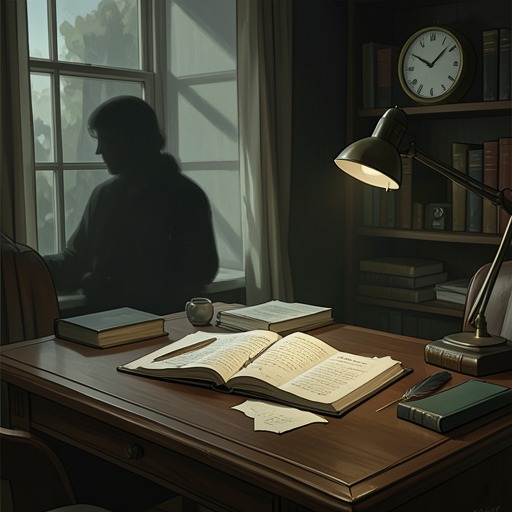
The main work takes place upstairs in a windowless room lined with long wooden shelves. Wieder has installed a new computer there and wants a searchable, coded record locating each book. Richard is to enter titles, authors, publishers, and Library of Congress numbers, then organize the collection by category. They estimate that the task will occupy his weekends for six months unless he can add working days during the week. The arrangement gives the residence a second, laborious rhythm: beyond its social rooms and lakeside setting, it contains a closed room in which Richard converts Wieder’s private library into an ordered information system.
Wieder pays Richard weekly and advances him three weeks’ wages. Richard observes that the professor is quieter and more direct when Laura is absent. The house thus also frames a change in their working relationship: Richard is no longer simply the young man accompanying Laura to dinner, but someone with regular access to Wieder’s rooms and books. That access later makes the library the place where an important secret comes into view.
The Library’s Concealed Compartment
While working in the library, Richard searches a small cupboard at the bottom of the shelves opposite the door. He wants paper for a diagram of the shelving arrangement and finds ordinary supplies: paper, old magazines, pencils, pens, and markers. When the sheets fall, he notices that a pencil appears wedged into the wall where two sides of the cupboard should meet. Moving the objects reveals that the cupboard’s left side is a false wall. Behind it lies a phonebook-sized space containing a sheaf of papers in a cardboard file.
The discovery alters the meaning of the library. Richard has been creating a systematic record that will make every book locatable, yet the cupboard contains a space deliberately omitted from its visible order. The hidden papers are not found in an obviously forbidden room but among routine work materials, by someone who has spent enough time in the house to search for paper without returning downstairs. The residence’s concealment is therefore built into its ordinary furnishings: the secret is physically close to the catalogued collection, but absent from the arrangement Richard has been hired to make.
Richard later describes finding the manuscript in Wieder’s library. The house’s importance consequently extends beyond the professor’s research and the work he assigns: it is where Richard’s access to the books becomes access to a concealed document. In the story’s structure, the discovery turns the domestic workplace into a source of information whose significance reaches beyond the library itself.
Murder and the Locked House
Wieder is murdered at his home on the night of 21–22 December 1987, a couple of days after the evening Richard and Laura had dinner with him. The residence’s living room becomes the scene of a fatal struggle. According to the autopsy and investigative reconstruction, Wieder is struck with a blunt object, probably a baseball bat. The first blow is thought to have landed while he sat on the couch; he then rises and tries to flee toward a window overlooking the lake, with fractured forearms indicating that he attempted to defend himself. The struggle moves into the middle of the room, where the television falls from its stand. A blow to the left temple proves fatal, though Wieder dies roughly two hours later from cardiac arrest and severe brain injury.
Derek Simmons, the handyman who works at the house, discovers Wieder’s body and calls 911 at 6:44 a.m. on 22 December. He tells the operator that Wieder is lying in a pool of blood in the living room. The paramedics cannot save him, and an assistant medical examiner pronounces him dead at the scene. This morning discovery fixes the residence as both a private home and the starting point of the murder investigation.
The house’s apparent security complicates that investigation. Simmons reports that the front door was locked when he arrived and that the windows were locked, with no sign of forced entry. Investigators therefore suppose that the killer had a key, entered without breaking in, and locked the door on leaving. The living room appears to have been searched, but theft seems an unlikely motive: Wieder still wears a Rolex and a precious gemstone, cash remains in an unlocked drawer, and valuable antiques have not been taken. Two recently used glasses suggest that he had been drinking with one other person that evening. The locked house offers investigators a constraint, not an answer: extensive inquiries never identify the perpetrator, and Richard himself becomes a suspect.
Across these episodes, the residence repeatedly changes what it signifies without changing its basic domestic form. The lake and garden frame an introduction; the upstairs room turns the home into a place of organized research; the false-sided cupboard makes that order porous; and the locked living room preserves the puzzle of the murder. The same house that admits Richard as a visitor and employee also holds a discovery and a death, tying access, concealment, and suspicion to one physical setting.