Laura Baines–Joseph Wieder relationship
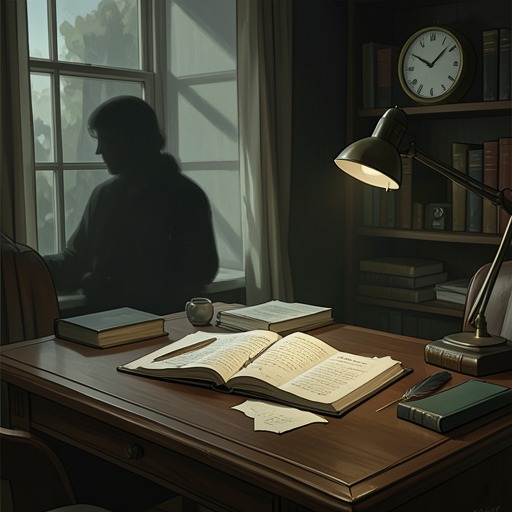
The Book of MirrorsThe Laura Baines–Joseph Wieder relationship joins academic mentorship to an intimacy that others can read as personal, even compromising. Laura is Wieder’s graduate researcher and increasingly trusted assistant, contributing mathematical expertise to his work on memory; she also moves comfortably in his home and possesses a set of keys. Yet when Richard Flynn directly asks whether she and Wieder were involved, Laura says no. The relationship’s importance lies partly in that unresolved tension: its visible closeness invites speculation, while the evidence establishes collaboration and trust more securely than romance.
Research Partnership and Mentorship
Two weeks before Thanksgiving, as the weather turned gloomy, Laura proposed introducing Richard to Professor Joseph Wieder. She was working under his supervision on a project she intended to develop into her graduate thesis. Cognitive psychology was then a pioneering discipline, newly prominent in a culture fascinated by the possibilities of computers and artificial intelligence. Laura understood the research more deeply than Richard did; he later recognizes that youthful egotism had kept him from making much effort to follow her explanations.
As Laura described it, Wieder was nearing the end of a major project about how the mind works and how mental stimuli connect to reactions. The work concerned memory and the formation of recollections, and it used mathematical formulae to quantify variables. Laura’s mathematical knowledge supplied expertise Wieder lacked: she regarded it as a particular strength in a project for which exact science was his weakness. Her contribution therefore exceeded routine student assistance. She began among roughly twenty or thirty volunteers, but discussion of the research led to her taking on a more advanced role, becoming a kind of assistant to him.
Wieder’s standing and intellectual range shaped the partnership. He had studied in Europe, earned a master’s degree in psychiatry at the Sorbonne, completed a doctorate at Cambridge, and published his first book. When Richard visited, Wieder spoke of showing him the upstairs library, which he described as his pride and joy. The encounter places Laura’s research work within the orbit of a senior scholar whose home, professional life, and intellectual authority overlapped.
Trust, Familiarity, and Suspicions
At dinner, Laura acted as hostess, serving the meal and clearing the plates and cutlery afterward. She addressed Wieder simply as Joe rather than using his academic title, and seemed entirely at home in the routine. Richard noticed how familiar the arrangement appeared, but at the time told himself that the two were only good friends. The scene gives that friendship a domestic ease without proving a sexual or romantic relationship.
Laura later explained that she had become Wieder’s assistant while still involved with a boyfriend who studied economics. Her boyfriend grew jealous, followed her, and questioned her about Wieder. An anonymous letter to the dean then accused Laura and the professor of being lovers. The accusation arose amid the boyfriend’s suspicion and the visible closeness of Laura’s work with Wieder; it is presented as an allegation, not as confirmation that an affair occurred.
Richard’s own doubts sharpen when he learns that Laura has keys to Wieder’s house. She explains that Wieder lived alone, had no partner, and had given her a set in case he needed help. A cleaner came on Fridays, and a former patient living nearby handled practical repairs. Laura says she had never used the keys and had never visited when Wieder was absent. The access is a concrete sign of trust, but her account distinguishes having permission from secretly entering his house. Richard remains struck by how little he understands about her, even as he decides that his love for her matters more to him than settling every uncertainty.
Boundaries and Private Knowledge
When Richard finally asks whether Laura has ever had a relationship with Wieder, she gives a direct denial. She also acknowledges why the question has arisen, given the circumstances. The exchange neither erases the earlier signs of closeness nor turns them into proof: Laura’s role, the keys, and the accusation remain part of the record, but the relationship is not established as an affair.
Wieder also knows about Laura’s relationship with Richard and makes clear that he is aware of it. He tells Richard that Laura had already discussed Timothy Sanders with him and that the two of them have no secrets from each other. Richard feels exposed, realizing that Laura and Wieder share a degree of confidence from which he has been excluded. Wieder then reveals that his earlier question about Richard and Laura had been a test: he already knew they were together. This episode demonstrates his access to Laura’s private life and his willingness to test Richard, but it does not settle the nature of his own bond with her.
The research itself also has limits to what Laura can disclose. After the argument about their relationship, she tells Richard about Wieder’s experiments, while admitting that she does not know all the details. Her position is therefore both unusually close and incomplete: she has earned an important role in the work, yet is not its sole interpreter or keeper of its secrets.
The Partnership’s Afterlife in the Investigation
Years later, John Keller’s inquiry into the missing manuscript leads back to the research partnership. The publisher’s archive shows that Wieder sent a proposal in July 1987 with the book’s first chapter, stating that the manuscript was complete and ready for submission. The publisher sent a contract in August, and Wieder was expected to begin revisions with an editor in November. He asked for several more weeks to polish the manuscript over the holidays, a request the publisher granted; the full manuscript never arrived. These records connect the project Laura had helped with to a book that remained unpublished, while leaving her precise knowledge of its final form uncertain.
The investigation does not make the relationship easier to fix into a simple account. Keller describes his growing sense of being lost among contradictory details, and notices that Wieder, once a figure in Richard Flynn’s story, has come to dominate the inquiry while Richard recedes. The shift echoes the relationship’s original imbalance: Laura’s work brought her close to Wieder’s research, but the professor’s stature and the missing book increasingly draw attention toward him. Their partnership remains consequential as both a real collaboration and a source of questions—about what Laura knew, what Wieder shared with her, and how much can be inferred from closeness when the surviving evidence does not resolve its private meaning.