Marlboro mental hospital
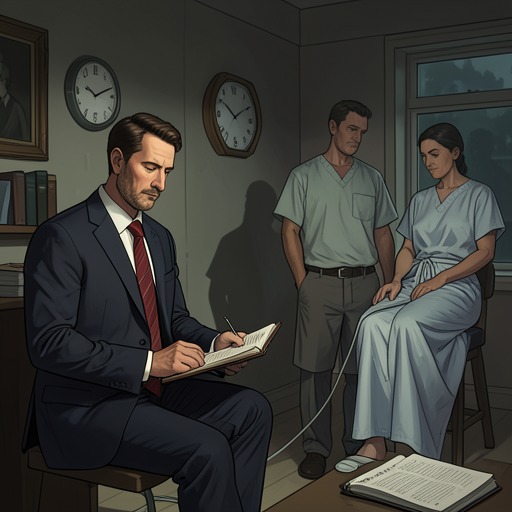
The Book of MirrorsMarlboro mental hospital serves two distinct periods in Derek Simmons’s history: his two-month admission as a teenager and his later transfer there after an attack at Trenton mental hospital left him with retrograde amnesia. In the later period, its less strict regime offered a setting in which Joseph Wieder helped Simmons resume a life outside the institution, though the loss of his past remained irreparable.
Institutional Role and Transfers
As a teenager, Simmons suffered a severe nervous breakdown, was diagnosed with schizophrenia, and spent two months at Marlboro mental hospital. The episode interrupted his education: he missed his final year of high school. After leaving, he abandoned the prospect of college and trained as an electrician, eventually taking a low-level job at Siemens. The hospital thus marked an early rupture in a life that had previously included strong academic performance.
Years later, following his arrest in connection with his wife’s murder, Simmons was committed to Trenton mental hospital. An attack by another patient caused a serious head injury and left him unable to retrieve memories formed before the assault, although he could still form new ones. At Joseph Wieder’s insistence, he was transferred to Marlboro mental hospital a year later, where the regime was less strict. Wieder helped him reconstruct a workable personality, but the continuity was incomplete: Simmons retained the name and appearance of the person he had been without remembering his schooling or how he had learned his trade. Skills survived even when their personal history had vanished.
In spring 1985, a judge approved Simmons’s lawyer’s request for his discharge, citing the complexity of the case and Simmons’s complete lack of violent tendencies. The institutional record also describes his eventual release from Marlboro under supervision and a later judicial order, in 1994, lifting that supervision after another expert assessment. The hospital’s place in his story is therefore not simply that of a destination after Trenton: it is the setting for an attempted return to ordinary life, followed by a gradual legal transition out of institutional control.
A Contested Alternative to Trenton
Marlboro mental hospital also appears as a possible destination for Frank Spoel, whose experience at Trenton mental hospital differed sharply from Derek Simmons’s. After Spoel’s new attorney, Kenneth Baldwin, sought a judicial review, Spoel again faced Joseph Wieder, who rejected both his request for discharge and his request to transfer to Marlboro. Spoel was sent back to Trenton, where the experimental ward was later closed and his treatment changed. His account makes the proposed transfer more than a matter of a less restrictive regime: it was a route away from the treatment and confinement he considered abusive, and Wieder had the power to block it.
The eventual change came when Spoel’s case was reviewed again and Wieder was no longer on the commission. Spoel’s request for discharge under legal supervision was approved, and he left the hospital a few weeks later, in October 1987. The contrast with Simmons’s history is pointed: Wieder had insisted that Simmons be moved to Marlboro and then supported his release, while Spoel remembered Wieder as the person who had denied him both options. Marlboro thus links two sharply different experiences of institutional authority, without making the hospital itself either a simple refuge or a simple threat.
Life After Discharge
Leaving Marlboro mental hospital did not mean Derek Simmons could manage alone. He had no dependable family support: his mother had died when he was a toddler, and his estranged father had moved away without leaving a forwarding address. Joseph Wieder arranged a small one-bedroom apartment near his own home and gave Simmons paid work maintaining the house. The arrangement joined shelter to routine: Simmons could still repair things, though he could not remember when or how he had learned the skills, and Wieder paid him each month for using them.
Simmons nevertheless lived in isolation. Neighbors regarded him as a freak, and at times he shut himself inside for days or weeks. Wieder brought him food and checked that he took his medication during these periods. Simmons later described the professor’s help in more personal terms: Wieder took him fishing, spent an evening with him at least once a week, and once hypnotized him at the university without telling him what the session had revealed. The relationship that followed Simmons’s transfer from Marlboro therefore extended beyond a change in institutional regime. It supplied practical support and companionship, while leaving unresolved the fragile boundary between care and dependence.
Memory Beyond the Hospital
Marlboro mental hospital’s attempted reconstruction of Derek Simmons’s life did not settle the question of whether his earlier memories were permanently lost. In the middle of March 1987, while living outside the hospital, he saw a NY1 report about a man from Bergen County who had died by suicide. The photograph brought back the name Stan Marini and the recognition that Marini had worked on the maintenance crew at Siemens when Simmons himself was an electrician there. Simmons understood the recognition as a memory no one had supplied to him and that he had not read about; it was a fragment of the life sealed off by his amnesia, returning through an ordinary television report rather than through a deliberate account of his past.
The recognition became a reversal in the story of his recovery: memories he had been told were inaccessible began, as he described it, to surface with the force and speed of a film running far too fast. That return complicates the apparent success of the reconstruction at Marlboro. Simmons had learned to function without knowing the origins of his abilities or the events of his former life, but his old identity was not simply replaced; traces of it remained and could emerge unexpectedly. The hospital stands within this unresolved history—not as the place where every memory was restored, but as one stage in a life whose past could reappear beyond institutional care.