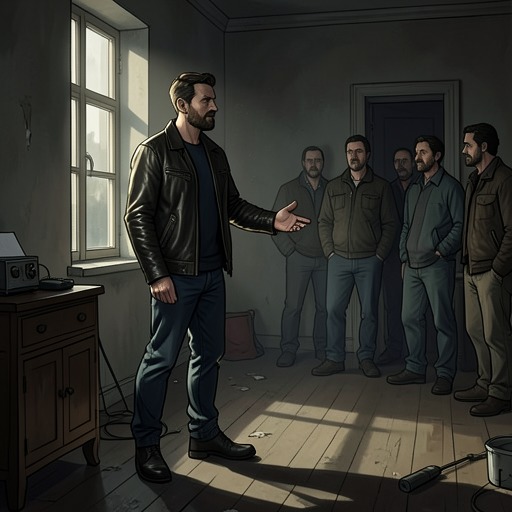
Matt Dominis
The Book of MirrorsMatt Dominis is Roy Freeman’s former colleague, longtime friend, and a veteran of Potosi Correctional Center. When Freeman reopens the Joseph Wieder murder investigation, Dominis helps him reach Frank Spoel, the man who confessed to the killing. Their reunion brings the case into conversation between two men shaped by years in law enforcement, but Dominis’s unsentimental view of criminals does not settle the question of whether Spoel is telling the truth.
Identity and Career
Dominis and Freeman worked together for eight years at the West Windsor Township Police Department. In the early 1990s, Dominis settled in Missouri, but the two maintained their friendship through occasional phone calls. They had visited each other two or three times and gone hunting together. His later work brought him to Potosi Correctional Center, where he had been employed for eleven years by the time of their reunion and was approaching retirement.
Dominis’s prison work followed a career spent among people accused or convicted of crimes. He tells Freeman that he had first tried to put criminals in jail and later worked to keep them there for as long as judges and juries required. His experience gives him an institutional perspective on criminality, though he expresses it in broad, categorical terms rather than as an analysis of any one prisoner.
Friendship with Roy Freeman
The professional partnership had become a durable friendship after the men’s careers diverged. They kept each other informed by telephone, and Freeman had attended Dominis’s wedding. A lifelong bachelor until then, Dominis had married Julia, a colleague, two years before the events of the reunion. The two men had not seen one another since the wedding.
When they meet again, Dominis is waiting for Freeman by a newspaper stand at the airport. They go to a nearby coffee shop, where Freeman has time before his scheduled visit to the prison. Their talk briefly touches on family: Freeman shares stories about his granddaughter, Erin, whom he has seen only once, just after her birth. Dominis then abruptly turns the conversation to Spoel and the old case. The shift makes the investigation feel less like an abstract professional puzzle than a question that has followed both men across years and state lines.
The book also gives Dominis a distinctive, affectionate place in Freeman’s memory. Tall and strongly built, he had a perpetually downtrodden air, as though expecting catastrophe. His colleagues nicknamed him Fozzie, after the bear on The Muppet Show; the nickname was friendly, and everyone in the department liked him. This remembered warmth sits beside his hard-edged comments about the people he has spent his working life guarding.
The Spoel Confession and the Prison Visit
Dominis’s role in Freeman’s renewed investigation is practical but consequential. After a conversation about the Wieder case, Freeman calls him back to ask whether he can speak with Spoel, who had confessed to killing Professor Joseph Wieder a few months before his scheduled execution. Freeman wants to hear Spoel directly, rather than rely on the confession at second hand, and remains uncertain whether Spoel is truthful or seeking attention after learning that a California author wants to include him in a book.
Dominis uses his standing at Potosi Correctional Center to help make the visit possible. The institution’s director grants the favor after learning that the request comes from a detective who worked on the case in the late 1980s. Dominis’s assistance reconnects Freeman with a confession that threatens to close off the explanations he has been pursuing, even as Freeman’s doubts make direct examination of Spoel essential.
During their discussion, Dominis asks what Freeman thinks of Spoel after all these years. Freeman explains that a reporter contacted him about the same story roughly three months earlier, prompting him to look over the case again. Dominis calls the coincidence striking. His questions establish that he is not simply arranging access from a distance: he wants to understand why the case has returned to his old colleague’s attention.
Outlook and Narrative Role
Dominis describes his experience of criminal offenders with blunt resignation: “some are born that way, just like one’s born with a talent for drawing or basketball.” He acknowledges that they all have sad stories, but says he does not care about them. The statement distinguishes his practical, hardened outlook from Freeman’s willingness to revisit an old case and test a confession against competing accounts. It does not prove that Dominis dismisses Spoel’s confession; rather, it shows how his long familiarity with criminals has shaped the terms in which he thinks about them.
As a friend, Dominis is both a route back into the case and a point of contrast for Freeman. Their shared police history gives him the authority to help secure the prison visit, while their reunion allows the investigation to emerge through ordinary conversation—coffee, family stories, and a question about an old murder. His assistance opens the door to Spoel, but the truth remains unsettled until Freeman can weigh what he hears against the conflicting testimony surrounding Wieder’s death.