Richard Flynn
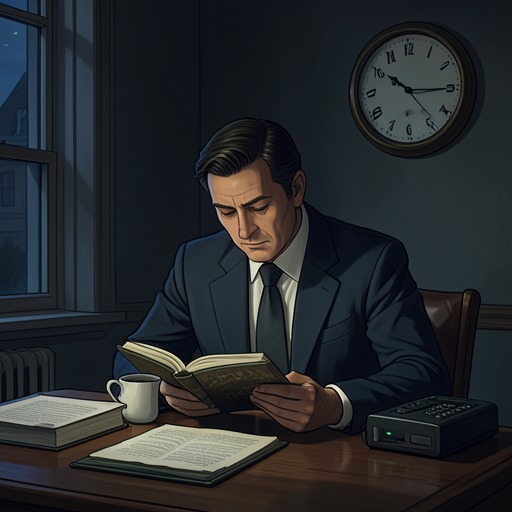
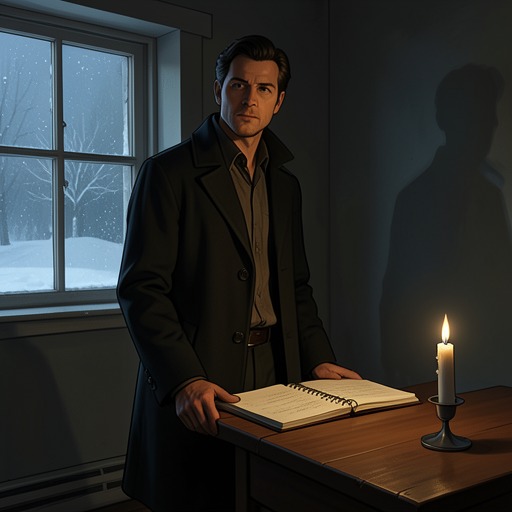
The Book of MirrorsRichard Flynn is an aspiring writer turned advertising professional whose attempt to explain the 1987 murder of Professor Joseph Wieder becomes inseparable from the failures of his own memory and judgment. His completed manuscript, The Book of Mirrors, brings his account to agent Peter Katz, but its persuasive theory of the crime is eventually unsettled: Flynn, like the other people around Wieder, appears to have mistaken his own suspicions and desires for knowledge of what happened.
Identity and Background
Twenty-seven years before writing to Peter Katz, Flynn majored in English at Princeton and hoped to become a writer. He published several short stories in magazines and completed a three-hundred-page novel, but abandoned it after publishers rejected it. Looking back, he judged the novel mediocre and dull. He then took a job at a small advertising agency in New Jersey and remained in the industry, initially persuading himself that advertising might be akin to literature and that he would eventually return to writing.
That return never came in the way he had imagined. Flynn described growing up as learning to lock away one’s dreams, and placed himself among those who had done so. The abandoned novel and his continued employment in advertising establish the distance between his early literary ambition and his adult life; the later manuscript reopens that gap rather than simply resolving it.
The Manuscript and Return to Writing
Flynn’s renewed writing begins after he discovers a truth about the events of 1987. Overwhelmed by memories, he writes more than five thousand words in one night, then takes two weeks off work and continues. He experiences the writing as a recovery of identity, as if he has rediscovered who he is after forgetting himself. The force of the remembered months grows greater than anything in his present life, and the events surrounding Laura Baines and Wieder become the material around which his attention gathers.
Flynn says that the story had been partly reported in newspapers and that police detectives and reporters harassed him for a long time. He connects that pressure with his departure from Princeton and his decision to pursue an MA at Cornell, where he spent two years in Ithaca. Although the public attention faded, he says that no one had learned the whole truth. He claims to have stumbled on it only three months before writing his query, and presents the manuscript as the result of an exhausting effort to disclose what had remained unknown.
The completed work is submitted to Peter Katz as The Book of Mirrors. Flynn sends a sample and offers the full manuscript, describing his motive as a need to share the truth despite the anger and frustration still attached to it. His return to writing is therefore driven not only by an old literary aspiration but by the belief that a buried personal history demands a public account.
Relationships and the Murder Case
Flynn’s account places Laura Baines and Wieder at the center of his recollection of 1987. Laura later tells John Keller that Flynn had been in love with her, or obsessed with her, but denies that they had a love affair; she says she had a boyfriend at the time. Flynn’s own version had described a sexual relationship and mutual love. The contradiction matters because it exposes how his account of the past is shaped by a relationship Laura remembers differently.
Wieder employed Flynn to make an electronic record of his library. Laura had introduced Flynn to the professor, and Wieder’s public standing and library gave the arrangement both professional and personal significance. After Wieder was murdered at his home on the night of 21–22 December 1987, Flynn became one of the suspects, although the police investigation did not identify the perpetrator. His association with the victim and his connection to Laura made him part of the case’s unresolved story long before he wrote about it.
Derek Simmons later identifies Flynn as the killer and claims that Laura witnessed the crime or assisted in it. Simmons’s recollection includes an earlier visit to Wieder’s house on the day of the murder: after repairing the downstairs toilet and eating lunch with Wieder, he returned that evening to collect a toolbox and saw Flynn and Wieder talking in the living room. Simmons says he left without being noticed. He inferred that Flynn might become a suspect if anything happened, reasoning that Flynn was in love with Laura and that Wieder was pursuing her. That inference is eventually shown to be part of Simmons’s mistaken reconstruction, not proof that Flynn killed Wieder.
Flynn’s Theory and Its Reversal
In the theory attributed to Flynn’s manuscript, Laura may have lied to him and manipulated him into killing Wieder, then abandoned him while using the outcome to build her career. Flynn’s imagined explanation is that he understood too late what had been at stake and had destroyed his life for a lie. The possibility that Laura promised to return to him after their apparent separation gives this account a personal motive, but the supposed romance on which it depends is disputed by Laura herself.
The final account makes clear that Flynn’s manuscript is not a reliable solution to the murder. After Simmons’s story leads to his arrest, Peter Katz recognizes that the premise of Flynn’s true-crime theory has been overturned: the author’s imagination had embellished real events. The conclusion remains qualified rather than wholly certain. Laura probably stole Wieder’s manuscript and left him to die, but she was probably not Flynn’s mistress; Simmons was wrong to think he saw Flynn flee through the glass door after beating Wieder; and Wieder was wrong about a relationship between Laura and Flynn. The people involved looked through their own obsessions as though they were windows onto the truth, when they were mirrors reflecting their own assumptions.
Illness, Death, and Narrative Significance
When Keller visits Flynn’s partner, Danna Olsen, she learns that Flynn has been admitted to All Saints Hospital. He had been diagnosed with lung cancer the previous year, already at stage three and inoperable; chemotherapy initially helped, but pneumonia contracted two weeks before Keller’s visit caused a sudden deterioration. The doctors offer little hope. Danna, who met Flynn at a marketing workshop, had moved to New York for him after they corresponded and traveled to the Grand Canyon together. She has no relatives in the city and expects to return to Alabama if she loses him. She also has not known that Flynn was writing a book about his past.
Flynn dies before his manuscript can be published. Danna later contacts Peter Katz to honor Flynn’s last wish that the book be published, even though the revelation of Simmons’s arrest has destroyed the manuscript’s central theory. The work survives not as the definitive account Flynn hoped to provide, but as evidence of his attempt to recover a life and a truth through writing. His story’s decisive irony is that the manuscript meant to expose other people’s concealed actions also exposes the limits of its author’s own certainty: Flynn had returned to writing, but he had not escaped the distortions through which he remembered the past.