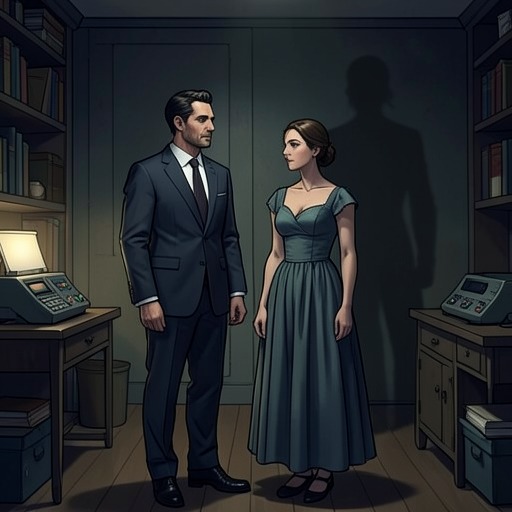
Richard Goes to Wieder’s House on the Night of the Murder
The Book of MirrorsRichard Flynn’s journey to Joseph Wieder’s house on the night of the murder is the point where the surviving manuscript turns suspicion into physical action, but it never supplies a settled account of what happened there. Flynn sets out through worsening snow after deciding that Laura Baines has lied about where she is and about the nature of their relationship. The trip matters not only because it brings him to the scene of the killing, but because its reported timing conflicts with what he later told investigators, making the journey itself part of the case’s uncertainty.
The Decision to Go
After Timothy Sanders visits, Flynn returns to the yard, smokes, and dwells on Laura’s face as she told him what he now regards as lies. His recollection of their early intimacy—sitting together on a couch while he ran his fingers through her hair—stands against his present anger. He is no longer simply trying to understand her explanation: he is thinking about finding Sarah, the friend Laura had said she was staying with.
Then Flynn abruptly decides that Laura had actually gone to Wieder’s house. The manuscript presents this as a conviction, not as something he has verified. He believes that if he goes there he will find Laura and the professor together, and that their relationship, his work in Wieder’s library, and the explanations he has received may all have been part of a deception. He even imagines that the professor and Laura may have treated him like a subject in an experiment. Those suspicions establish the emotional pressure behind the journey, but the passage does not confirm that Laura was at the house or that Wieder had conspired against him.
Keys and Departure
Flynn has a practical means of acting on his suspicion: he has found the keys to Wieder’s house on the sideboard and put them in his pocket before Sanders rang the doorbell. The keys had not gone with Laura. Their presence turns his certainty into an immediate choice; instead of waiting for an explanation or trying to establish where she is, Flynn can go to the house himself.
He goes back inside, calls a cab, and sets out for Wieder’s house as the snowfall grows heavier. The manuscript ends its surviving fragment at this departure. It does not narrate his arrival, a meeting with Laura, or any confrontation with Wieder. The distinction is crucial: Flynn’s journey toward the house is established by the fragment, while what he might have found there remains outside its surviving account.
Conflicting Accounts of the Visit
The manuscript’s ending places Flynn’s departure about twenty minutes after Sanders’s visit, which the later investigator estimates would make it roughly 6 p.m. The estimated journey took about twenty minutes each way, perhaps longer in the weather. On that reconstruction, the manuscript places Flynn at Wieder’s house earlier than the time he gave investigators.
According to that later account, Flynn said he went to see Wieder at about 9 p.m. to discuss something concerning the library before leaving for Christmas break. He said that they talked, that he returned home at 10 p.m., and that he went to bed shortly afterward. These accounts do not align: one places the departure around 6 p.m., while the other describes a visit beginning around 9 p.m. The discrepancy leaves open whether Flynn lied during the investigation, whether the manuscript distorted or changed his account, or whether his memory was unreliable. The available evidence does not resolve which explanation is correct.
Narrative Significance
The journey makes Flynn relevant to the murder investigation without establishing that he committed the crime. In the manuscript, his decision to go follows an escalating reinterpretation of his relationship with Laura: ordinary details, including his library work and her account of where she is staying, become possible parts of an imagined deception. The movement from suspicion to action places him at Wieder’s house on the night of the killing, but the missing arrival scene withholds the information that could distinguish a visit from a confrontation or establish what happened next.
For the reader examining the manuscript, the conflicting times turn an apparent endpoint into a problem of evidence. The fragment offers a vivid motive for the trip and a specific object that enables it—the keys—yet stops before confirming its outcome. Flynn’s later reported account supplies a different schedule rather than a definitive correction. The journey therefore becomes both a plot hinge and a test of narrative reliability: it connects Flynn to the crime scene while making the truth of his own account harder to fix.