Roy Freeman’s final confrontation with Derek Simmons
The Book of MirrorsRoy Freeman’s final confrontation with Derek Simmons turns a neglected phone record into a challenge to Derek’s account of two crimes. Roy confronts him with evidence that he called Joseph Wieder on the morning he said he found Anne Simmons’s body, then uses Derek’s precise recollection of an event from 1979 to question whether his amnesia was ever genuine. Derek denies killing Anne, but begins telling Roy the story of his life; Roy secretly records their conversation, making the encounter both an interrogation and the opening of a fuller account.
The Call That Reconnected the Cases
The confrontation begins with a detail Roy nearly missed. He had kept a copy of the calls made and received on Derek’s phone before and after Anne’s murder. The list contained twenty-eight calls, arranged in five columns recording the number, address, subscriber, date, and length. One address was familiar, although its listed subscriber, Jesse E. Banks, meant nothing to Roy at first. The call had lasted fifteen minutes and forty-one seconds.
Roy recognized the address and checked the surrounding details. In 1983, when investigators were looking into Anne’s murder, the number had not led them to anyone relevant: Banks had died, and the house had been sold through an estate agency. By the time Roy began investigating Wieder’s death in December 1987, he had not thought to connect the two cases. Now the old call suggested that Derek had spoken with Wieder on the very morning he allegedly found his wife’s body.
A phrase Derek had used in a recent conversation helped Roy make sense of the connection. Roy spent two hours assembling the details of the Simmons and Wieder cases, then went over his papers in a long meeting with an assistant from the Mercer County Prosecutor’s Office. The assistant contacted Chief Brocato to settle the arrangements. This preparation turns the eventual meeting with Derek from a hunch-driven encounter into a confrontation grounded in a specific, overlooked record.
Roy Challenges Derek’s Memory
Roy asks Derek when his memory returned, whether it came back in 1987 or earlier, and whether he had ever lost it at all. The point of pressure is Derek’s account of being in a stadium in the Bronx in 1979, hearing an announcer speak after an eight-minute standing ovation for Thurman Lee Munson, who had died in a plane accident in Ohio. Derek had described this as something he remembered hearing himself.
Derek says he tried to learn everything about himself after the accident. Roy counters that this stadium experience could not simply have been learned: unless Derek had written it down in a diary, he could only know it by remembering it. Roy then widens the challenge beyond the stadium story. He asks why Derek called Wieder on the morning he supposedly discovered Anne’s body, when they first met, and how Derek arranged for Wieder to provide an expert opinion in his favor. Each question links Derek’s claimed memory loss to a practical connection with the psychologist whose house and death later became central to Roy’s investigation.
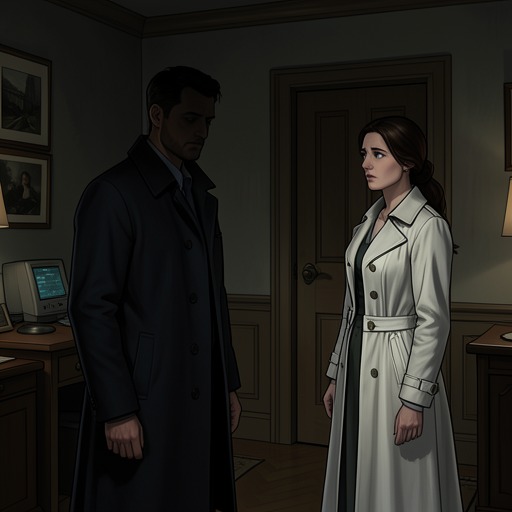
Derek does not answer at once. He watches Roy smoking, then asks whether Roy is wearing a wire. Roy says no. Derek’s suspicion gives the pause a double edge: he is weighing not only the questions but whether it is safe to speak. Roy waits rather than pressing him, convinced that Derek has wanted to tell someone the whole story and that he will leave town without returning. The narrative presents the silence as a moment when the interrogation changes character—not yet an exoneration or a complete explanation, but a decision to talk.
Derek’s Account and Denial
Derek asks how Roy found the call to Wieder. Roy explains that the house had only recently been bought and its telephone number had not yet been transferred into Wieder’s name. Investigators who traced the calls reached the former owner, Jesse E. Banks, and stopped there; even if they had identified Wieder, the name had not seemed relevant to Anne’s case at the time. Roy also points out that Derek had called from his own home number rather than using a nearby telephone booth.
Derek says he did not want to leave the house because he feared being seen, and that he needed to speak to Wieder quickly without knowing whether the responding patrol would arrest him. Roy asks directly whether Derek killed his wife. Derek shakes his head and denies it. He maintains that he found Anne lying in a pool of blood, while acknowledging that he knew she had been unfaithful. His admission that he believed she deserved to die makes the denial emotionally charged, but it does not establish that he killed her.
Over the next half-hour, Derek begins describing how his life had collapsed after he was admitted to a mental hospital in his final year of high school. In his account, former schoolmates avoided him, he abandoned the prospect of college, and he took menial work. His father left; his mother had died when he was very young. For about ten years, he lived alone and took prescribed medication, which he eventually stopped because of its side effects. Nine years after high school, he met Anne while repairing a motel’s heating system in Princeton. Derek describes her as having grown up in a Rhode Island orphanage, left at eighteen, slept rough, become involved with gangs, and worked as a prostitute in Atlantic City by nineteen. This history is presented as Derek’s testimony, not as an independently verified account.
The Recording and Its Unresolved Aftermath
Roy’s apparent lack of a wire reassures Derek, but the reassurance is misleading. After leaving, Roy reveals that a special pencil in the breast pocket of his jacket has recorded the conversation. A couple of minutes later, as he pulls away from Witherspoon Street, he hears police sirens. The sequence places the recording at the center of the encounter: Derek has begun to speak in what he takes to be a private conversation, while Roy has preserved his words for the investigation.
The scene does not resolve every question Derek’s account raises. Roy recalls that a document said Derek’s father had moved to another state and disappeared, and wonders whether anyone checked that claim. He also considers whether Wieder had hypnotized Derek, whether the psychologist understood what his patient might be capable of, and whether he believed Derek’s amnesia would leave him harmless—a bomb without a detonator. These remain Roy’s questions, not conclusions established by the confrontation. The final image of the detonator having been present all along gathers the scene’s central reversal: the apparent blank in Derek’s memory may have concealed knowledge rather than erased it, but the record and Derek’s words still leave the truth to be tested.