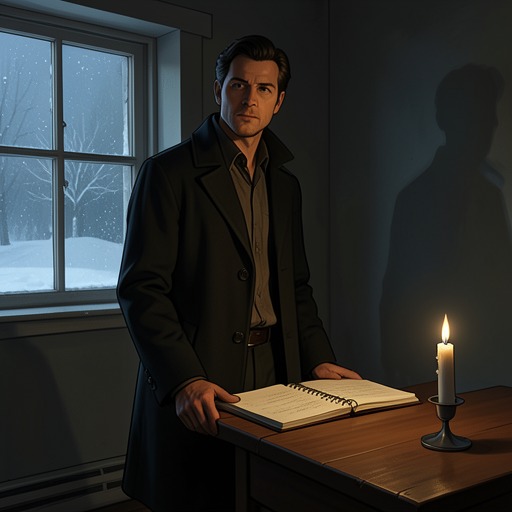
Sarah Harper
The Book of MirrorsSarah Harper is a former college roommate and close friend of Laura Baines whose account of the night Joseph Wieder was murdered becomes a contested piece of John Keller’s investigation. She recalls Laura arriving at her apartment in the early hours and describes a story that could explain Laura’s whereabouts, but Keller suspects Sarah is concealing something. Her testimony supplies concrete details while leaving its reliability unresolved.
Background and Life After College
Sarah graduated in 1989. According to information Harry Miller gathered, she later worked at a school for children with special needs in Queens and lived an apparently ordinary life for about a decade. She married Gerry Lowndes, a jazz singer; Miller’s account describes the marriage as deeply unhappy and says Sarah began using drugs and spent a year in jail. She divorced in 2008 and was living in Castle Hill in the Bronx when Miller found her. He reported that she seemed willing to discuss the past.
That willingness was time-sensitive. After several attempts to reach her, Keller finally received a call from Sarah as he was preparing to contact Peter and end the investigation. She said she would soon be leaving town and wanted to know why Keller was seeking her out. Though Keller had grown weary of conflicting accounts and had little enthusiasm for another interview, Sarah offered to come into the city. She arranged to meet him at a pub and said he could recognize her by her green travel bag.
Friendship with Laura Baines
Sarah remembered Laura as a close friend with whom she had shared an apartment until Laura moved in with a boyfriend. In Sarah’s recollection, Laura was free-spirited and highly cultured, and had an allure that drew both men and women. She made friends quickly, was invited to parties, and attracted notice from her professors; Sarah described her as the most popular student in their class.
Keller asked Sarah about Laura’s relationship with Joseph Wieder because other people had suggested an affair, while Laura denied that anything romantic had occurred. Sarah’s memories place her near the people and events at the center of that dispute, but the available account does not establish that she witnessed a romance between Laura and Wieder. Her testimony instead offers a view of Laura’s social appeal and the way others might have responded to her.
Sarah’s Account of the Murder Night
Sarah said Laura came to her apartment at about three in the morning on the night Wieder was murdered. Sarah had gone to bed early because she planned to travel home for the holidays the next day, with a friend offering her a ride to New York. Laura, Sarah recalled, seemed frightened. She said she had argued with Richard Flynn, who had taken her flirtation seriously and become obsessed with her.
Sarah also recounted that Laura had collected her belongings from the house and put them in the trunk of her car. Laura told her that Timothy Sanders had returned a couple of days earlier and that they planned to move in together again. This account casts Richard as the person Laura was leaving and Timothy as the partner she intended to rejoin. It also differs from Richard’s account: he claimed Laura had said she would spend the day with Sarah and stay overnight at her apartment. The discrepancy makes Sarah’s testimony relevant to Laura’s whereabouts, but not independently conclusive.
Reliability and Narrative Role
Sarah’s account also interprets the earlier relationship between Laura and Richard. She suggested that Wieder may have recognized the danger in Laura’s demand to appear on the cover of a major academic work: Laura had not completed her master’s degree, and the decision might have damaged the professor’s career. Keller connected that recollection to Richard’s version of his first meeting with Wieder, in which Richard’s role may have been only to make the professor jealous. Sarah’s story thus offers a possible explanation for the triangle, but it is still testimony from a participant in Laura’s social circle rather than settled proof.
Keller came away with a poor impression and the feeling that Sarah had lied when asked what happened. The novel does not resolve that suspicion in the evidence presented here. Sarah’s importance lies in this tension: she remembers Laura vividly and provides a specific account of the night of the murder, yet her version joins other conflicting narratives rather than closing the case. Her appearance reinforces the investigation’s central difficulty—personal memory can make the past more detailed without making it more certain.